The Smart Materials Era (2000-2015)
Metal-Organic Framework Polymers (MOFs)
Swiss Army Knife
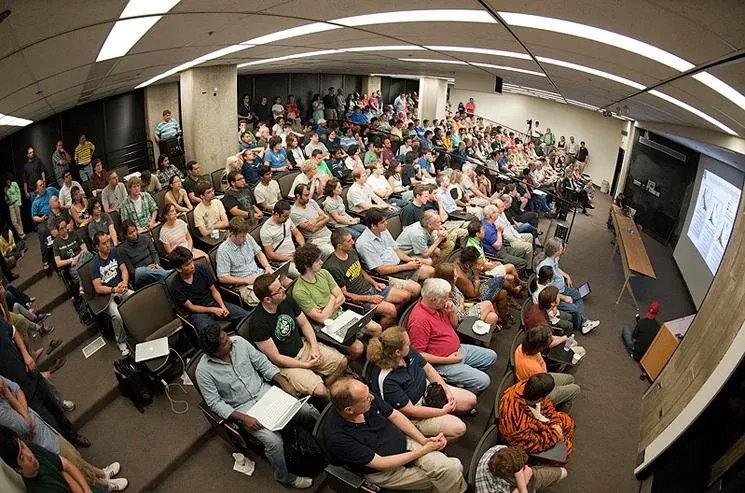
At 2 a.m. Central time on 4 July 2012, more than two hundred physicists crowded into an auditorium at Fermilab outside Chicago to watch a live feed from Geneva. When CERN’s director-general said the words “I think we have it,” the room erupted: decades of searching had finally caught the Higgs boson, a particle whose mass and properties had been predicted so precisely that finding it was really an act of confirmation, not discovery. It was the triumph of an entire discipline built to hunt for one specific, exactly-specified thing inside an overwhelming amount of noise.
Plate I
.jpg)
A much smaller kind of precision hunt reached its own milestone that August. At Northwestern University, a team led by Omar Farha and Joseph Hupp published a material called NU-110, a crystalline sponge whose internal surface (measured, not estimated) set a new world record: unfold one gram of it flat and it would cover roughly one and a half football fields. That number was not an accident of chemistry; it was the result of having learned, over the preceding two decades, how to specify a pore’s exact size and shape in advance and then actually build it. Where particle physicists had spent forty years designing an experiment large enough to catch one particle of a precisely predicted mass, the chemists behind NU-110 had spent about as long learning to design a molecular void small enough, and exact enough, to catch one specific kind of gas molecule and let its neighbours pass through. Both were stories about engineering exactness at a scale the eye cannot see. 2012 is the year this Atlas assigns to metal-organic frameworks because NU-110 is the year that exactness reached its most extreme demonstrated point.
An Idea With Three Names on It
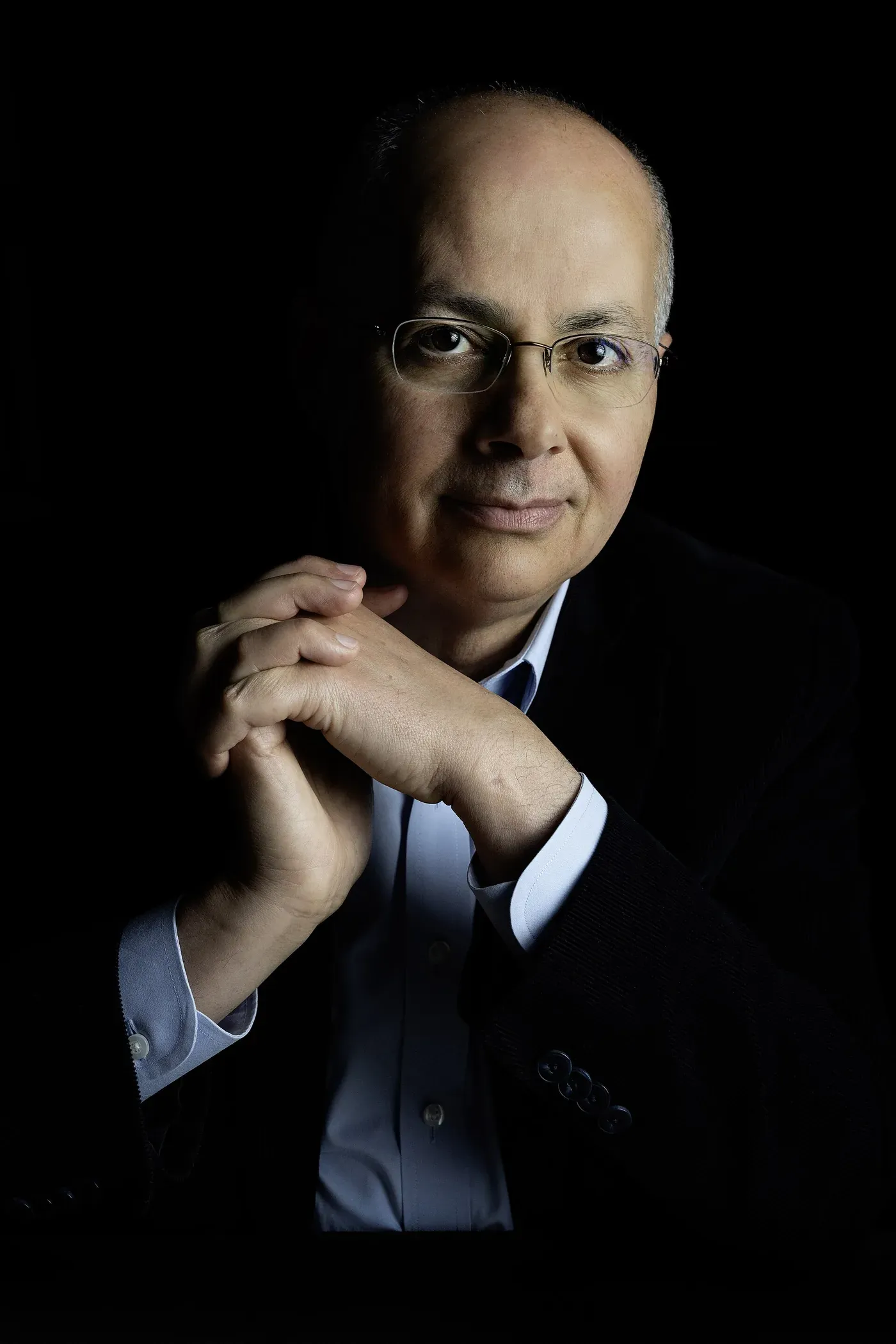
The honest history of MOFs does not begin with a single inventor. In 1989, at the University of Melbourne, Richard Robson built the first framework of its kind: metal ions at the corners, rigid organic rods holding them apart, an open three-dimensional lattice with nothing but empty space at its centre. Nobody yet knew whether that space would survive the solvent being pumped out of it, or whether the whole scaffold would simply collapse the moment it was asked to hold nothing. In 1997, Susumu Kitagawa’s group in Kyoto answered that question: they showed a coordination framework could keep its pores open and empty, and even flex to admit a gas molecule and let it back out again: permanent, usable porosity, not just an elegant crystal that happened to have holes in it. And through the second half of the 1990s, Omar Yaghi, then at the University of Michigan, turned the idea into a system: MOF-5 in 1999, with its cubic lattice of zinc-oxide clusters and terephthalate rods, and the isoreticular series that followed it, which showed the same architecture could be resized almost at will simply by lengthening the linker. In October 2025 the Nobel Prize in Chemistry went to all three men jointly, “for the development of metal-organic frameworks”. This was a rare case of a prize committee crediting a discovery, its proof of concept, and its systematisation as three separate, equally necessary contributions.
Plate II

Metal Joints, Organic Rods
A metal-organic framework is built from two kinds of part, repeated in three dimensions. Metal ions or small metal-oxide clusters act as the joints; rigid organic molecules, usually carrying an acid group at each end, act as the rods connecting them. MOF-5, the framework that established the field’s basic grammar, uses clusters of four zinc atoms around a central oxygen, each cluster linked to six neighbours by a rod of terephthalic acid: a cubic lattice with a cavity at the centre of every cell, and, crucially, nothing propping that cavity open except the rigidity of the rods themselves.
Plate III
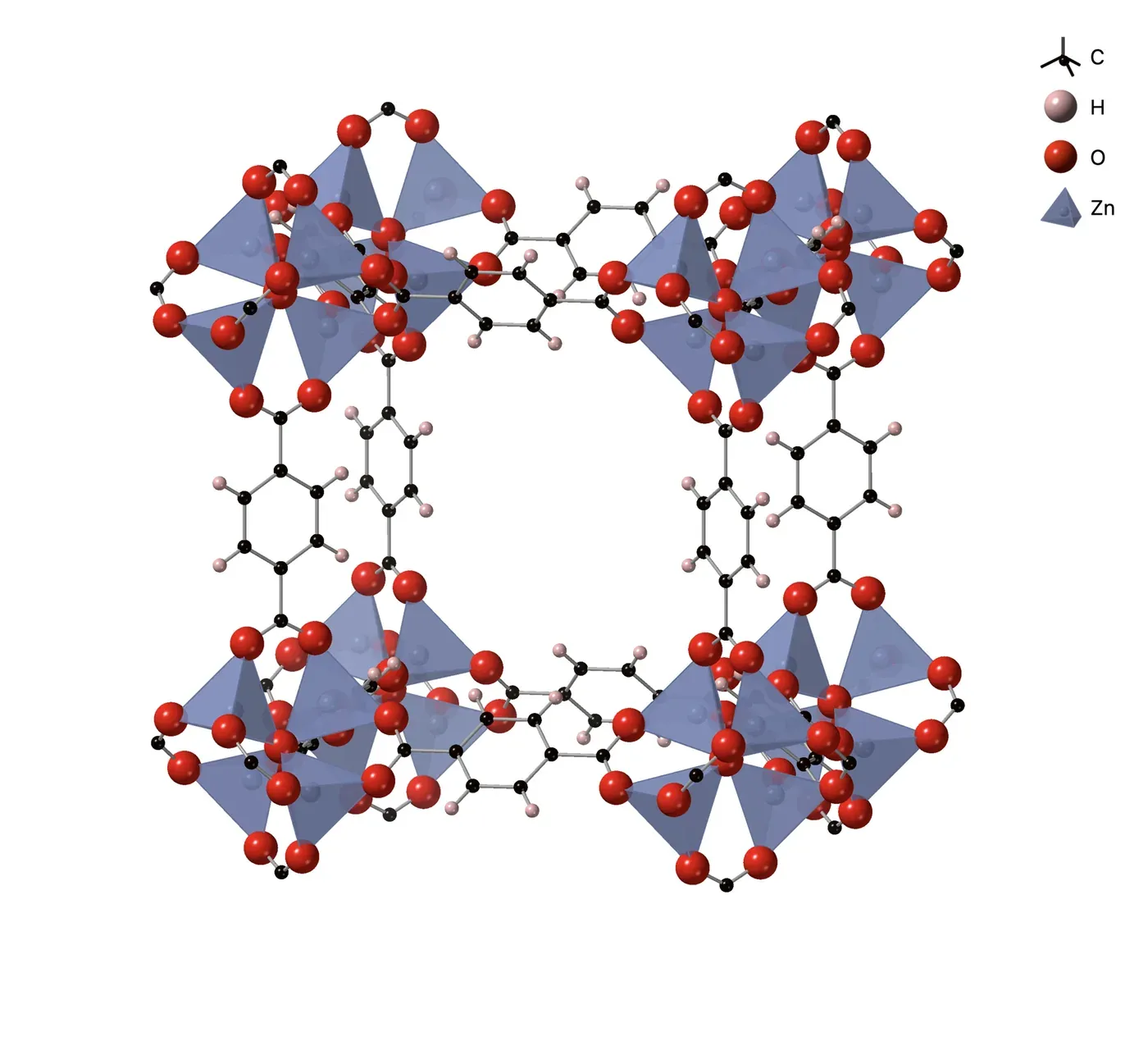

Change the rod’s length and the cavity grows or shrinks to match. This is the isoreticular principle Yaghi’s group demonstrated with the IRMOF series, keeping the same cubic topology while resizing the pore almost like adjusting a recipe. Change the metal or the rod’s chemistry entirely and an even wider range of behaviour opens up. MIL-53, developed by Gérard Férey’s group in France, can swell and contract its own unit cell by more than double depending on what molecule is sitting inside it. It is a framework that visibly “breathes.” Bio-MOF-1, built from zinc and the DNA base adenine, replaces part of the usual industrial organic chemistry with a biomolecule the body already knows how to handle, aimed at drug storage and release rather than gas separation. None of these is a variation on a theme so much as proof that the same basic joints-and-rods idea can be pointed at almost any application a chemist can specify a pore for.
Why the Atlas Calls This a Bordering Case
MOFs sit at the edge of what this encyclopedia usually covers. They are not built from repeating covalent bonds the way a conventional polymer chain is; the metal-ligand coordination bonds holding the framework together are directional and specific, but they are also more easily broken and reformed than a carbon backbone, which is exactly what lets some frameworks breathe or self-heal after their pores are disturbed. There is consequently no single chemical formula this page can print, and no one structural repeat unit: composition is defined entirely by which metal node and which organic linker a chemist chooses, and that choice changes from one MOF to the next far more freely than a monomer choice changes an ordinary polymer.
What the Pores Are Actually For
The property that dominates every MOF application is the one already on display in NU-110: an almost unreasonable amount of internal surface packed into a small volume, with the size and shape of that surface tunable in advance. That combination makes a MOF good at exactly one kind of job: holding onto a specific small molecule, in preference to its neighbours, until it is deliberately released again. Natural-gas and hydrogen storage exploit it directly: a cylinder packed with the right MOF holds substantially more fuel at a given pressure than an empty cylinder does, because the gas is adsorbed across an enormous internal surface rather than simply compressed into open space. Carbon capture exploits the same trick with a framework tuned to prefer carbon dioxide over nitrogen, and can usually be persuaded to let the captured gas back out again with nothing more aggressive than mild heating; a MOF built for this purpose can, in principle, be used over and over. Drug delivery asks a different question of the same architecture: rather than adsorbing a gas, a framework like Bio-MOF-1 holds a therapeutic molecule in its pores and releases it as its own crystal structure slowly degrades.
Plate IV

From Bench to Cylinder
Commercialisation has followed a slower, more mundane path than the framework chemistry itself. BASF began producing MOFs at industrial scale for gas-storage trials in the years around 2010, and Omar Farha’s 2012 spin-out, NuMat Technologies, set out to sell frameworks engineered to hold specific hazardous gases (arsine, phosphine, boron trifluoride) safely at low pressure for the semiconductor industry, a market where a MOF’s selectivity mattered more than its cost. Most synthesis routes remain some version of what MOF-5 first demonstrated: metal salt and organic linker combined in a solvent, usually heated under modest pressure until the framework crystallises, though solvent-free mechanochemical grinding and rapid microwave-assisted methods have both been developed since to cut the process from days to minutes.
A Family Still Being Written
New MOF chemistries continue to appear faster than any one page can catalogue them: multivariate frameworks that mix several different linkers in one lattice, catalytic frameworks that use their pore walls to carry out chemical reactions rather than merely store molecules, frameworks built to be electrically or optically active rather than simply porous. What holds the whole family together is not a shared formula but a shared design principle, first sketched by Robson in 1989 and only fully proven and systematised over the following decade: that a chemist can decide, in advance, exactly what shape of nothing they want a material to contain.
values with [n] cite the numbered references·estimates are flagged·“not yet available” and “N/A” are honest states, not gaps
- Abbreviation
- MOFs
- Type
- polymer family (hub)
- CAS number
- None (heterogeneous class or not assigned)
- Resin ID code
- none assigned
- Formula
- MOFs are hybrid organic-inorganic coordination networks (metal-ion clusters/secondary building units linked by organic di- or tricarboxylic-acid ligands), not a classical covalent polymer, but included in this atlas as a bordering/hybrid material class per the manifest's own framing. No single repeat unit represents the class; composition is defined by metal-node + linker choice (e.g. MOF-5 uses Zn4O clusters with terephthalate linkers).
- Repeat unit (BigSMILES)
- MOFs are hybrid organic-inorganic coordination networks (metal-ion clusters/secondary building units linked by organic di- or tricarboxylic-acid ligands), not a classical covalent polymer, but included in this atlas as a bordering/hybrid material class per the manifest's own framing. No single repeat unit represents the class; composition is defined by metal-node + linker choice (e.g. MOF-5 uses Zn4O clusters with terephthalate linkers).
- IUPAC name
- —
- Synonyms
- —
- Also known as
- —
- Chemical family
- porous-polymer-network
- Backbone class
- —
- Polymerization mechanism
- —
- Constitutional monomer
- Terephthalic acid (H2bdc, a common linker example)
- Polymer class
- —
- Year of origin
- 2012
- Era
- The Smart Materials Era (2000-2015)
- Key figures
- Richard Robson · Susumu Kitagawa · Omar Yaghi
- Events referenced
- Higgs boson discovery announced at CERN (4 July 2012) · Northwestern University's NU-110 sets a world-record surface area for a porous material (August 2012) · 2025 Nobel Prize in Chemistry awarded to Robson, Kitagawa and Yaghi for the development of metal-organic frameworks
- Polymerization type
- not yet available
- Common monomers (feedstocks)
- not yet available
- Catalysts
- not yet available
Omar Yaghi pioneered MOF chemistry, first crystallizing carboxylate-linker frameworks in 1995, introducing the secondary building unit (SBU) concept in 1998, and developing the landmark ultra-high-porosity material MOF-5 in 1999. Yaghi, Susumu Kitagawa, and Richard Robson were awarded the 2025 Nobel Prize in Chemistry for their MOF work. Synthesis routes include solvothermal and microwave-assisted solvothermal methods (producing micron-scale crystals in seconds to minutes), mild room-temperature routes in green solvents (e.g. MIL-100(Fe)), solvent-free mechanochemical synthesis, and chemical vapor deposition.
- Tacticity
- not yet available
- Crystal structure
- Metal-ion clusters (secondary building units, SBUs) connected by rigid organic linker ligands into a highly ordered, permanently porous crystalline network; pore size and chemistry are tunable via metal/linker selection and remain accessible (refillable with guest molecules) after activation.
- Typical crystallinity
- Not applicableCrystalline by definition (ordered coordination network), but crystallinity-percentage framing doesn't map cleanly onto this material class.
Molecular weight
- Number average (Mn)
- not yet available
- Mass average (Mw)
- not yet available
- Dispersity (Mw/Mn)
- not yet available
Mark-Houwink constants
not yet available
- Density
- Not applicableVaries enormously by metal node/linker combination; not a single value for the class.
- Melt flow index
- Not applicable
- Refractive index
- Not applicable
- Transmittance
- not yet available
- Haze
- not yet available
- Gloss
- not yet available
- Water absorption
- not yet available
- Dielectric constant
- Not applicable
- Dielectric strength
- not yet available
- Electrical conductivity
- Not applicable
- Glass transition (Tg)
- Not applicable
- Melting temperature (Tm)
- Not applicable
- Crystallization (Tc)
- Not applicable
- Heat deflection (HDT)
- Not applicable
- Decomposition onset
- not yet available
- Thermal conductivity
- Not applicable
- Tensile modulus
- Not applicable
- Yield strength
- Not applicable
- Tensile strength at break
- Not applicable
- Elongation at break
- Not applicable
- Impact strength (Izod)
- Not applicable
- Impact strength (Charpy)
- Not applicable
- Hardness
- Not applicable
- Flexural modulus
- Not applicable
- Poisson's ratio
- not yet available
- Coefficient of friction
- not yet available
- Weathering / UV
- Not applicable
- Hydrolysis resistance
- not yet availableWater/moisture stability varies hugely by MOF chemistry: some (e.g. zeolitic imidazolate frameworks) are quite stable, others degrade readily; not a single answer for the class.
- Flammability (UL94)
- Not applicable
- Limiting oxygen index
- not yet available
- Solubility parameter (δ)
- not yet available
Gas permeability
not yet available
Polymer-solvent interaction parameter (χ)
not yet available
- Processing methods
- solvothermal synthesismicrowave-assisted solvothermal synthesismechanochemical (solvent-free) synthesischemical vapor deposition
- Drying required
- not yet determined
- Processing temperature
- Not applicable
- Shrinkage rate
- Not applicable
- Gas storage & separationhydrogen and CO2 capture with tunable selectivity
- Catalysisheterogeneous catalysts for asymmetric synthesis and photocatalysis
- Drug deliverypH- and temperature-responsive therapeutic release
- Environmentalcarbon capture from flue gas/biogas · water-vapor adsorption for dehumidification
- Recyclable
- not yet determined
- Biodegradable
- not yet determined
- Degradation pathway
- not yet available
Commercial MOF products exist for industrial gas-separation use (e.g. Svante).
- LD50 (oral, rat)
- not yet available
- NFPA health
- not yet available
- NFPA flammability
- not yet available
- NFPA reactivity
- not yet available
- Carcinogenic classification
- not yet available
- [1]Metal-organic frameworkWikipediaAccessed 2026-07-14https://en.wikipedia.org/wiki/Metal%E2%80%93organic_framework[wiki-mof]
Illustrations
- Plate IFermilab researchers crowd a lecture hall at 2 a.m. on 4 July 2012, watching CERN announce the discovery of the Higgs boson: a triumph of predicting, then finding, an exact and specific thing.Wikimedia Commons
- Plate IIOmar Yaghi, photographed in 2025, the year he shared the Nobel Prize in Chemistry with Susumu Kitagawa and Richard Robson for turning an open architectural idea into a designable chemistry.Wikimedia Commons
- Plate IIIThe structure of MOF-5, rendered from its crystallographic data: zinc-oxide clusters (blue tetrahedra) held apart by rigid organic rods, leaving the open cavities that give the framework its enormous internal surface area.Wikimedia Commons
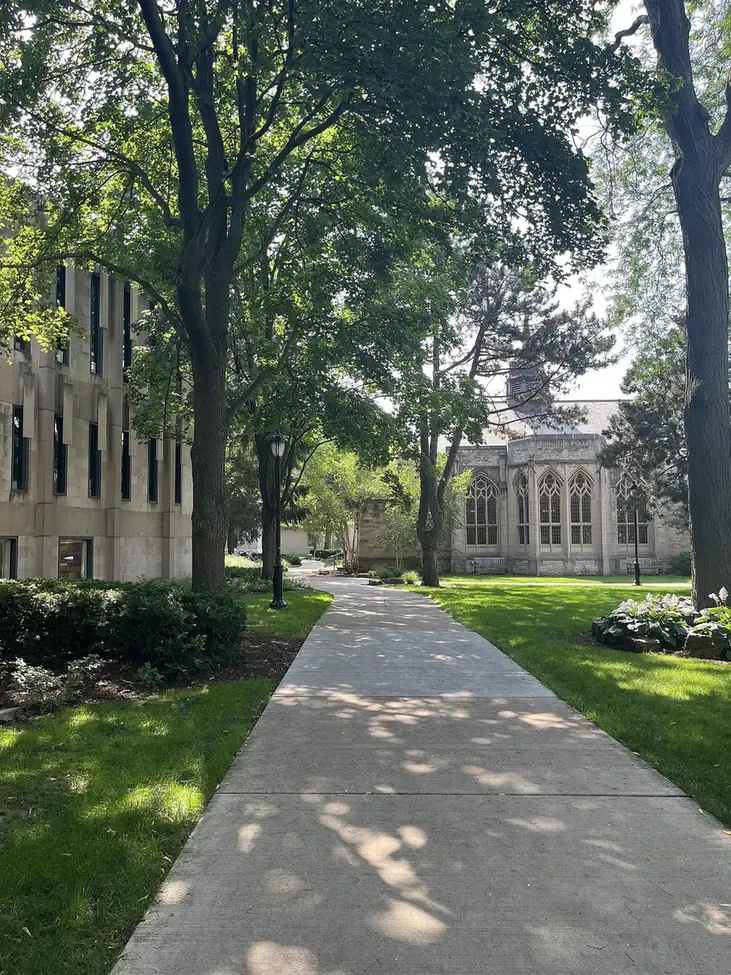
- Plate IVNorthwestern University's Evanston campus, home to the Farha and Hupp laboratories where NU-110 set its 2012 surface-area record, and, that same year, the site of NuMat Technologies, a spin-out company founded to move MOF chemistry from the laboratory bench toward industrial gas storage and separation.Wikimedia Commons