
Image credit
- Title
- File:Welrod Mk I (6825681998).jpg
- Author
- Askild Antonsen(attribution required)
- Licence
- CC BY 2.0
- Source
- https://commons.wikimedia.org/wiki/File:Welrod_Mk_I_(6825681998).jpg

How Muzzle energy is calculated
E = ½ · m · v²
Inputs
- m4.6 g70.99 grverifiedsourcePublished as 71 grains.
- v274.3 m/s899.9 fpsverifiedMeasured with a 101.6 mm barrel, not this arm's 83 mm. Velocity outside the sourced range is not projected.
1 of 2 inputs link to their source.
How Muzzle velocity is calculated
nearest sourced barrel length, no extrapolation
Inputs
- v at 101.6 mm274.3 m/s899.9 fpsverifiedsourcePublished as 900 ft/s.
Assumptions
- This figure belongs to a 101.6 mm barrel. It is shown because it is the closest measurement that exists, not because it applies here.
1 of 1 inputs link to their source.
How Loaded mass is calculated
m_loaded = m_empty + m_magazine + n · m_cartridge
Not calculated: m_empty has no sourced figure yet. Nothing is substituted for a missing input.
Assumptions
- One magazine, filled to the stated capacity. Spare magazines, optics, slings and lights are the owner’s, not the arm’s.
No input on this calculation carries a clickable source yet.
How Free recoil is calculated
E_recoil = ½ · m_firearm · v_recoil²
Not calculated: m_firearm has no sourced figure yet. Nothing is substituted for a missing input.
Assumptions
- Propellant gas momentum is excluded: ARMAG does not record charge weights. This is therefore a lower bound on the real free recoil, consistent between entries but smaller than a figure that includes the gas term.
- Free recoil: the arm is unrestrained. Stock design, muzzle devices, stance and shooter mass are not modelled, because none of them is a property of the arm.
No input on this calculation carries a clickable source yet.
How Capacity is calculated
as published for the primary chambering
Inputs
- capacity8estimatedFrom the Wikipedia infobox, uncited there. The primary production chambering (Mk II / IIA).
No input on this calculation carries a clickable source yet.
Derived figures
Computed from the sourced values above. Open ƒ on any figure for the formula, its inputs, and the assumptions it makes.
How Momentum is calculated
p = m · v
Inputs
- m4.6 g70.99 grverifiedsourcePublished as 71 grains.
- v274.3 m/s899.9 fpsverifiedMeasured with a 101.6 mm barrel, not this arm's 83 mm. Velocity outside the sourced range is not projected.
1 of 2 inputs link to their source.
How Sectional density is calculated
SD = mass(gr) / (7000 · diameter(in)²)
Inputs
- mass4.6 g70.99 grverifiedsourcePublished as 71 grains.
- diameter7.85 mm0.3091 inverifiedsourceC.I.P. G1, maximum bullet diameter.
Assumptions
- Reported in the conventional lb/in² so it is directly comparable with published figures.
2 of 2 inputs link to their source.
How Power factor is calculated
PF = mass(gr) · velocity(fps) / 1000
Inputs
- mass4.6 g70.99 grverifiedsourcePublished as 71 grains.
- velocity274.3 m/s899.9 fpsverifiedMeasured with a 101.6 mm barrel, not this arm's 83 mm. Velocity outside the sourced range is not projected.
Assumptions
- A competition classification defined by the IPSC and USPSA rulebooks, stated in their units. It describes a scoring category, not an effect.
1 of 2 inputs link to their source.
How Magazine dump is calculated
t = (n − 1) / (rpm / 60)
Not calculated: rpm has no sourced figure yet. Nothing is substituted for a missing input.
Assumptions
- Cyclic rate held for the whole magazine, no stoppages, trigger held down. A theoretical figure for comparing mechanisms, not a measured one.
No input on this calculation carries a clickable source yet.
How Sight error at 1 mm is calculated
θ = atan(misalignment / sight radius)
Not calculated: sight radius has no sourced figure yet. Nothing is substituted for a missing input.
Assumptions
- Shows what a stated aiming error costs. The misalignment is the reader’s figure; the site does not claim how well anyone aims.
No input on this calculation carries a clickable source yet.
Specifications
Every row here is generated from the schema, so a figure recorded on this entry cannot be missing from the table, and the same rows, read the same way, are what the comparison shows.
Identity
- Type
- Pistol
- Action
- Bolt action
- Fire modes
- Single shot
- Operating system
- Manually operated
- Roles
- Designed in
- United Kingdom
- Produced in
- Introduced
- 1943
- Production
- 1942–present
Dimensions and mass
- Mass, empty
- not recorded
- Magazine, empty
- not recorded
- Length
- 305 mm12.01 inestimated
Cited on Wikipedia to a 1945-dated page on timelapse.dk describing the pistol as a roughly 12-inch cylinder; that site did not respond when checked, so the figure is recorded as estimated rather than verified.
- Length, folded
- not recorded
- Width
- not recorded
- Height
- not recorded
- Barrel length
- 83 mm3.268 inestimated
From the Wikipedia infobox, uncited there (3.25 in). This is the vented barrel and expansion chamber inside the suppressor housing, not a conventional exposed barrel.
Sights and rifling
- Sight radius
- not recorded
- Sight height over bore
- not recorded
- Rifling twist
- not recorded
- Twist direction
- not recorded
- Grooves
- not recorded
- Sight graduation
- not recorded
Operation
- Cyclic rate
- not recorded
- Trigger pull
- not recorded
- Effective range
- 23 m25.15 ydestimated
From the Wikipedia infobox, uncited there: 25 yd stated for daylight use; a separate 7–8 yd figure is given for night use, and the manual states the pistol was most effective fired in contact with the target.
- Units produced
- not recorded
- Launch price
- not recorded
Chamberings
- .32 ACPprimary8 rounds
- 9x19mm Parabellum6 rounds
Scale
A to-scale outline against family siblings. The dimensions are sourced; the shape is a representative outline for the type, and says so.
- Welrod305 mm12.01 inheight not recorded
Representative outline: the dimensions are sourced, the shape is not. Overall length, and barrel length where recorded, are drawn from this entry's own figures; the profile is a generic one for the firearm type and says nothing about this arm's actual contours. Welrod records no height, so its outline is drawn at the type's proportion. That height is part of the shape, not a measurement.
Gallery
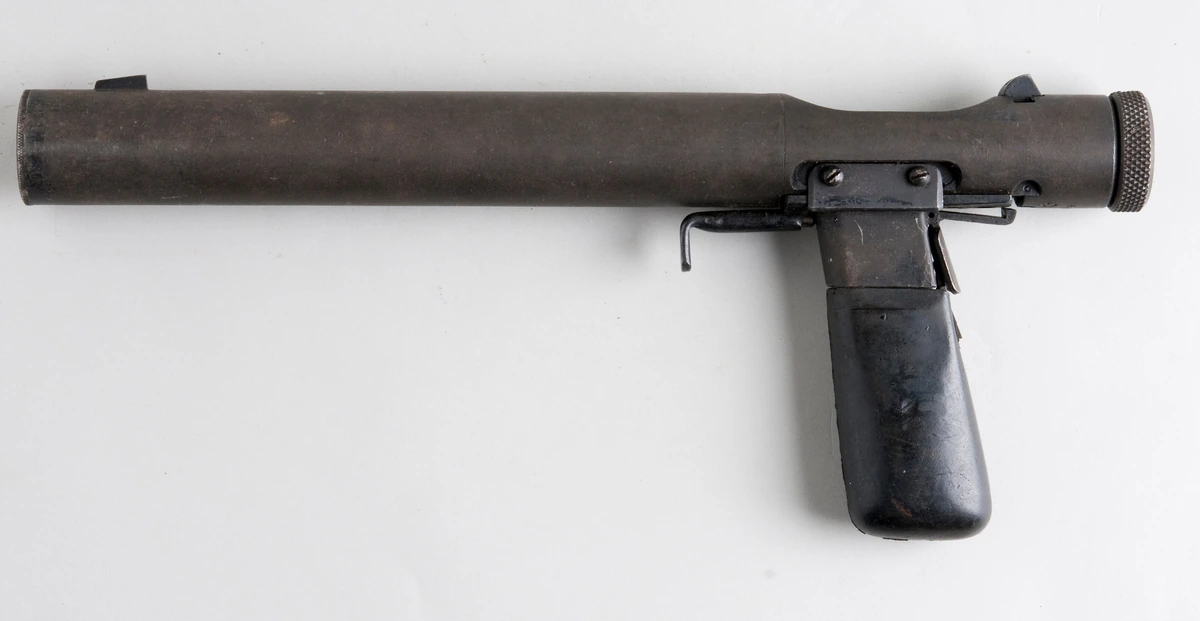
Image credit
- Title
- File:Welrod Mk II (6825681888).jpg
- Author
- Askild Antonsen(attribution required)
- Licence
- CC BY 2.0
- Source
- https://commons.wikimedia.org/wiki/File:Welrod_Mk_II_(6825681888).jpg

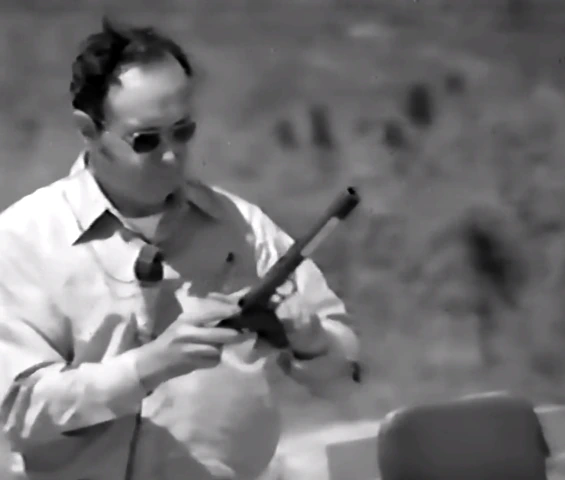
Image credit
- Title
- File:Loading the Welrod gun.jpg
- Author
- U.S. Army Foreign Science and Technology Center
- Licence
- Public domain
- Source
- https://commons.wikimedia.org/wiki/File:Loading_the_Welrod_gun.jpg

Detail
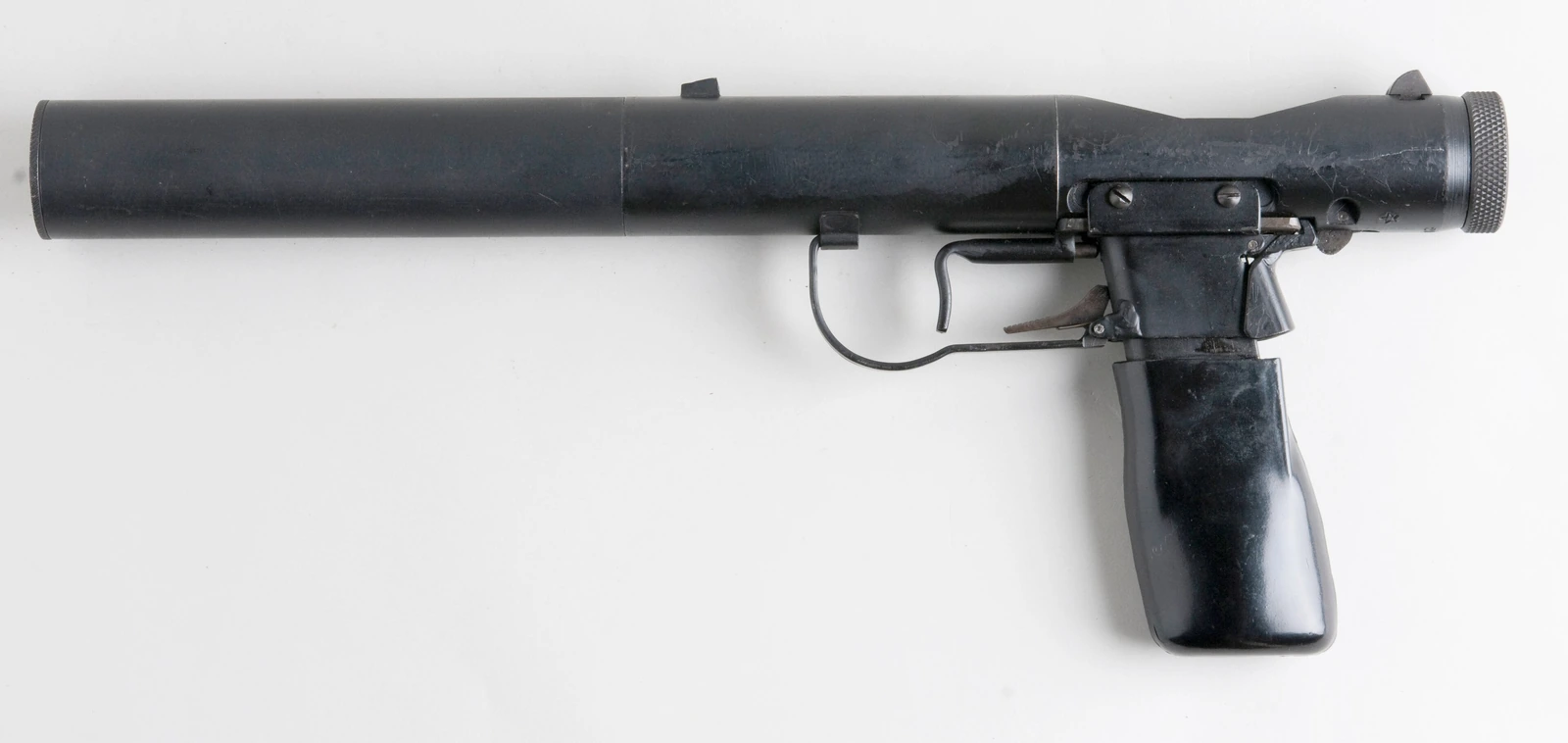
The Welrod is a British bolt-action pistol designed in 1942 by Major Hugh Reeves at the Inter-Services Research Bureau’s Station IX, in Welwyn. Welwyn is the source of its name, a deliberately misleading combination of “Wel” (the prefix given to all of Station IX’s clandestine equipment) and “rod”, a slang term for a gun. It was built for the Special Operations Executive and resistance groups working in occupied Europe, and its whole design serves one purpose: to be as quiet and as unremarkable as possible.
The pistol takes the form of a plain metal tube. Its rear section holds the bolt, its middle section a ported barrel that bleeds propellant gas gradually into an expansion chamber rather than releasing it all at the muzzle, and its front section a set of metal baffles and rubber wipes that slow the escaping gas further still. This is the working principle later reused in weapons such as the MP5SD and AS Val. Because .32 ACP already travels below the speed of sound in most loadings, the primary Mk II/IIA production version needed only to quiet the mechanical report; a later 9mm Mk I variant, built after reports of poor field performance from the .32 ACP version, had to slow a normally supersonic 9×19mm Parabellum loading as well, which is why it is recorded as a separate chambering on this page rather than a simple rebarrel. The detachable magazine doubles as the pistol’s grip and can be removed entirely, leaving an object with no obvious pistol grip at all; some resistance groups reportedly called it a “bicycle pump” for this reason. Birmingham Small Arms, the one maker that has confirmed building it, delivered its Welrods without any markings identifying the maker or country of origin, adding to the weapon’s deniability.
Roughly 2,800 were built during the war and perhaps 14,000 in total including post-war production, and the type has been reported in use well beyond 1945, including with British special forces during the Falklands War and the 1991 Gulf War, and with U.S. special operations personnel in Vietnam and Cold War Berlin. A wartime plan existed to distribute Welrods to resistance fighters across occupied Europe for a coordinated month of attacks against German security personnel; the plan is thought to have been shelved in the aftermath of the 1942 assassination of Reinhard Heydrich and the mass reprisals that followed it.
No verifiable dimensional or ballistic figure independent of Wikipedia’s own uncited infobox was found for this page’s barrel length, magazine capacity or effective range, so those are recorded as estimated. The pistol’s overall length is likewise recorded as estimated: Wikipedia cites it to an older private website that did not respond when checked for this entry. No logo or wordmark for Birmingham Small Arms could be sourced through any of this site’s three image routes.
References
This entry's own bibliography. Every citation key on this page resolves into this list.
- Welrod · Wikipedia · 1360537351 · read 2026-09-24 · CC BY-SA 4.0
Last verified 2026-09-24 · review status: agent-populated