
Remington Model 870
Remington Arms1951–presentEarly Cold War
Also known as 870 Wingmaster, 870 Express, M870
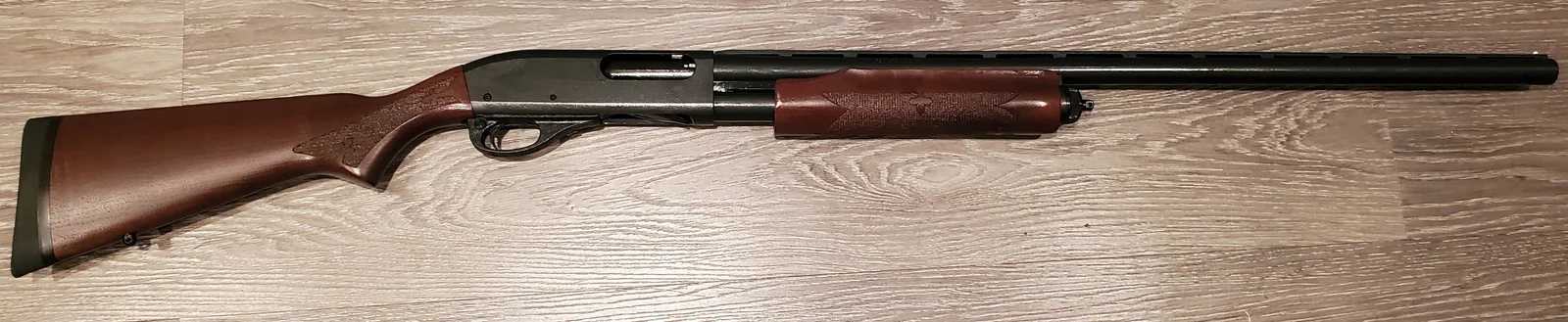
Image credit
- Title
- Remington 870 Fieldmaster
- Author
- Burnyburnout(attribution required)
- Licence
- CC BY-SA 4.0
- Source
- https://commons.wikimedia.org/wiki/File:Remington_870_Fieldmaster.jpg

How Muzzle energy is calculated
E = ½ · m · v²
Inputs
- m28.38 g438.0 grverifiedsource438 gr as published, converted to grams. One ounce.
- v490.7 m/s1,610 fpsverifiedMeasured with a 762 mm barrel, not this arm's 711.2 mm. Velocity outside the sourced range is not projected.
1 of 2 inputs link to their source.
How Muzzle velocity is calculated
nearest sourced barrel length, no extrapolation
Inputs
- v at 762 mm490.7 m/s1,610 fpsverifiedsource1610 fps as published.
Assumptions
- This figure belongs to a 762 mm barrel. It is shown because it is the closest measurement that exists, not because it applies here.
1 of 1 inputs link to their source.
How Loaded mass is calculated
m_loaded = m_empty + m_magazine + n · m_cartridge
Not calculated: m_magazine has no sourced figure yet. Nothing is substituted for a missing input.
Assumptions
- One magazine, filled to the stated capacity. Spare magazines, optics, slings and lights are the owner’s, not the arm’s.
2 of 4 inputs link to their source.
How Free recoil is calculated
E_recoil = ½ · m_firearm · v_recoil²
Inputs
- m_firearm3.402 kg7.500 lbverifiedsourceAverage weight of the 12-gauge Fieldmaster with a 28 in barrel, 7.5 lb.
- v_recoil4.094 m/s13.43 fpsestimated
Assumptions
- Propellant gas momentum is excluded: ARMAG does not record charge weights. This is therefore a lower bound on the real free recoil, consistent between entries but smaller than a figure that includes the gas term.
- Free recoil: the arm is unrestrained. Stock design, muzzle devices, stance and shooter mass are not modelled, because none of them is a property of the arm.
1 of 2 inputs link to their source.
How Capacity is calculated
as published for the primary chambering
Inputs
- capacity4verifiedsourceMagazine capacity. The 3.5 in chambered model holds three of that shell and four of the shorter ones.
1 of 1 inputs link to their source.
Derived figures
Computed from the sourced values above. Open ƒ on any figure for the formula, its inputs, and the assumptions it makes.
How Momentum is calculated
p = m · v
Inputs
- m28.38 g438.0 grverifiedsource438 gr as published, converted to grams. One ounce.
- v490.7 m/s1,610 fpsverifiedMeasured with a 762 mm barrel, not this arm's 711.2 mm. Velocity outside the sourced range is not projected.
1 of 2 inputs link to their source.
How Sectional density is calculated
SD = mass(gr) / (7000 · diameter(in)²)
Not calculated: diameter has no sourced figure yet. Nothing is substituted for a missing input.
Assumptions
- Reported in the conventional lb/in² so it is directly comparable with published figures.
1 of 2 inputs link to their source.
How Power factor is calculated
PF = mass(gr) · velocity(fps) / 1000
Inputs
- mass28.38 g438.0 grverifiedsource438 gr as published, converted to grams. One ounce.
- velocity490.7 m/s1,610 fpsverifiedMeasured with a 762 mm barrel, not this arm's 711.2 mm. Velocity outside the sourced range is not projected.
Assumptions
- A competition classification defined by the IPSC and USPSA rulebooks, stated in their units. It describes a scoring category, not an effect.
1 of 2 inputs link to their source.
How Magazine dump is calculated
t = (n − 1) / (rpm / 60)
Not calculated: rpm has no sourced figure yet. Nothing is substituted for a missing input.
Assumptions
- Cyclic rate held for the whole magazine, no stoppages, trigger held down. A theoretical figure for comparing mechanisms, not a measured one.
1 of 2 inputs link to their source.
How Sight error at 1 mm is calculated
θ = atan(misalignment / sight radius)
Not calculated: sight radius has no sourced figure yet. Nothing is substituted for a missing input.
Assumptions
- Shows what a stated aiming error costs. The misalignment is the reader’s figure; the site does not claim how well anyone aims.
No input on this calculation carries a clickable source yet.
Variants
Wingmaster
1950–present
The original grade and still the polished-blue, walnut-stocked one. RemArms publishes no dimensional specification for it.
Express
1987–2023
The matte-finished budget grade that took over the volume of the line for thirty-five years, discontinued when the Fieldmaster replaced it.
Fieldmaster
2023–present
The current field grade, which replaced the Express in 2023 and returned walnut and a vent-rib barrel to the standard-price gun. The figures on this page are this variant in 12 gauge with the 28 in barrel.
| Variant | Years | Changes |
|---|---|---|
| Wingmaster | 1950–present | no spec change |
| Express | 1987–2023 | no spec change |
| Fieldmaster | 2023–present | no spec change |
Specifications
Every row here is generated from the schema, so a figure recorded on this entry cannot be missing from the table, and the same rows, read the same way, are what the comparison shows.
Identity
- Type
- Shotgun
- Action
- Pump action
- Fire modes
- Single shot
- Operating system
- Manually operated
- Feed
- Designed in
- United States
- Produced in
- Introduced
- 1950
- Production
- 1951–present
Dimensions and mass
- Mass, empty
- 3.402 kg7.500 lbsource
Average weight of the 12-gauge Fieldmaster with a 28 in barrel, 7.5 lb.
- Magazine, empty
- not recorded
- Length
- 1,232 mm48.50 insource
Overall length of the 12-gauge Fieldmaster with a 28 in barrel.
- Length, folded
- not recorded
- Width
- not recorded
- Height
- not recorded
- Barrel length
- 711.2 mm28.00 insource
Sights and rifling
- Sight radius
- not recorded
- Sight height over bore
- not recorded
- Rifling twist
- not recorded
- Twist direction
- not recorded
- Grooves
- not recorded
- Sight graduation
- not recorded
Operation
- Cyclic rate
- not recorded
- Trigger pull
- not recorded
- Effective range
- not recorded
- Units produced
- not recorded
- Launch price
- not recorded
Chamberings
- 12 gaugeprimary4 rounds
Scale
A to-scale outline against family siblings. The dimensions are sourced; the shape is a representative outline for the type, and says so.
- Remington Model 8701,232 mm48.50 inheight not recorded
Representative outline: the dimensions are sourced, the shape is not. Overall length, and barrel length where recorded, are drawn from this entry's own figures; the profile is a generic one for the firearm type and says nothing about this arm's actual contours. Remington Model 870 records no height, so its outline is drawn at the type's proportion. That height is part of the shape, not a measurement.
Gallery
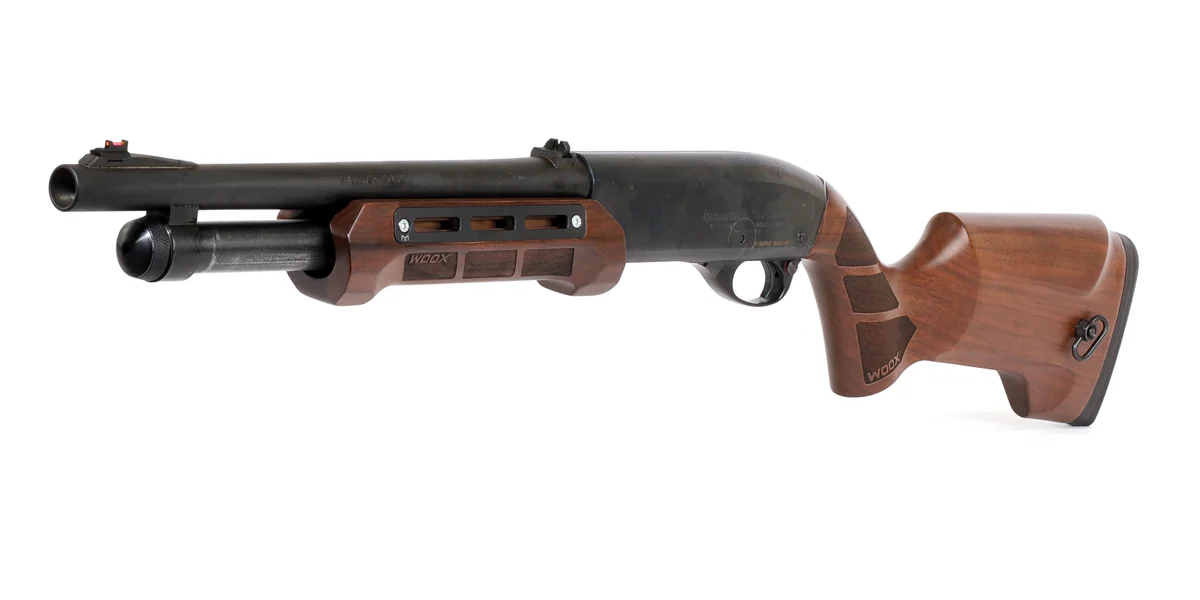
Image credit
- Title
- Remington 870 Wingmaster (55416542561)
- Author
- Mitch Barrie(attribution required)
- Licence
- CC BY-SA 4.0
- Source
- https://commons.wikimedia.org/wiki/File:Remington_870_Wingmaster_(55416542561).jpg
.jpg)
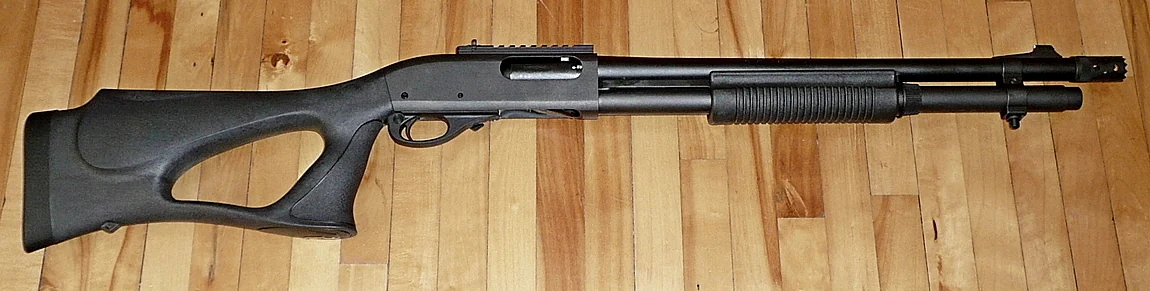
Image credit
- Title
- Remington-870-Express-Tactical
- Author
- Picanox(attribution required)
- Licence
- CC BY-SA 4.0
- Source
- https://commons.wikimedia.org/wiki/File:Remington-870-Express-Tactical.jpg

Image credit
- Title
- 0028228352 Remington Model 870 P in Wehrtechnische Studiensammlung
- Author
- Verein der Freunde und Förderer der Wehrtechnischen Studiensammlung Koblenz e. V.(attribution required)
- Licence
- CC BY-SA 4.0
- Source
- https://commons.wikimedia.org/wiki/File:0028228352_Remington_Model_870_P_in_Wehrtechnische_Studiensammlung.jpg

Detail
Four Remington engineers set out in the late 1940s to replace the Model 31 with something cheaper to make, and the answer was a receiver milled from one billet of steel and twin action bars instead of one. The twin bars are the design’s whole reputation: a single bar lets the fore-end twist under a hurried stroke and bind, and two do not. More than eleven million have been built, which makes this the best-selling shotgun ever made and, by a wide margin, the most-copied pump action.
A shotgun’s figures differ from a rifle’s in kind. There is no rifling twist because the standard barrel is smooth. There is no sight radius because the sight is a brass bead. Capacity depends on which shell is loaded rather than on the magazine, and the barrel is a customer-swappable part rather than a fixed property of the arm, so the figures here are for one configuration and the others are listed beside it.
The variant structure below is the other thing the 870 exposes. Wingmaster, Express and Fieldmaster are market grades rather than mechanical redesigns, and only the current one has a published specification; the barrel and gauge options underneath it are configurations, because each of them changes a measurable figure.
References
This entry's own bibliography. Every citation key on this page resolves into this list.
- Model 870 Fieldmaster specifications · RemArms LLC · read 2026-08-27
- Remington Model 870 · 1368228246 · read 2026-08-27 · CC BY-SA 4.0
Last verified 2026-08-27 · review status: spot-checked