
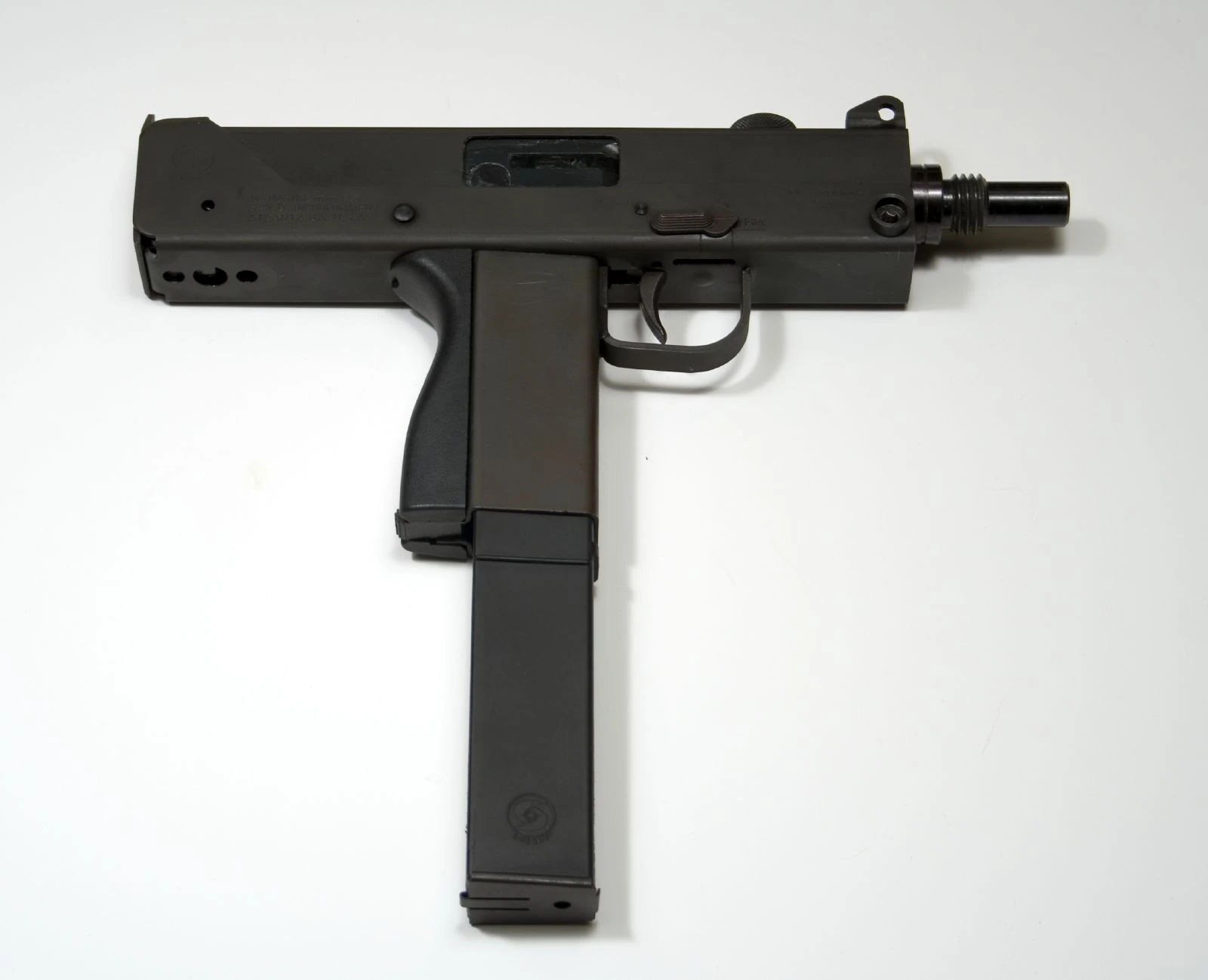
Image credit
- Title
- File:Flickr - ~Steve Z~ - Cobray M11.jpg
- Author
- Stephen Z(attribution required)
- Licence
- CC BY-SA 2.0
- Source
- https://commons.wikimedia.org/wiki/File:Flickr_-_~Steve_Z~_-_Cobray_M11.jpg

How Muzzle energy is calculated
E = ½ · m · v²
Inputs
- m6.156 g95.00 grverifiedsourcePublished as 95 gr; 1 gr = 0.06479891 g exactly.
- v298.7 m/s980.0 fpsverifiedMeasured with a 95.25 mm barrel, not this arm's 129 mm. Velocity outside the sourced range is not projected.
1 of 2 inputs link to their source.
How Muzzle velocity is calculated
nearest sourced barrel length, no extrapolation
Inputs
- v at 95.25 mm298.7 m/s980.0 fpsverifiedsourcePublished as 980 ft/s.
Assumptions
- This figure belongs to a 95.25 mm barrel. It is shown because it is the closest measurement that exists, not because it applies here.
1 of 1 inputs link to their source.
How Loaded mass is calculated
m_loaded = m_empty + m_magazine + n · m_cartridge
Not calculated: m_magazine has no sourced figure yet. Nothing is substituted for a missing input.
Assumptions
- One magazine, filled to the stated capacity. Spare magazines, optics, slings and lights are the owner’s, not the arm’s.
2 of 4 inputs link to their source.
How Free recoil is calculated
E_recoil = ½ · m_firearm · v_recoil²
Inputs
- m_firearm1.59 kg3.505 lbestimatedsourceCited article's infobox carries no inline citation for this figure; recorded as estimated rather than verified. Unclear whether it includes an empty magazine.
- v_recoil1.156 m/s3.794 fpsestimated
Assumptions
- Propellant gas momentum is excluded: ARMAG does not record charge weights. This is therefore a lower bound on the real free recoil, consistent between entries but smaller than a figure that includes the gas term.
- Free recoil: the arm is unrestrained. Stock design, muzzle devices, stance and shooter mass are not modelled, because none of them is a property of the arm.
1 of 2 inputs link to their source.
How Capacity is calculated
as published for the primary chambering
Inputs
- capacity32estimatedsourceCited article states a 16- or 32-round box magazine, citing a collector reference page (stevespages.com) rather than a factory source.
1 of 1 inputs link to their source.
Derived figures
Computed from the sourced values above. Open ƒ on any figure for the formula, its inputs, and the assumptions it makes.
How Momentum is calculated
p = m · v
Inputs
- m6.156 g95.00 grverifiedsourcePublished as 95 gr; 1 gr = 0.06479891 g exactly.
- v298.7 m/s980.0 fpsverifiedMeasured with a 95.25 mm barrel, not this arm's 129 mm. Velocity outside the sourced range is not projected.
1 of 2 inputs link to their source.
How Sectional density is calculated
SD = mass(gr) / (7000 · diameter(in)²)
Inputs
- mass6.156 g95.00 grverifiedsourcePublished as 95 gr; 1 gr = 0.06479891 g exactly.
- diameter9.04 mm0.3559 inverifiedsourceC.I.P. G1, maximum bullet diameter.
Assumptions
- Reported in the conventional lb/in² so it is directly comparable with published figures.
2 of 2 inputs link to their source.
How Power factor is calculated
PF = mass(gr) · velocity(fps) / 1000
Inputs
- mass6.156 g95.00 grverifiedsourcePublished as 95 gr; 1 gr = 0.06479891 g exactly.
- velocity298.7 m/s980.0 fpsverifiedMeasured with a 95.25 mm barrel, not this arm's 129 mm. Velocity outside the sourced range is not projected.
Assumptions
- A competition classification defined by the IPSC and USPSA rulebooks, stated in their units. It describes a scoring category, not an effect.
1 of 2 inputs link to their source.
How Magazine dump is calculated
t = (n − 1) / (rpm / 60)
Inputs
- n32estimatedsourceCited article states a 16- or 32-round box magazine, citing a collector reference page (stevespages.com) rather than a factory source.
- rpm1,200 rpmestimatedsourceCited article attributes this figure to Robert E. Walker, Cartridges and Firearm Identification (CRC Press, 2012), a book with no clickable source, so recorded as estimated rather than verified. The article itself notes the rate empties a 32-round magazine in roughly two seconds.
Assumptions
- Cyclic rate held for the whole magazine, no stoppages, trigger held down. A theoretical figure for comparing mechanisms, not a measured one.
2 of 2 inputs link to their source.
How Sight error at 1 mm is calculated
θ = atan(misalignment / sight radius)
Not calculated: sight radius has no sourced figure yet. Nothing is substituted for a missing input.
Assumptions
- Shows what a stated aiming error costs. The misalignment is the reader’s figure; the site does not claim how well anyone aims.
No input on this calculation carries a clickable source yet.
Specifications
Every row here is generated from the schema, so a figure recorded on this entry cannot be missing from the table, and the same rows, read the same way, are what the comparison shows.
Identity
- Type
- Submachine gun
- Action
- Self-loading
- Fire modes
- Semi-automatic
- Fully automatic
- Operating system
- Blowback, simple
- Roles
- Designed in
- United States
- Produced in
- Introduced
- 1972
- Production
- not recorded
Dimensions and mass
- Mass, empty
Cited article's infobox carries no inline citation for this figure; recorded as estimated rather than verified. Unclear whether it includes an empty magazine.
- Magazine, empty
- not recorded
- Length
Cited article's infobox, stock folded; carries no inline citation. A second figure of 531 mm is given for the stock extended.
- Length, folded
- not recorded
- Width
- not recorded
- Height
- not recorded
- Barrel length
Cited article's infobox carries no inline citation for this figure.
Sights and rifling
- Sight radius
- not recorded
- Sight height over bore
- not recorded
- Rifling twist
- not recorded
- Twist direction
- not recorded
- Grooves
- not recorded
- Sight graduation
- not recorded
Operation
- Cyclic rate
Cited article attributes this figure to Robert E. Walker, Cartridges and Firearm Identification (CRC Press, 2012), a book with no clickable source, so recorded as estimated rather than verified. The article itself notes the rate empties a 32-round magazine in roughly two seconds.
- Trigger pull
- not recorded
- Effective range
- not recorded
- Units produced
- not recorded
- Launch price
- not recorded
Chamberings
- .380 ACPprimary32 rounds
- 9x19mm Parabellum32 rounds
Scale
A to-scale outline against family siblings. The dimensions are sourced; the shape is a representative outline for the type, and says so.
- MAC-11248 mm9.764 inheight not recorded
Representative outline: the dimensions are sourced, the shape is not. Overall length, and barrel length where recorded, are drawn from this entry's own figures; the profile is a generic one for the firearm type and says nothing about this arm's actual contours. MAC-11 records no height, so its outline is drawn at the type's proportion. That height is part of the shape, not a measurement.
Gallery
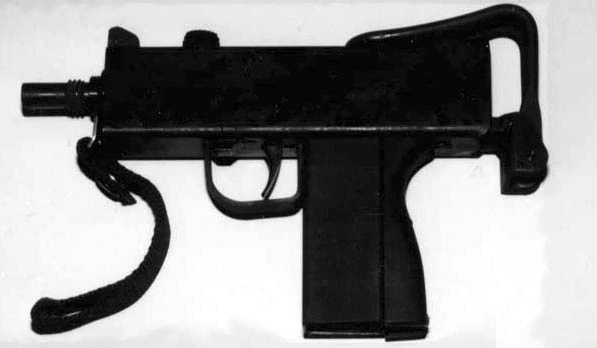
Image credit
- Title
- File:MAC11.jpg
- Author
- IkapitanzurseeI at English Wikipedia
- Licence
- Public domain
- Source
- https://commons.wikimedia.org/wiki/File:MAC11.jpg

Detail
The MAC-11 is a straight-blowback submachine gun Gordon Ingram designed for the Military Armament Corporation, entering production in 1972 as a scaled-down companion to his earlier MAC-10. Where the MAC-10 was chambered in .45 ACP and 9×19mm, the MAC-11 shrank the design to the smaller, lower-pressure .380 ACP, producing the smallest and lightest gun in the family at the cost of controllability at its very high cyclic rate.
Its box-section stamped-steel receiver, cocking knob on top of the receiver rather than a separate handle, and telescoping bolt that wraps around the rear of the barrel are all inherited directly from the MAC-10: the same construction shrunk to a smaller cartridge rather than a new design. Military Armament Corporation collapsed in 1976, and production passed through a long chain of successor companies (RPB, Cobray, SWD, and eventually MasterPiece Arms, the current rights holder) that built the gun, and civilian semi-automatic variants of it, for decades afterward, including the M11/9 rechambered for the more available 9×19mm Parabellum shown in this entry’s photograph.
This entry’s weight, length, barrel length and cyclic rate figures all come from the cited Wikipedia infobox, which carries no inline citation for any of them; they are recorded as estimated rather than verified for that reason, and the cyclic rate specifically traces to a print reference (Robert E. Walker’s Cartridges and Firearm Identification) with no clickable source. No manufacturer product sheet with primary figures for the original MAC-11 was found; current MasterPiece Arms literature describes later semi-automatic pistols built on the same platform rather than the original open-bolt submachine gun this entry describes.
References
This entry's own bibliography. Every citation key on this page resolves into this list.
- MAC-11 · Wikipedia · 1371331161 · read 2026-09-01 · CC BY-SA 4.0
Last verified 2026-09-01 · review status: agent-populated