
Thompson submachine gun
Auto-Ordnance Corporation1921–1945Interwar
Also known as Tommy gun, M1928A1, Chicago typewriter
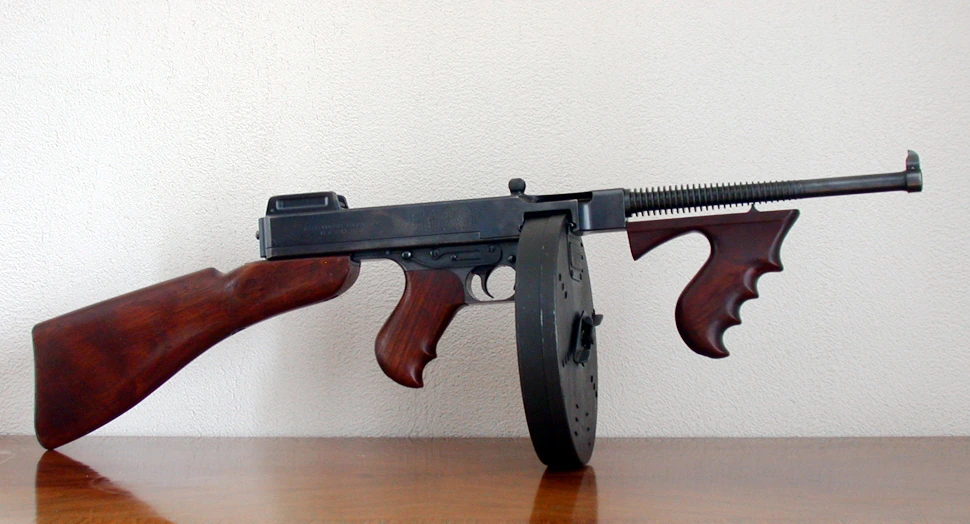
Image credit
- Title
- File:Campbell Thompson.jpg
- Author
- Hmaag(attribution required)
- Licence
- CC BY-SA 3.0
- Source
- https://commons.wikimedia.org/wiki/File:Campbell_Thompson.jpg

How Muzzle energy is calculated
E = ½ · m · v²
Inputs
- m14.90 g230.0 grverifiedsource230 gr as published, converted at 1 gr = 0.06479891 g.
- v271.3 m/s890.0 fpsverifiedMeasured with a 127 mm barrel, not this arm's 267.208 mm. Velocity outside the sourced range is not projected.
1 of 2 inputs link to their source.
How Muzzle velocity is calculated
nearest sourced barrel length, no extrapolation
Inputs
- v at 127 mm271.3 m/s890.0 fpsverifiedsource890 ft/s as published, converted at 1 ft/s = 0.3048 m/s.
Assumptions
- This figure belongs to a 127 mm barrel. It is shown because it is the closest measurement that exists, not because it applies here.
1 of 1 inputs link to their source.
How Loaded mass is calculated
m_loaded = m_empty + m_magazine + n · m_cartridge
Not calculated: m_magazine has no sourced figure yet. Nothing is substituted for a missing input.
Assumptions
- One magazine, filled to the stated capacity. Spare magazines, optics, slings and lights are the owner’s, not the arm’s.
2 of 4 inputs link to their source.
How Free recoil is calculated
E_recoil = ½ · m_firearm · v_recoil²
Inputs
- m_firearm4.899 kg10.80 lbverifiedsourcePublished as 10.8 lb; 1 lb = 0.45359237 kg exactly. Empty, M1928A1; the M1 is published at 10 lb.
- v_recoil0.8253 m/s2.708 fpsestimated
Assumptions
- Propellant gas momentum is excluded: ARMAG does not record charge weights. This is therefore a lower bound on the real free recoil, consistent between entries but smaller than a figure that includes the gas term.
- Free recoil: the arm is unrestrained. Stock design, muzzle devices, stance and shooter mass are not modelled, because none of them is a property of the arm.
1 of 2 inputs link to their source.
How Capacity is calculated
as published for the primary chambering
Inputs
- capacity30verifiedsourceBox magazines of 20 and 30 rounds; drums of 50 and 100. The M1 and M1A1 do not accept drums.
1 of 1 inputs link to their source.
Derived figures
Computed from the sourced values above. Open ƒ on any figure for the formula, its inputs, and the assumptions it makes.
How Momentum is calculated
p = m · v
Inputs
- m14.90 g230.0 grverifiedsource230 gr as published, converted at 1 gr = 0.06479891 g.
- v271.3 m/s890.0 fpsverifiedMeasured with a 127 mm barrel, not this arm's 267.208 mm. Velocity outside the sourced range is not projected.
1 of 2 inputs link to their source.
How Sectional density is calculated
SD = mass(gr) / (7000 · diameter(in)²)
Inputs
- mass14.90 g230.0 grverifiedsource230 gr as published, converted at 1 gr = 0.06479891 g.
- diameter11.48 mm0.4520 inverifiedsourceC.I.P. G1, maximum bullet diameter.
Assumptions
- Reported in the conventional lb/in² so it is directly comparable with published figures.
2 of 2 inputs link to their source.
How Power factor is calculated
PF = mass(gr) · velocity(fps) / 1000
Inputs
- mass14.90 g230.0 grverifiedsource230 gr as published, converted at 1 gr = 0.06479891 g.
- velocity271.3 m/s890.0 fpsverifiedMeasured with a 127 mm barrel, not this arm's 267.208 mm. Velocity outside the sourced range is not projected.
Assumptions
- A competition classification defined by the IPSC and USPSA rulebooks, stated in their units. It describes a scoring category, not an effect.
1 of 2 inputs link to their source.
How Magazine dump is calculated
t = (n − 1) / (rpm / 60)
Inputs
- n30verifiedsourceBox magazines of 20 and 30 rounds; drums of 50 and 100. The M1 and M1A1 do not accept drums.
- rpm700 rpmestimatedsourcePublished per variant and as ranges: 900 rpm (M1921), 600–725 (M1928), 700–800 (M1A1). Recorded as the M1A1 lower bound; see the note on ranges in the methodology page.
Assumptions
- Cyclic rate held for the whole magazine, no stoppages, trigger held down. A theoretical figure for comparing mechanisms, not a measured one.
2 of 2 inputs link to their source.
How Sight error at 1 mm is calculated
θ = atan(misalignment / sight radius)
Not calculated: sight radius has no sourced figure yet. Nothing is substituted for a missing input.
Assumptions
- Shows what a stated aiming error costs. The misalignment is the reader’s figure; the site does not claim how well anyone aims.
No input on this calculation carries a clickable source yet.
Variants
M1928A1
1928–1942
The Blish-locked service version, with the Cutts compensator, finned barrel and drum capability.
M1
1942–1943
Wartime simplification: the Blish lock deleted in favour of straight blowback, the finned barrel and compensator gone, the cocking handle moved to the side, and no drum.
M1A1
1943–1945
The M1 with a fixed firing pin machined into the bolt face instead of a separate hammer.
| Variant | Years | Changes |
|---|---|---|
| M1928A1 | 1928–1942 | no spec change |
| M1 | 1942–1943 | no spec change |
| M1A1 | 1943–1945 | no spec change |
Specifications
Every row here is generated from the schema, so a figure recorded on this entry cannot be missing from the table, and the same rows, read the same way, are what the comparison shows.
Identity
- Type
- Submachine gun
- Action
- Self-loading
- Fire modes
- Semi-automatic
- Fully automatic
- Operating system
- Blowback, friction-delayed
- Designed in
- United States
- Produced in
- Introduced
- 1921
- Production
- 1921–1945
Dimensions and mass
- Mass, empty
- 4.899 kg10.80 lbsource
Published as 10.8 lb; 1 lb = 0.45359237 kg exactly. Empty, M1928A1; the M1 is published at 10 lb.
- Magazine, empty
- not recorded
- Length
- 856.0 mm33.70 insource
Published as 33.7 in; 1 in = 25.4 mm exactly. M1928A1 with compensator; the M1 and M1A1 are 31.9 in.
- Length, folded
- not recorded
- Width
- not recorded
- Height
- not recorded
- Barrel length
- 267.2 mm10.52 insource
Published as 10.52 in; 1 in = 25.4 mm exactly.
Sights and rifling
- Sight radius
- not recorded
- Sight height over bore
- not recorded
- Rifling twist
- not recorded
- Twist direction
- not recorded
- Grooves
- not recorded
- Sight graduation
- not recorded
Operation
- Cyclic rate
Published per variant and as ranges: 900 rpm (M1921), 600–725 (M1928), 700–800 (M1A1). Recorded as the M1A1 lower bound; see the note on ranges in the methodology page.
- Trigger pull
- not recorded
- Effective range
- not recorded
- Units produced
- not recorded
- Launch price
- not recorded
Chamberings
- .45 ACPprimary30 rounds
Scale
A to-scale outline against family siblings. The dimensions are sourced; the shape is a representative outline for the type, and says so.
- Thompson submachine gun856.0 mm33.70 inheight not recorded
Representative outline: the dimensions are sourced, the shape is not. Overall length, and barrel length where recorded, are drawn from this entry's own figures; the profile is a generic one for the firearm type and says nothing about this arm's actual contours. Thompson submachine gun records no height, so its outline is drawn at the type's proportion. That height is part of the shape, not a measurement.
Lineage
What came from it
- Succeeded by M3 submachine gun
Detail
John Thompson believed he had found a way to make a rifle work without a gas system. John Blish had patented the observation that dissimilar metals under high pressure resist sliding against each other at an inclined face, and Thompson bought the rights expecting it to hold a breech closed until the pressure fell. It does not, at rifle pressures. What it does do, at pistol pressures, is very little: the wartime M1 deleted the bronze Blish lock entirely and worked exactly as well as a plain blowback.
So the weapon’s real character is its mass. Ten and a half pounds of milled steel firing a heavy, slow .45 bullet is remarkably controllable, and that is what made its reputation with police forces, with the Marines in Nicaragua, and with the criminals whose newspaper photographs gave it a nickname it has never lost.
It was also expensive: early guns cost as much as a car, and every wartime revision was an attempt to make it cheaper.
The cyclic rate here is recorded as an estimate. The article publishes three different figures for three variants, two of them as ranges, and a single number cannot represent that honestly.
References
This entry's own bibliography. Every citation key on this page resolves into this list.
- Thompson submachine gun · Wikipedia · 1372206709 · read 2026-08-31 · CC BY-SA 4.0
Last verified 2026-08-31 · review status: agent-populated