
Image credit
- Title
- File:5,45mm AK-12 6P70 assault rifle at Military-technical forum ARMY-2016 03 noBG.jpg
- Author
- Vitaly V. Kuzmin(attribution required)
- Licence
- CC BY-SA 4.0
- Source
- https://commons.wikimedia.org/wiki/File:5,45mm_AK-12_6P70_assault_rifle_at_Military-technical_forum_ARMY-2016_03_noBG.jpg

How Muzzle energy is calculated
E = ½ · m · v²
Inputs
- m3.43 g52.93 grverifiedsourceBallistics table of the cited article, which publishes bullet mass in grams.
- v880 m/s2,887 fpsverified
1 of 2 inputs link to their source.
How Muzzle velocity is calculated
measured at this barrel length
Inputs
- v880 m/s2,887 fpsverifiedsourceBallistics table of the cited article.
1 of 1 inputs link to their source.
How Loaded mass is calculated
m_loaded = m_empty + m_magazine + n · m_cartridge
Not calculated: m_magazine has no sourced figure yet. Nothing is substituted for a missing input.
Assumptions
- One magazine, filled to the stated capacity. Spare magazines, optics, slings and lights are the owner’s, not the arm’s.
2 of 4 inputs link to their source.
How Free recoil is calculated
E_recoil = ½ · m_firearm · v_recoil²
Inputs
- m_firearm3.7 kg8.157 lbestimatedsourceempty, from the infobox, uncited on Wikipedia
- v_recoil0.8158 m/s2.676 fpsestimated
Assumptions
- Propellant gas momentum is excluded: ARMAG does not record charge weights. This is therefore a lower bound on the real free recoil, consistent between entries but smaller than a figure that includes the gas term.
- Free recoil: the arm is unrestrained. Stock design, muzzle devices, stance and shooter mass are not modelled, because none of them is a property of the arm.
1 of 2 inputs link to their source.
How Capacity is calculated
as published for the primary chambering
Inputs
- capacity30estimatedsource30-round detachable box magazine, from the infobox, uncited on Wikipedia; 45-round, 60-round and 95-round magazines from other RPK-family weapons are also published as compatible
1 of 1 inputs link to their source.
Derived figures
Computed from the sourced values above. Open ƒ on any figure for the formula, its inputs, and the assumptions it makes.
How Momentum is calculated
p = m · v
Inputs
- m3.43 g52.93 grverifiedsourceBallistics table of the cited article, which publishes bullet mass in grams.
- v880 m/s2,887 fpsverified
1 of 2 inputs link to their source.
How Sectional density is calculated
SD = mass(gr) / (7000 · diameter(in)²)
Inputs
- mass3.43 g52.93 grverifiedsourceBallistics table of the cited article, which publishes bullet mass in grams.
- diameter5.6 mm0.2205 inverifiedsourceC.I.P. G1, maximum bullet diameter.
Assumptions
- Reported in the conventional lb/in² so it is directly comparable with published figures.
2 of 2 inputs link to their source.
How Power factor is calculated
PF = mass(gr) · velocity(fps) / 1000
Inputs
- mass3.43 g52.93 grverifiedsourceBallistics table of the cited article, which publishes bullet mass in grams.
- velocity880 m/s2,887 fpsverified
Assumptions
- A competition classification defined by the IPSC and USPSA rulebooks, stated in their units. It describes a scoring category, not an effect.
1 of 2 inputs link to their source.
How Magazine dump is calculated
t = (n − 1) / (rpm / 60)
Inputs
- n30estimatedsource30-round detachable box magazine, from the infobox, uncited on Wikipedia; 45-round, 60-round and 95-round magazines from other RPK-family weapons are also published as compatible
- rpm700 rpmestimatedsourcefrom the infobox, uncited on Wikipedia, published as a single figure
Assumptions
- Cyclic rate held for the whole magazine, no stoppages, trigger held down. A theoretical figure for comparing mechanisms, not a measured one.
2 of 2 inputs link to their source.
How Sight error at 1 mm is calculated
θ = atan(misalignment / sight radius)
Not calculated: sight radius has no sourced figure yet. Nothing is substituted for a missing input.
Assumptions
- Shows what a stated aiming error costs. The misalignment is the reader’s figure; the site does not claim how well anyone aims.
No input on this calculation carries a clickable source yet.
Specifications
Every row here is generated from the schema, so a figure recorded on this entry cannot be missing from the table, and the same rows, read the same way, are what the comparison shows.
Identity
- Type
- Rifle
- Action
- Self-loading
- Fire modes
- Semi-automatic
- Fully automatic
- Operating system
- Gas, long-stroke piston
- Roles
- Designed in
- Russia
- Produced in
- Introduced
- 2018
- Production
- 2018–present
Dimensions and mass
- Mass, empty
empty, from the infobox, uncited on Wikipedia
- Magazine, empty
- not recorded
- Length
stock extended, from the infobox, uncited on Wikipedia
- Length, folded
stock folded, from the infobox, uncited on Wikipedia
- Width
- not recorded
- Height
- not recorded
- Barrel length
standard-length rifle; the shorter AK-12K and AK-12SK carbine barrels are not recorded on this entry
Sights and rifling
- Sight radius
- not recorded
- Sight height over bore
- not recorded
- Rifling twist
- not recorded
- Twist direction
- not recorded
- Grooves
- not recorded
- Sight graduation
- not recorded
Operation
- Cyclic rate
from the infobox, uncited on Wikipedia, published as a single figure
- Trigger pull
- not recorded
- Effective range
published as the AK-12's own point-blank range figure, uncited on Wikipedia
- Units produced
published as '150,000+' across the AK-12 family, so this is a floor rather than a count; uncited on Wikipedia
- Launch price
- not recorded
Chamberings
- 5.45×39mmprimary30 rounds
Scale
A to-scale outline against family siblings. The dimensions are sourced; the shape is a representative outline for the type, and says so.
- AK-12922 mm36.30 inheight not recorded
Representative outline: the dimensions are sourced, the shape is not. Overall length, and barrel length where recorded, are drawn from this entry's own figures; the profile is a generic one for the firearm type and says nothing about this arm's actual contours. AK-12 records no height, so its outline is drawn at the type's proportion. That height is part of the shape, not a measurement.
Gallery
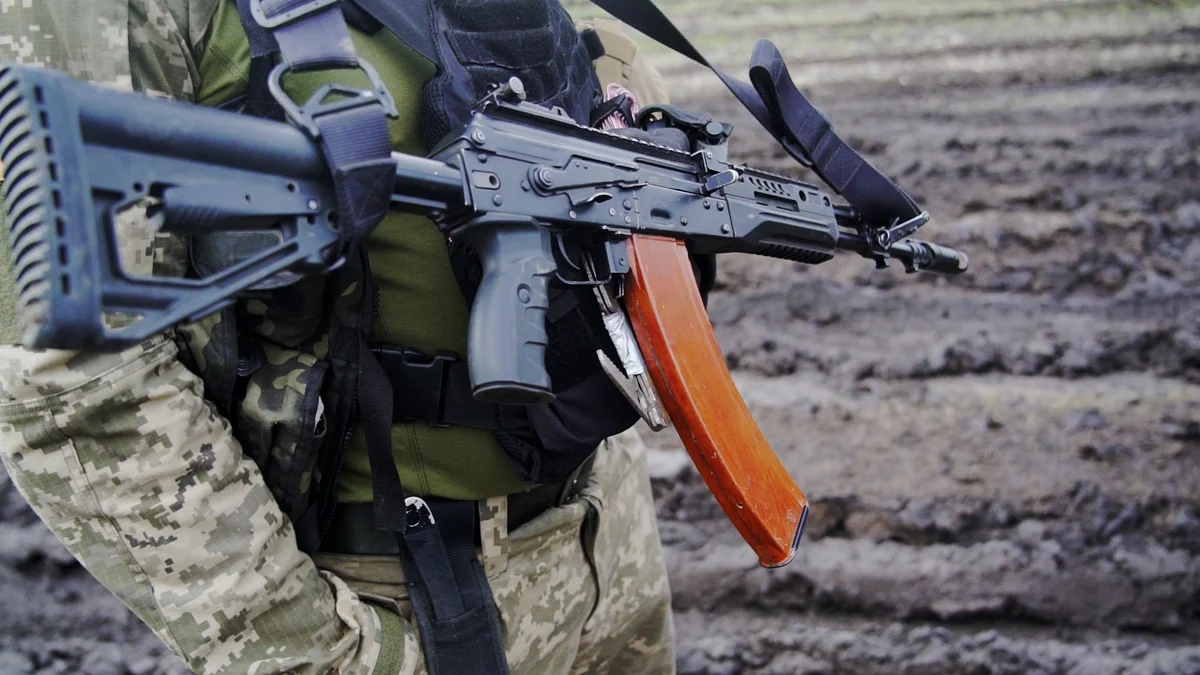
Image credit
- Title
- File:UA TDF with captured AK-12.jpg
- Author
- 110th Territorial Defense Brigade of Zaporizhizhia Region(attribution required)
- Licence
- CC BY 4.0
- Source
- https://commons.wikimedia.org/wiki/File:UA_TDF_with_captured_AK-12.jpg

Detail
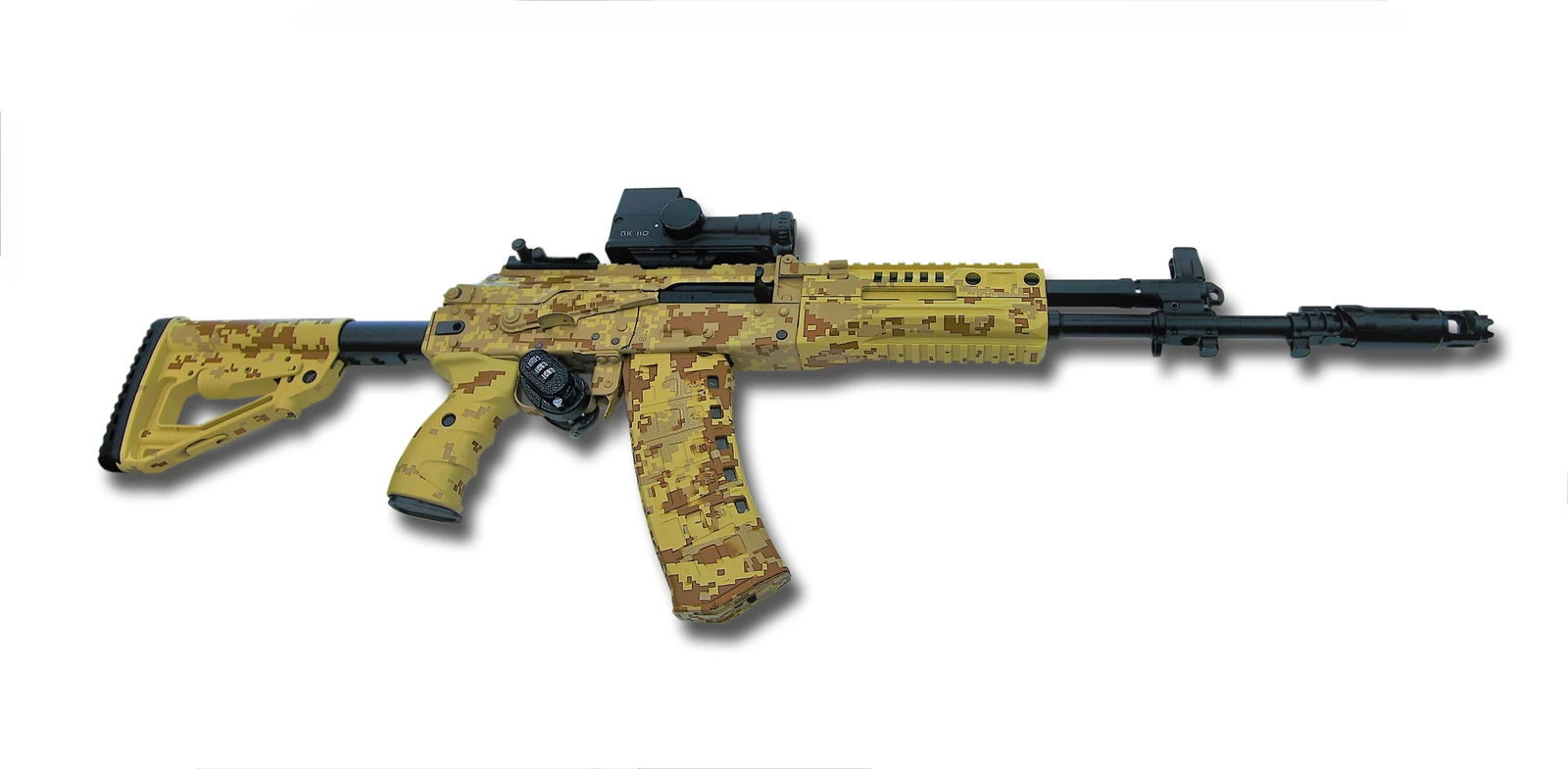
The AK-12 was designed at Izhmash, now Kalashnikov Concern, from 2011 and entered Russian service production in 2018 as the newest formal successor to the AK-47 lineage, keeping the same gas-operated, long-stroke piston, rotating-bolt action that has defined every Kalashnikov rifle since 1947 while updating the furniture, sights and ergonomics around it. It replaces the AK-74M and AK-100-series rifles as Russia’s current-issue service rifle, retaining the AK family’s 5.45×39mm chambering while adding a folding, length-adjustable stock, an ambidextrous fire selector and safety, and Picatinny rails for optics in place of the side-rail mounts used on earlier Kalashnikov-pattern rifles.
Unlike most earlier Kalashnikov variants, which changed a proven action to fit a new cartridge without otherwise redesigning it, the AK-12 was developed alongside a family of siblings built on the same action but chambered for different cartridges entirely: the AK-15 in 7.62×39mm, the AK-19 in 5.56×45mm NATO for the export market, and the AK-308 in 7.62×51mm NATO. Because each of those changes the rifle’s primary cartridge family rather than only its furniture or sights, they are treated on this site as separate designs rather than variants of this entry, even though they share the AK-12’s action and much of its outer architecture.
The AK-12 retains the Kalashnikov system’s long-standing reputation for tolerance of dirt, sand and poor maintenance, a design priority that traces back to its 1940s origins and that the AK-12 program deliberately preserved rather than trading away for closer tolerances or lighter construction. It has seen combat use in Syria and, since 2022, in Russia’s invasion of Ukraine, alongside older AK-74M and AK-100-series rifles still in wide Russian service.
Every figure in this entry is drawn from Wikipedia’s infobox rather than a primary source, none of it individually cited on Wikipedia itself, so all figures here are recorded as estimated rather than verified; Kalashnikov Concern’s own product pages could not be reached to check them. No muzzle velocity is recorded because no source found ties a published velocity figure to a stated barrel length, and this entry does not attempt to give separate figures for the shorter AK-12K and AK-12SK carbine configurations.
References
This entry's own bibliography. Every citation key on this page resolves into this list.
- AK-12 · Wikipedia · 1365177067 · read 2026-09-04 · CC BY-SA 4.0
Last verified 2026-09-04 · review status: draft