
.577/450 Martini–Henry
Introduced 1871
Dimensions and pressure
Generated from the schema, like every specification table on this site, so a figure recorded on this entry cannot be missing from the table.
Identity
- Designed by
- not recorded
- Introduced
- 1871
- Production
- not recorded
- Standards body
- No standards body
- Case type
- Rimmed
- Case shape
- Bottleneck
Dimensions
- Bullet diameter
- 11.56 mm0.4551 inestimated
Converted from .455 in, Cartridges of the World, via the Wikipedia infobox.
- Bore diameter
- not recorded
- Case length
- 59.44 mm2.340 inestimated
Converted from 2.34 in, Cartridges of the World, via the Wikipedia infobox (no primary dimensional standard exists for this obsolete British service round).
- Overall length
- 79.25 mm3.120 inestimated
Converted from 3.12 in, Cartridges of the World, via the Wikipedia infobox.
- Rim diameter
- 18.95 mm0.7461 inestimated
Converted from .746 in, Cartridges of the World, via the Wikipedia infobox.
- Neck diameter
- 12.37 mm0.4870 inestimated
Converted from .487 in, Cartridges of the World, via the Wikipedia infobox.
- Base diameter
- 16.97 mm0.6681 inestimated
Converted from .668 in, Cartridges of the World, via the Wikipedia infobox.
Pressure
- Maximum pressure
- not recorded
- Pressure standard
- not recorded
SAAMI and C.I.P. measure pressure differently and their figures are not interchangeable, which is why the body is always named beside the figure.
Loads
Velocity is recorded per barrel length as published. A gun page interpolates between these points and never projects beyond them.
480 gr lead alloy
- Bullet mass
- 31.1 g479.9 grestimated
480 gr lead-alloy bullet, Cartridges of the World, via the Wikipedia infobox. No test-barrel length is stated for the load's published velocity, so velocity is not recorded.
- Cartridge mass
- not recorded
- Bullet type
- lead alloy
- G1 BC
- not recorded
- G7 BC
- not recorded
Chambered in
Computed from every entry that lists this cartridge. Nothing here is hand-maintained.
- Martini–Henry
Royal Small Arms Factory
Gallery
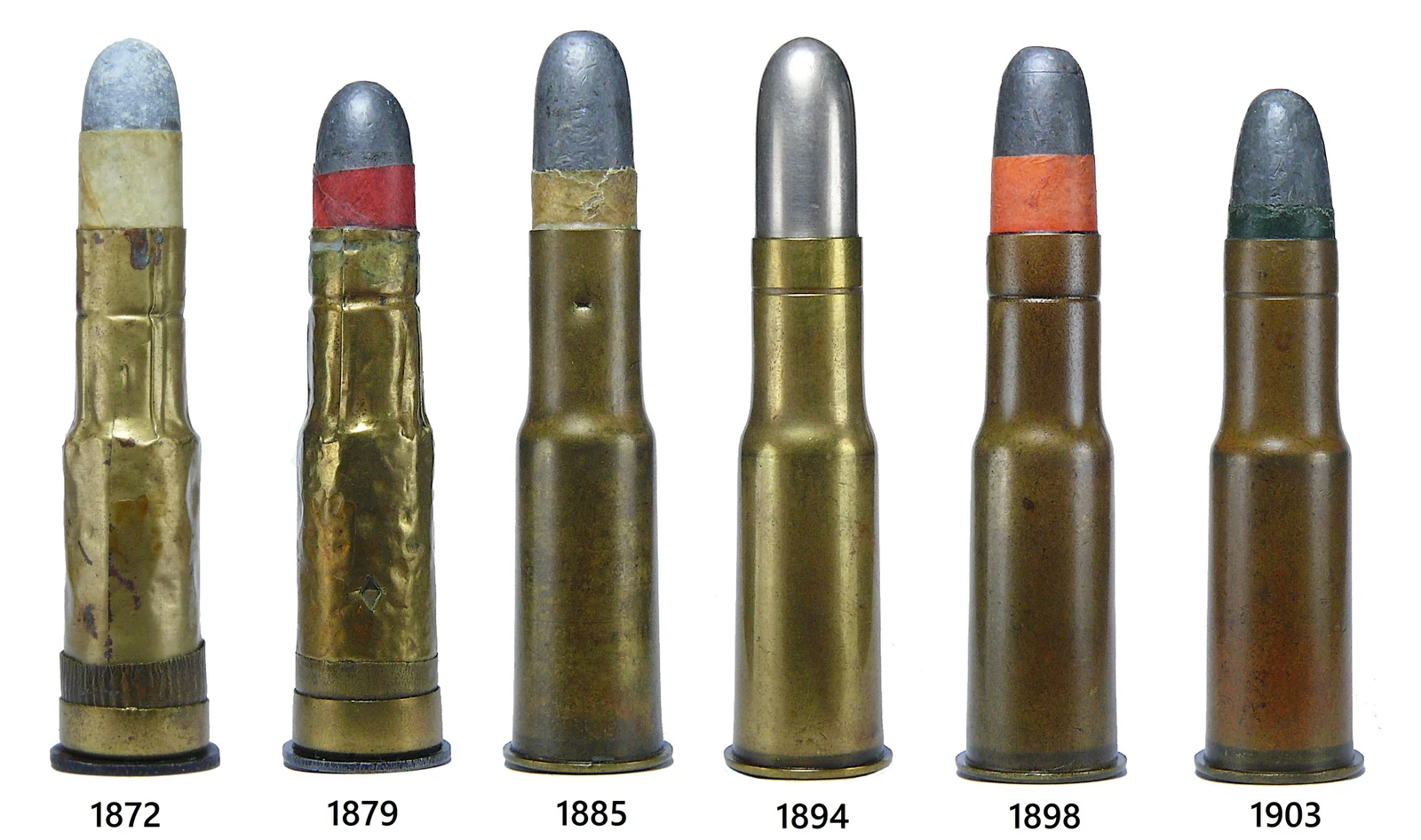
Image credit
- Title
- File:577 450 Martini-Henry by the years.jpg
- Author
- Jim Miles(attribution required)
- Licence
- CC BY-SA 4.0
- Source
- https://commons.wikimedia.org/wiki/File:577_450_Martini-Henry_by_the_years.jpg

Detail
Adopted in 1871 for the single-shot Martini-Henry rifle, this cartridge lengthened and bottlenecked the case of its predecessor, the .577 Snider, down to a .450 bullet. The name states two bore diameters rather than a caliber and charge: .577 for the parent case at its base, .450 for the bullet the necked-down case carries.
Its early service life was troubled by its own case construction rather than its ballistics. The first Marks were made from coiled brass sheet wrapped around a strengthening strip, a cheaper process than drawing a case from a single blank, and that construction proved fragile and prone to sticking in a fouled chamber. Reinforcement was increased through several Marks before the army abandoned the coiled case altogether in 1885 for a solid drawn-brass one, the construction every modern rifle cartridge now uses as a matter of course.
No dimensional standard governs an obsolete black-powder military round: the figures here are converted
from the reference work Cartridges of the World rather than a primary standards body, so they carry
estimated status throughout. No test-barrel length is published for the cartridge’s era ballistics, so
only bullet mass is recorded for its load.
References
- .577/450 Martini–Henry · 1366237810 · read 2026-09-09
Last verified 2026-09-09 · review status: agent-populated