
Martini–Henry
Royal Small Arms Factory1871–1889Metallic cartridge
Also known as Martini-Henry, Aynalı Martin
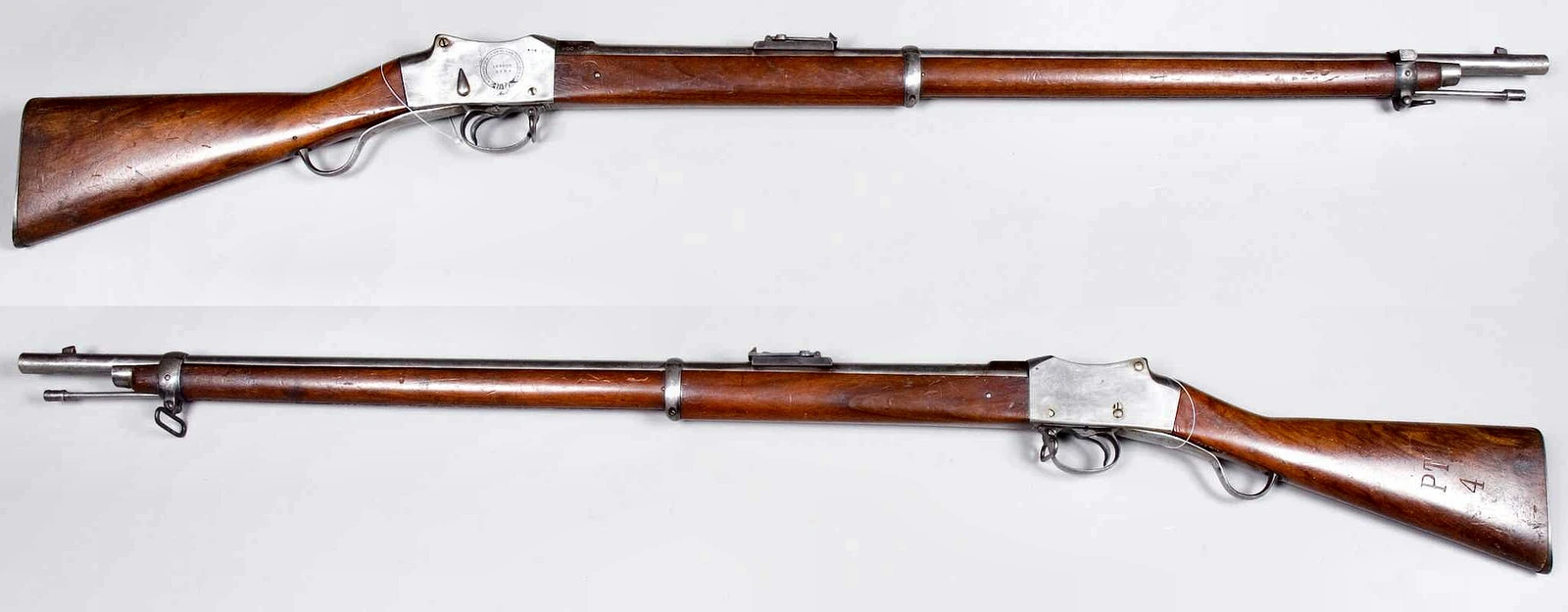
Image credit
- Title
- File:Martini-Henry m1871 - England - AM.032017.jpg
- Author
- Armémuseum (The Swedish Army Museum)
- Licence
- Public domain
- Source
- https://commons.wikimedia.org/wiki/File:Martini-Henry_m1871_-_England_-_AM.032017.jpg

How Muzzle energy is calculated
E = ½ · m · v²
Not calculated: v has no sourced figure yet. Nothing is substituted for a missing input.
No input on this calculation carries a clickable source yet.
How Muzzle velocity is calculated
no sourced velocity for this load
Not calculated: muzzle velocity has no sourced figure yet. Nothing is substituted for a missing input.
No input on this calculation carries a clickable source yet.
How Loaded mass is calculated
m_loaded = m_empty + m_magazine + n · m_cartridge
Not calculated: m_magazine has no sourced figure yet. Nothing is substituted for a missing input.
Assumptions
- One magazine, filled to the stated capacity. Spare magazines, optics, slings and lights are the owner’s, not the arm’s.
2 of 4 inputs link to their source.
How Free recoil is calculated
E_recoil = ½ · m_firearm · v_recoil²
Not calculated: v_recoil has no sourced figure yet. Nothing is substituted for a missing input.
Assumptions
- Propellant gas momentum is excluded: ARMAG does not record charge weights. This is therefore a lower bound on the real free recoil, consistent between entries but smaller than a figure that includes the gas term.
- Free recoil: the arm is unrestrained. Stock design, muzzle devices, stance and shooter mass are not modelled, because none of them is a property of the arm.
1 of 2 inputs link to their source.
How Capacity is calculated
as published for the primary chambering
Inputs
- capacity1estimatedsourceDerived from the article's description of the rifle as breech-loading and single-shot with no magazine; one round loaded directly into the chamber at a time.
1 of 1 inputs link to their source.
Derived figures
Computed from the sourced values above. Open ƒ on any figure for the formula, its inputs, and the assumptions it makes.
How Momentum is calculated
p = m · v
Not calculated: v has no sourced figure yet. Nothing is substituted for a missing input.
No input on this calculation carries a clickable source yet.
How Sectional density is calculated
SD = mass(gr) / (7000 · diameter(in)²)
Inputs
- mass31.1 g479.9 grestimated480 gr lead-alloy bullet, Cartridges of the World, via the Wikipedia infobox. No test-barrel length is stated for the load's published velocity, so velocity is not recorded.
- diameter11.56 mm0.4551 inestimatedConverted from .455 in, Cartridges of the World, via the Wikipedia infobox.
Assumptions
- Reported in the conventional lb/in² so it is directly comparable with published figures.
No input on this calculation carries a clickable source yet.
How Power factor is calculated
PF = mass(gr) · velocity(fps) / 1000
Not calculated: velocity has no sourced figure yet. Nothing is substituted for a missing input.
Assumptions
- A competition classification defined by the IPSC and USPSA rulebooks, stated in their units. It describes a scoring category, not an effect.
No input on this calculation carries a clickable source yet.
How Magazine dump is calculated
t = (n − 1) / (rpm / 60)
Not calculated: rpm has no sourced figure yet. Nothing is substituted for a missing input.
Assumptions
- Cyclic rate held for the whole magazine, no stoppages, trigger held down. A theoretical figure for comparing mechanisms, not a measured one.
1 of 2 inputs link to their source.
How Sight error at 1 mm is calculated
θ = atan(misalignment / sight radius)
Not calculated: sight radius has no sourced figure yet. Nothing is substituted for a missing input.
Assumptions
- Shows what a stated aiming error costs. The misalignment is the reader’s figure; the site does not claim how well anyone aims.
No input on this calculation carries a clickable source yet.
Specifications
Every row here is generated from the schema, so a figure recorded on this entry cannot be missing from the table, and the same rows, read the same way, are what the comparison shows.
Identity
- Type
- Rifle
- Action
- Falling block
- Fire modes
- Single shot
- Operating system
- Manually operated
- Feed
- not recorded
- Roles
- Designed in
- United Kingdom
- Produced in
- Introduced
- 1871
- Production
- 1871–1889
Dimensions and mass
- Mass, empty
Converted from 8 lb 7 oz, unloaded, from the infobox; no inline citation is given there.
- Magazine, empty
- not recorded
- Length
Converted from 49 in, from the infobox; no inline citation is given there.
- Length, folded
- not recorded
- Width
- not recorded
- Height
- not recorded
- Barrel length
Converted from 33.22 in, from the infobox; no inline citation is given there.
Sights and rifling
- Sight radius
- not recorded
- Sight height over bore
- not recorded
- Rifling twist
- not recorded
- Twist direction
- not recorded
- Grooves
- not recorded
- Sight graduation
- not recorded
Operation
- Cyclic rate
- not recorded
- Trigger pull
- not recorded
- Effective range
Converted from 400 yd, from the infobox; no inline citation is given there. The article body separately states the rifle was found capable of hitting a man-sized target to about this range.
- Units produced
Published as a range of approx. 500,000-1,000,000 in the infobox, uncited there; midpoint recorded here.
- Launch price
- not recorded
Chamberings
- .577/450 Martini–Henryprimary1 rounds
Scale
A to-scale outline against family siblings. The dimensions are sourced; the shape is a representative outline for the type, and says so.
- Martini–Henry1,245 mm49.00 inheight not recorded
Representative outline: the dimensions are sourced, the shape is not. Overall length, and barrel length where recorded, are drawn from this entry's own figures; the profile is a generic one for the firearm type and says nothing about this arm's actual contours. Martini–Henry records no height, so its outline is drawn at the type's proportion. That height is part of the shape, not a measurement.
Gallery
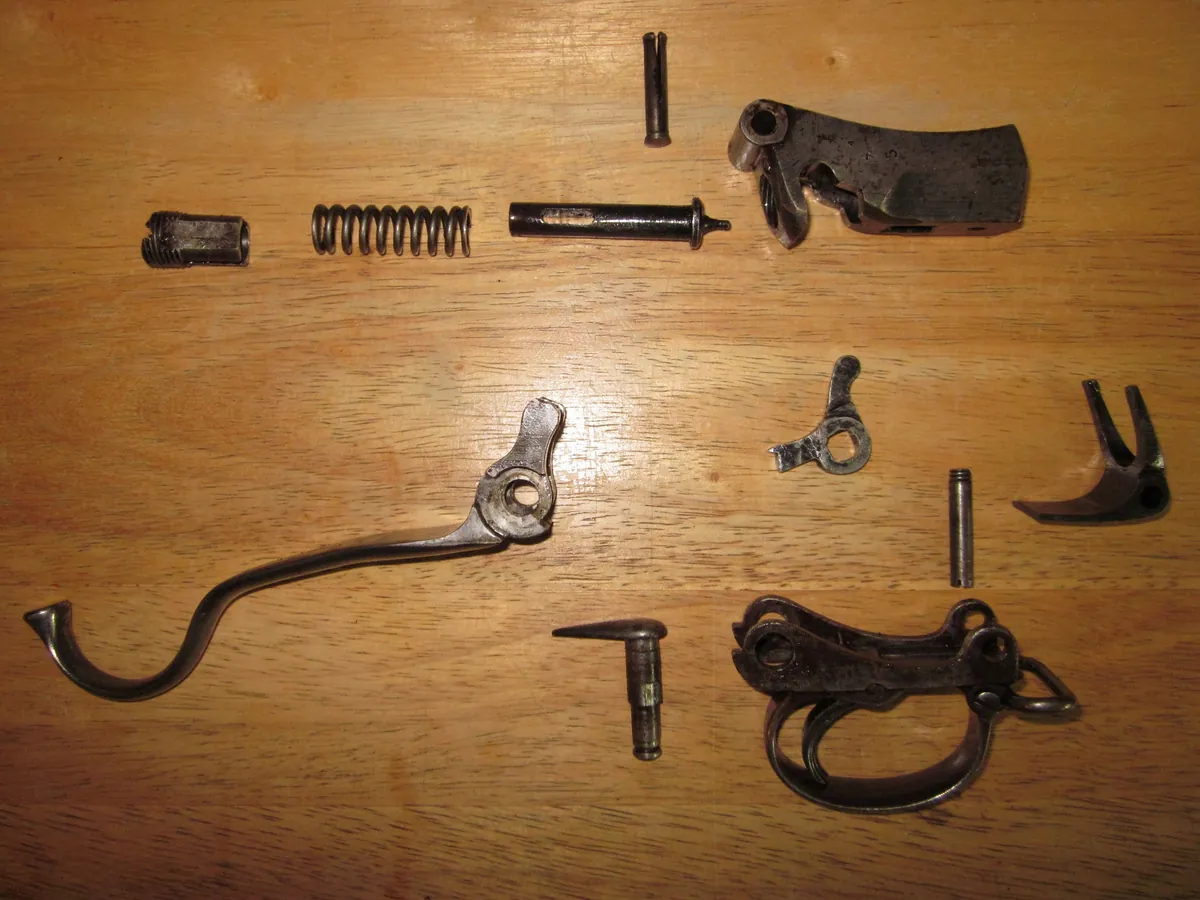
Image credit
- Title
- File:Martini Henry Action Parts.jpg
- Author
- SupremeDalek(attribution required)
- Licence
- CC BY-SA 3.0
- Source
- https://commons.wikimedia.org/wiki/File:Martini_Henry_Action_Parts.jpg

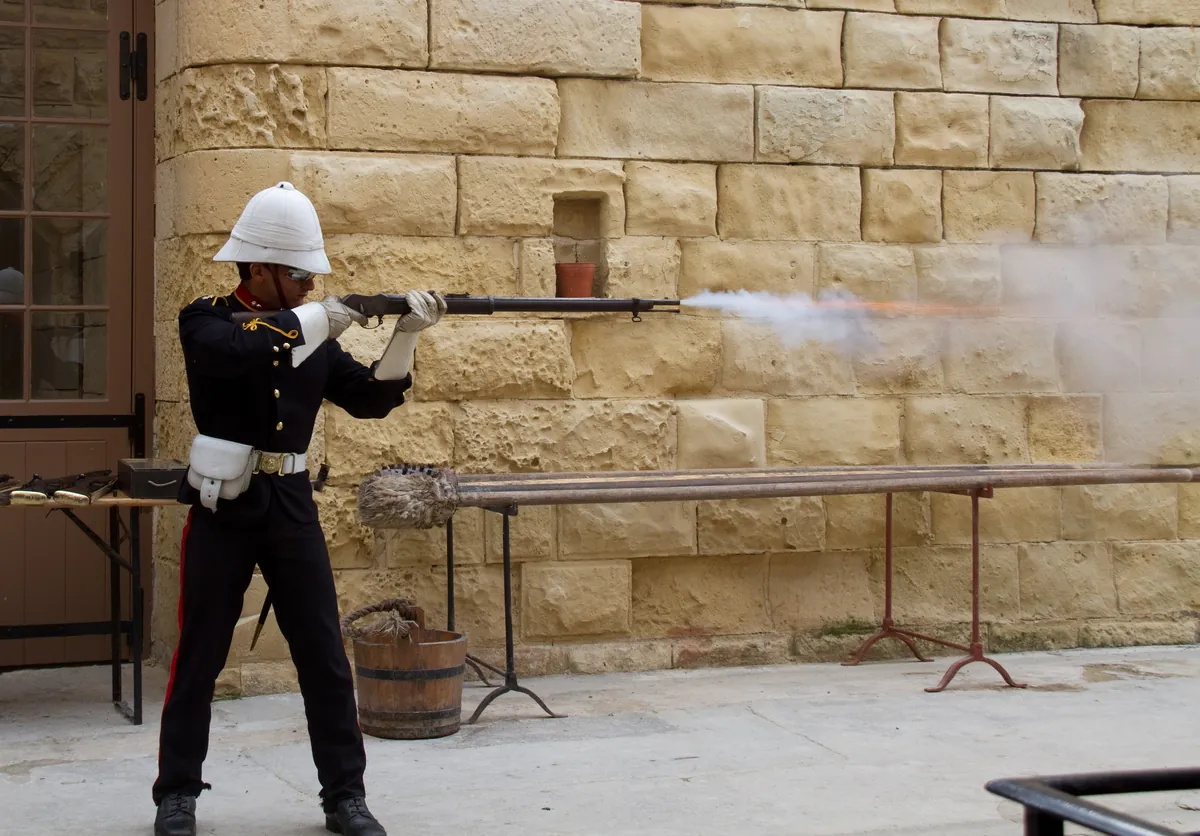
Image credit
- Title
- File:Martini-Henry Rifle (6950096771).jpg
- Author
- Tony Hisgett from Birmingham, UK(attribution required)
- Licence
- CC BY 2.0
- Source
- https://commons.wikimedia.org/wiki/File:Martini-Henry_Rifle_(6950096771).jpg

Detail
The Martini–Henry replaced the Snider–Enfield, itself a muzzle-loader hastily converted to fire a metallic cartridge, with a rifle designed from the outset as a breechloader. Its falling-block action combined Henry O. Peabody’s dropping breech block, reworked by the Swiss engineer Friedrich von Martini into a hammerless design cocked by the underlever itself, with polygonal rifling by the Scottish gunmaker Alexander Henry. Pulling the underlever down and forward tips the block clear of the chamber for loading and draws the striker spring back in the same motion; there is no separate hammer to cock and no magazine to load: one round at a time, by hand.
It entered British service in 1871 and stayed there, in one mark or another, for 47 years, fighting through the colonial campaigns of the late Victorian empire, including Isandlwana and Rorke’s Drift during the Anglo-Zulu War. Early production used a rolled brass-foil cartridge case that expanded under firing pressure until it stuck or tore in the chamber, jamming the action; the fix, a stronger drawn-brass case paired with a longer loading lever for more forceful extraction, arrived on the Mk IV. Ottoman forces used near-identical rifles built under contract by the Providence Tool Company in Rhode Island, and Romania bought a further batch from Steyr in Austria-Hungary, production the Royal Small Arms Factory at Enfield, already at capacity rearming British troops, could not itself supply. The design was eventually superseded by the bolt-action, magazine-fed Lee–Metford, and converted survivors chambered for smaller-bore cartridges were reissued under other names, among them the Martini–Enfield and Martini–Metford, rather than as the Martini–Henry itself.
The same falling-block action, retooled by W. W. Greener decades later for a proprietary shotshell that no other gun could chamber, became the Greener Prison Shotgun issued to colonial prison and police services; the change of cartridge family and role makes it a separate design built on the same mechanism rather than a configuration of this one.
This entry has no verified weight, overall length, barrel length, sight range or production total: the cited Wikipedia infobox carries all of them with no inline citation of its own, so they are recorded here as estimated rather than verified. No free primary source (a period ordnance manual or a museum collection record) was found online to upgrade them.
References
This entry's own bibliography. Every citation key on this page resolves into this list.
- Martini–Henry · Wikipedia · 1370890676 · read 2026-09-09 · CC BY-SA 4.0
Last verified 2026-09-09 · review status: agent-populated