
.45 Schofield
Introduced 1875Smith & WessonCIP standard
Also known as 45 S&W Schofield, .45 Smith & Wesson, 11.5×27mmR: the same cartridge under different names, all of which find this page.
Dimensions and pressure
Generated from the schema, like every specification table on this site, so a figure recorded on this entry cannot be missing from the table.
Identity
- Designed by
- Smith & Wesson
- Introduced
- 1875
- Production
- not recorded
- Standards body
- C.I.P.
- Case type
- Rimmed
- Case shape
- Straight
Dimensions
- Bullet diameter
- 11.58 mm0.4559 insource
Cartridge maximum, dimension G1.
- Bore diameter
- not recorded
- Case length
- 27.69 mm1.090 insource
- Overall length
- 36.32 mm1.430 insource
- Rim diameter
- 12.95 mm0.5098 insource
Cartridge maximum, dimension R1.
- Neck diameter
- 12.19 mm0.4799 insource
- Base diameter
- 12.19 mm0.4799 insource
Pressure
- Maximum pressure
- 100 MPa14,504 psisource
- Pressure standard
- C.I.P.
SAAMI and C.I.P. measure pressure differently and their figures are not interchangeable, which is why the body is always named beside the figure.
Loads
Velocity is recorded per barrel length as published. A gun page interpolates between these points and never projects beyond them.
230 gr lead
- Bullet mass
- 14.90 g230.0 grestimated
230 gr, the factory lead loading in the Wikipedia infobox, which attributes it to Cartridges of the World (a book). No source pairs its velocity with a test barrel, so none is recorded.
- Cartridge mass
- not recorded
- Bullet type
- lead
- G1 BC
- not recorded
- G7 BC
- not recorded
Chambered in
Computed from every entry that lists this cartridge. Nothing here is hand-maintained.
No entry on the site is chambered in it yet.
Gallery
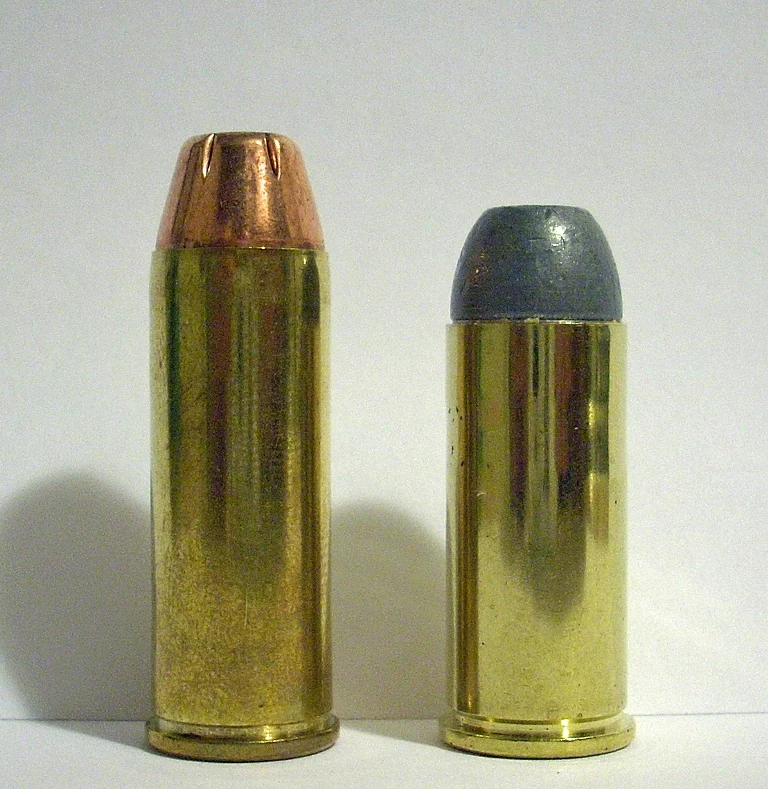
Image credit
- Title
- File:45 Schofield.JPG
- Author
- Harvey Henkelmann(attribution required)
- Licence
- CC BY 3.0
- Source
- https://commons.wikimedia.org/wiki/File:45_Schofield.JPG

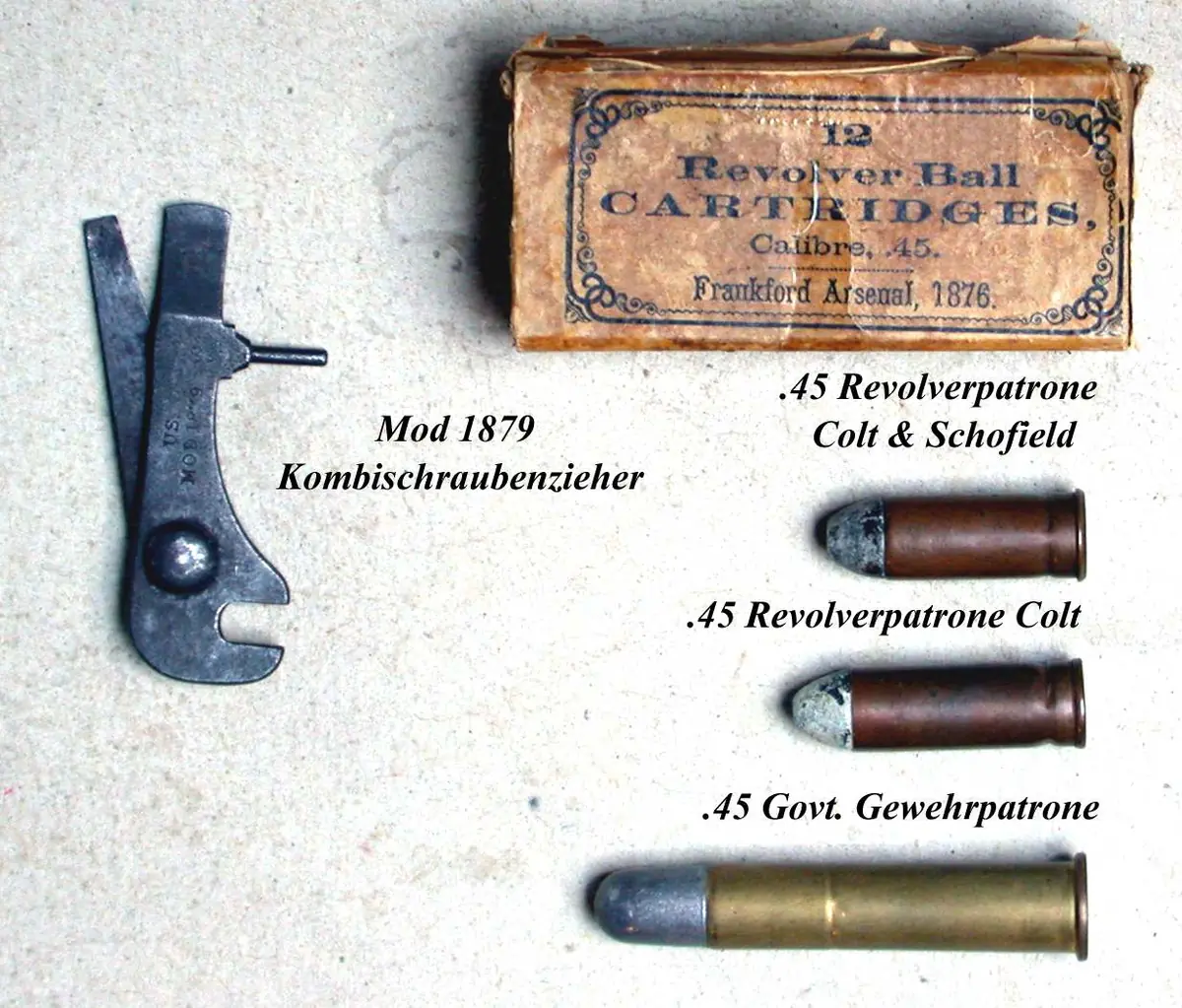
Image credit
- Title
- File:.45 Cartridges Tool 1879.JPG
- Author
- Hmaag(attribution required)
- Licence
- CC BY-SA 3.0
- Source
- https://commons.wikimedia.org/wiki/File:.45_Cartridges_Tool_1879.JPG

Detail
The .45 Schofield, also sold as the .45 Smith & Wesson, is the revolver cartridge Smith & Wesson developed for the Schofield, the Model 3 top-break revolver it modified at the suggestion of Major George Schofield so that a cavalryman could reload it more quickly on horseback. It is a .45 Colt with a shorter case and a larger rim, and United States government arsenals supplied it for both the Schofield and the Colt Single Action Army, of which the Army had bought 8,285 Schofields by 1879.
The two rounds did not interchange cleanly. The shorter Schofield cartridge fired in the Colt, but the longer .45 Colt would not fit the Schofield’s cylinder, and by the late 1880s the Army settled on a single round for both revolvers: the M1887 Military Ball Cartridge, made at Frankford Arsenal, which combined the Schofield’s short case with the Colt’s smaller rim so that it would fire in the Schofield and still eject from the rod-ejector Colt. In the early 1880s the internal Benét primer of the first cartridges gave way to the external Boxer primer for all later military revolver ammunition. Because the modern .454 Casull and .460 S&W Magnum are lengthened descendants of the .45 Colt, revolvers chambered for them usually accept the .45 Schofield as well.
The dimensions and the notably low pressure ceiling on this page come from the C.I.P. datasheet for “45 S&W Schofield”. The one load recorded is the 230-grain lead factory loading, taken from a book and so estimated; no source pairs a velocity for it with a test barrel, and the other figures the encyclopedia lists are handloading data, so this entry records no velocity.
References
- .45 Schofield · 1360454578 · read 2026-09-24
- C.I.P. TDCC datasheet — 45 S&W Schofield · 2000-06-07 · read 2026-09-24
Last verified 2026-09-24 · review status: draft