
.45 Colt
Introduced 1873US Army and ColtCIP standard
Also known as .45 Long Colt: the same cartridge under different names, all of which find this page.
Dimensions and pressure
Generated from the schema, like every specification table on this site, so a figure recorded on this entry cannot be missing from the table.
Identity
- Designed by
- US Army and Colt
- Introduced
- 1873
- Production
- not recorded
- Standards body
- C.I.P.
- Case type
- Rimmed
- Case shape
- Straight
Dimensions
- Bullet diameter
- 11.58 mm0.4559 insource
C.I.P. G1, maximum bullet diameter.
- Bore diameter
- not recorded
- Case length
- 32.64 mm1.285 insource
C.I.P. L3, maximum case length.
- Overall length
- 40.64 mm1.600 insource
C.I.P. L6, maximum cartridge overall length.
- Rim diameter
- 13 mm0.5118 insource
C.I.P. R1.
- Neck diameter
- 12.19 mm0.4799 insource
C.I.P. H2.
- Base diameter
- 12.19 mm0.4799 insource
C.I.P. P1.
Pressure
- Maximum pressure
- 110 MPa15,954 psisource
C.I.P. Pmax 1100 bar; 1 bar = 0.1 MPa exactly.
- Pressure standard
- C.I.P.
SAAMI and C.I.P. measure pressure differently and their figures are not interchangeable, which is why the body is always named beside the figure.
Loads
No load data recorded yet. Without a sourced bullet mass and velocity there is nothing honest to compute, so the ballistic figures on pages that chamber this cartridge stay blank rather than being estimated into existence.
Chambered in
Computed from every entry that lists this cartridge. Nothing here is hand-maintained.
- Colt Single Action Army
Colt's Manufacturing Company
- Taurus Judge
Taurus Armas
- Taurus Raging Bull
Taurus Armas
Gallery
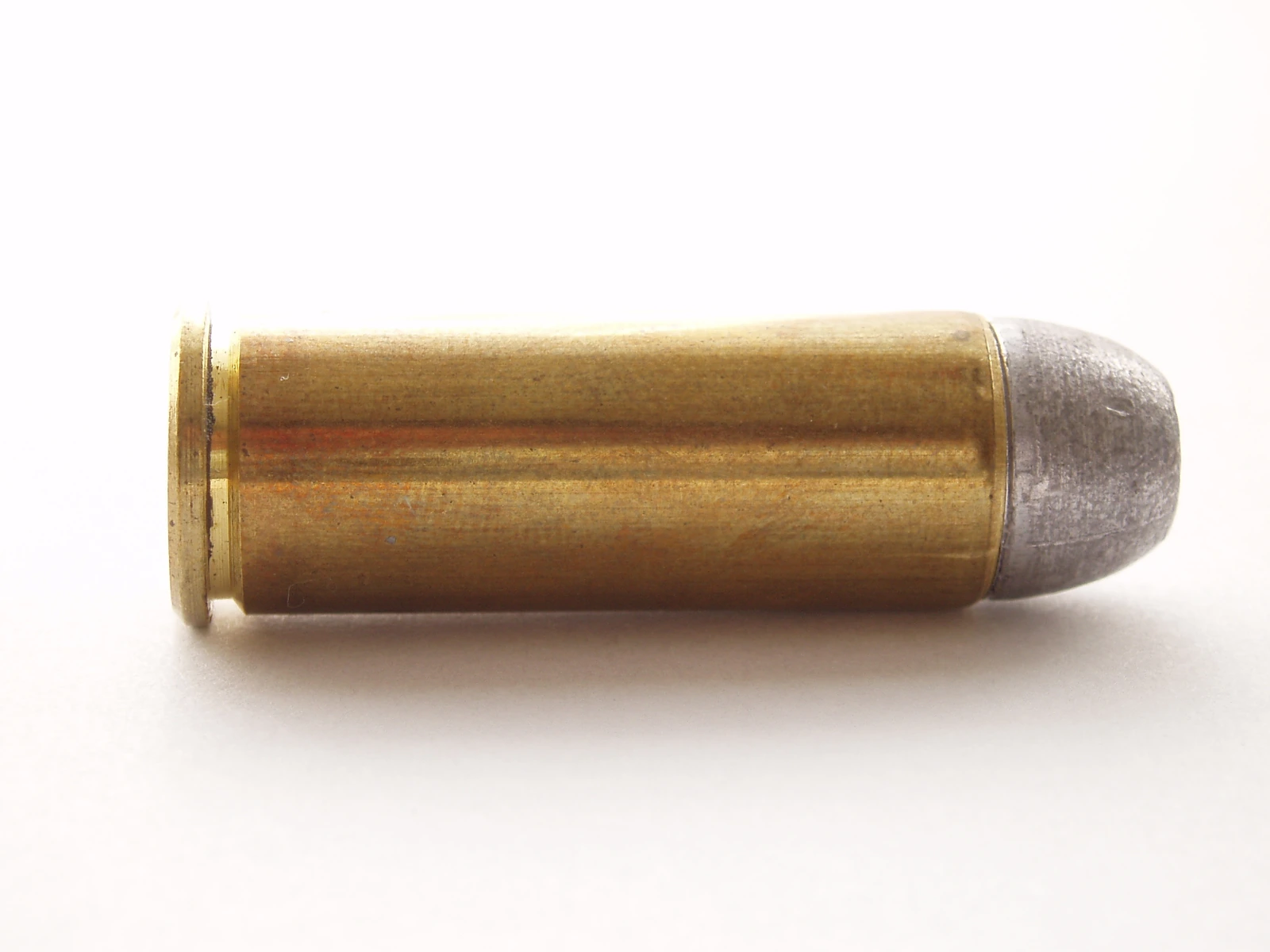
Image credit
- Title
- File:45 Colt - 1.jpg
- Author
- Malis
- Licence
- Public domain
- Source
- https://commons.wikimedia.org/wiki/File:45_Colt_-_1.jpg

Detail
Adopted with the Single Action Army in 1873 and the US Army’s handgun cartridge for the next two decades. It began as a black-powder round carrying a 250-grain lead bullet, and the case is long because black powder is bulky, not because the round is powerful.
Its rim is unusually small for the case head, a detail that mattered once revolvers began ejecting all six chambers at once: the extractor star has little to grip. Smith & Wesson’s shorter .45 Schofield had a larger rim and would chamber in a Colt, which is why the Army spent years issuing two incompatible cartridges to units carrying two incompatible revolvers.
The C.I.P. ceiling of 110 MPa reflects the antique arms still chambered for it. Modern revolvers built on heavier frames are loaded far beyond it, which is a fact about those revolvers rather than about this standard.
References
- C.I.P. TDCC datasheet — 45 Colt · 2000-06-07 · read 2026-08-31
- .45 Colt · 1368451355 · read 2026-08-31
Last verified 2026-08-31 · review status: agent-populated