
.45-70
Introduced 1873United States Army, at Springfield ArmoryCIP standard
Also known as .45-70 Government, 45-70 Govt., .45 Government, 11.6x53mmR: the same cartridge under different names, all of which find this page.
Dimensions and pressure
Generated from the schema, like every specification table on this site, so a figure recorded on this entry cannot be missing from the table.
Identity
- Designed by
- United States Army, at Springfield Armory
- Introduced
- 1873
- Production
- not recorded
- Standards body
- C.I.P.
- Case type
- Rimmed
- Case shape
- Straight
Dimensions
- Bullet diameter
- 11.63 mm0.4579 insource
Cartridge maximum, dimension G1.
- Bore diameter
- not recorded
- Case length
- 53.47 mm2.105 insource
Cartridge maximum, dimension L3.
- Overall length
- 64.77 mm2.550 insource
Cartridge maximum, dimension L6. Rifles with tubular magazines and lever actions are the constraint on how far out a bullet can be seated.
- Rim diameter
- 15.44 mm0.6079 insource
Dimension R1. The rim stands 2.6 mm proud of the base, which is what the case headspaces on.
- Neck diameter
- 12.19 mm0.4799 insource
Dimension H2.
- Base diameter
- 12.84 mm0.5055 insource
Dimension P1. The 0.65 mm of taper from base to neck is all the case has; there is no shoulder.
Pressure
- Maximum pressure
- 220 MPa31,908 psisource
Pmax 2200 bar. SAAMI rates the same chambering at 28,000 CUP by its own method, and the two figures are not interchangeable.
- Pressure standard
- C.I.P.
SAAMI and C.I.P. measure pressure differently and their figures are not interchangeable, which is why the body is always named beside the figure.
Loads
Velocity is recorded per barrel length as published. A gun page interpolates between these points and never projects beyond them.
Government rifle load, 405 gr lead round nose
Frankford Arsenal
- Bullet mass
- 26.24 g404.9 grsource
405 gr as published in the article's ballistics table, converted to grams. The table attributes the row to Springfield Armory test data published in 1874.
- Cartridge mass
- not recorded
- Bullet type
- lead round nose
- G1 BC
- not recorded
- G7 BC
- not recorded
| Barrel | Velocity |
|---|---|
| 828 mm32.60 in | 411.5 m/s1,350 fps |
Government rifle load, 500 gr lead round nose
Frankford Arsenal
- Bullet mass
- 32.4 g500.0 grsource
500 gr as published in the article's ballistics table, converted to grams. The table attributes the row to Springfield Armory test data published in 1887.
- Cartridge mass
- not recorded
- Bullet type
- lead round nose
- G1 BC
- not recorded
- G7 BC
- not recorded
| Barrel | Velocity |
|---|---|
| 828 mm32.60 in | 401 m/s1,316 fps |
Chambered in
Computed from every entry that lists this cartridge. Nothing here is hand-maintained.
No entry on the site is chambered in it yet.
Gallery
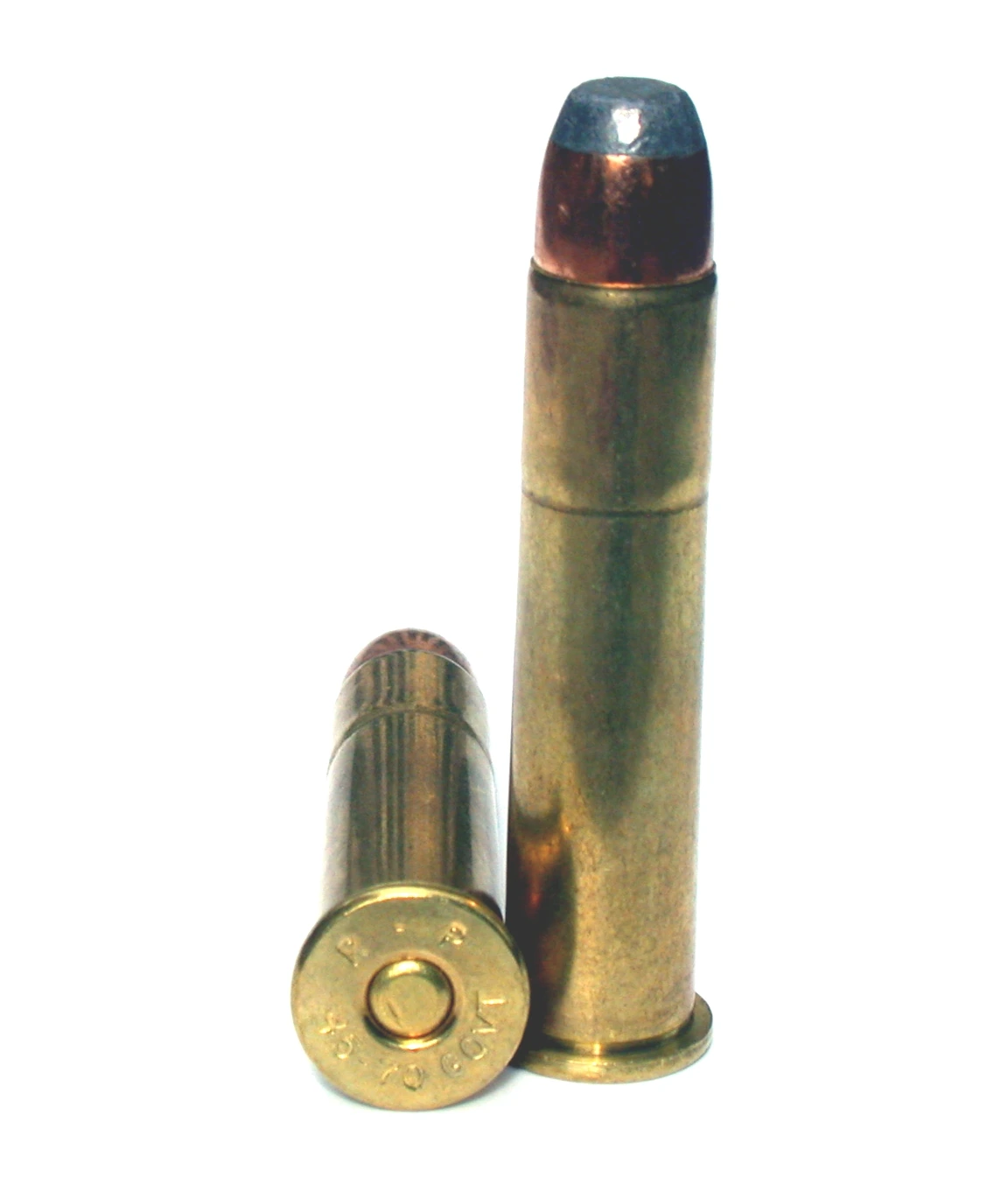
Image credit
- Title
- File:45-70 Govt.JPG
- Author
- Hmaag(attribution required)
- Licence
- CC BY 3.0
- Source
- https://commons.wikimedia.org/wiki/File:45-70_Govt.JPG

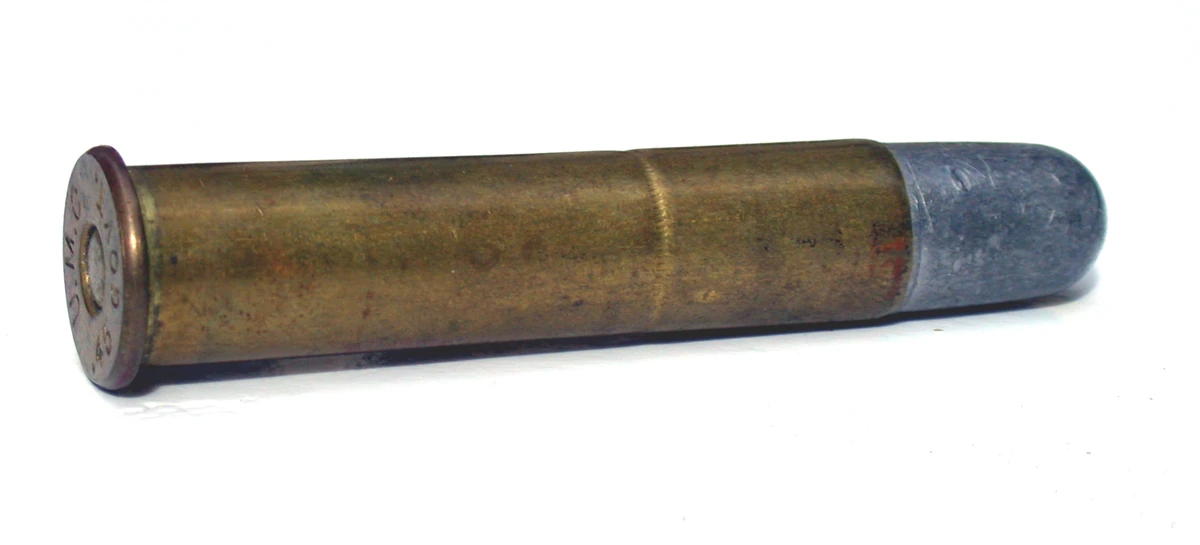
Image credit
- Title
- File:45-70 Govt Sp.JPG
- Author
- Hmaag(attribution required)
- Licence
- CC BY-SA 3.0
- Source
- https://commons.wikimedia.org/wiki/File:45-70_Govt_Sp.JPG

Detail
The .45-70 was adopted by the United States Army in 1873, with the Springfield Model 1873 built around it, to replace the stop-gap .50-70 taken up seven years earlier. It is a straight, rimmed, black-powder case that has outlived every rifle it was designed for, and it survives because its geometry suits a class of arm (the single-shot breechloader and the lever gun) that nothing since has replaced.
Nothing about the case is subtle. It is 53.47 mm long and tapers only 0.65 mm from a base of 12.84 mm to a neck of 12.19 mm, so there is no shoulder to headspace on and the job falls to a rim standing 2.6 mm proud of the base. That rim is why the round still works in falling-block and lever actions: extraction depends on a positive flange rather than on a groove, and a rimmed case will feed from a tubular magazine that has no way to control a rimless one. The bullet is 11.63 mm across and blunt, because a tubular magazine stacks primer against bullet nose and a pointed one is not welcome there.
Two service loads are recorded here, both from Springfield Armory’s own test data: a 405-grain rifle round published in 1874 and a heavier 500-grain round published in 1887, the first at about 411 m/s and the second at about 401 m/s from the rifle’s 32.6-inch barrel. A third, deliberately reduced, carbine round existed for the shorter Springfield carbine. The Army’s own tests put the 1873 rifle at 19,000 psi and the Model 1884 firing the heavier bullet at 25,000 psi, figures that explain why modern loading data for this cartridge is published in three separate pressure tiers according to what action the round is going into.
The .45-70 left front-line service in 1893 when the Army adopted the .30-40 Krag, lingered with the National Guard, Navy and Marine Corps until 1897, and was last used in quantity in 1898. It remains a US military item in one form: the caliber .45 M32 line-throwing blank.
Gaps on this page: the two loads are the encyclopedia’s ballistics table, which attributes them to Springfield Armory publications of 1874 and 1887 (books, not clickable documents) and states one 32.6-inch test barrel for the table as a whole; the carbine round is not recorded because no barrel length is published beside it, and the modern high-pressure handloading rows in the same table are not recorded because they are loading-manual data rather than a factory measurement. No ballistic coefficient is given for either bullet. The C.I.P. dimensions transcribed here are the modern commercial maxima and are not necessarily the 1873 arsenal drawing.
References
- C.I.P. TDCC datasheet, 45-70 Govt. · Tab. II, adopted 1984-06-14, revised 2002-05-15 · read 2026-09-01
- .45-70 · 1367008470 · read 2026-09-01
Last verified 2026-09-01 · review status: agent-populated