
.30-40 Krag
Introduced 1892CIP standard
Also known as .30 U.S., .30 Army: the same cartridge under different names, all of which find this page.
Dimensions and pressure
Generated from the schema, like every specification table on this site, so a figure recorded on this entry cannot be missing from the table.
Identity
- Designed by
- not recorded
- Introduced
- 1892
- Production
- not recorded
- Standards body
- C.I.P.
- Case type
- Rimmed
- Case shape
- Bottleneck
Dimensions
- Bullet diameter
- 7.85 mm0.3091 insource
C.I.P. G1, maximum bullet diameter.
- Bore diameter
- not recorded
- Case length
- 58.78 mm2.314 insource
C.I.P. L3, maximum case length.
- Overall length
- 78.46 mm3.089 insource
C.I.P. L6, maximum cartridge overall length.
- Rim diameter
- 13.84 mm0.5449 insource
C.I.P. R1.
- Neck diameter
- 8.59 mm0.3382 insource
C.I.P. H2.
- Base diameter
- 11.71 mm0.4610 insource
C.I.P. P1.
Pressure
- Maximum pressure
- 325 MPa47,137 psisource
C.I.P. Pmax 3250 bar; 1 bar = 0.1 MPa exactly. Wikipedia's cited SAAMI figure (47,137 psi / 325 MPa) agrees closely with this.
- Pressure standard
- C.I.P.
SAAMI and C.I.P. measure pressure differently and their figures are not interchangeable, which is why the body is always named beside the figure.
Loads
Velocity is recorded per barrel length as published. A gun page interpolates between these points and never projects beyond them.
Hornady Custom 180 gr spire point
Hornady
- Bullet mass
- 11.66 g179.9 grsource
Published as 180 grains.
- Cartridge mass
- not recorded
- Bullet type
- SP
- G1 BC
- not recorded
- G7 BC
- not recorded
| Barrel | Velocity |
|---|---|
| 609.6 mm24.00 in | 740.8 m/s2,430 fps |
Chambered in
Computed from every entry that lists this cartridge. Nothing here is hand-maintained.
No entry on the site is chambered in it yet.
Gallery
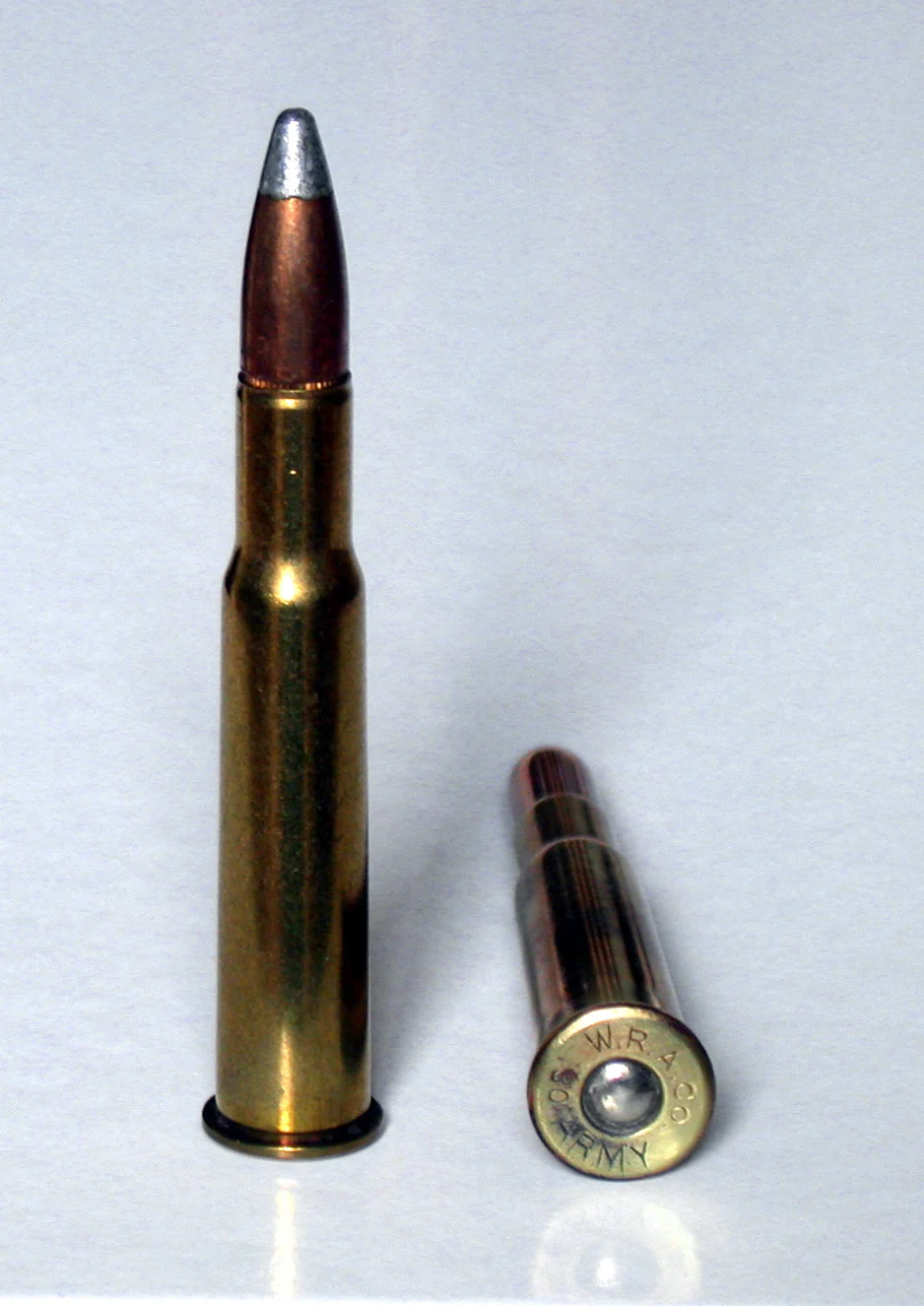
Image credit
- Title
- File:30-40 Krag.JPG
- Author
- Hmaag(attribution required)
- Licence
- CC BY-SA 3.0
- Source
- https://commons.wikimedia.org/wiki/File:30-40_Krag.JPG

Detail
The .30-40 Krag, originally designated the .30 U.S. or .30 Army, is a rimmed, bottlenecked rifle cartridge adopted by the United States in 1892 for the Krag–Jørgensen rifle. It was the first smokeless-powder cartridge issued by the US military, replacing the black-powder .45-70 Government and its trapdoor Springfield, and it saw combat in the Spanish–American War before the US Army replaced both rifle and cartridge with the M1903 Springfield and the rimless .30-03 in the early 1900s.
Its name follows the black-powder-era convention of pairing bore diameter with a second number that described the original loading rather than any dimension of the cartridge. At a 325 MPa C.I.P. pressure ceiling and a rimmed, single-locking-lug action behind it, the Krag rifle could not be loaded as fast from a magazine as its rimless European contemporaries, one of the technical shortcomings that pushed the US Army toward the rimless Mauser-influenced M1903 within a decade.
This entry carries the full C.I.P. dimensional standard and one current factory load, Hornady’s Custom 180-grain spire point rated at 740.8 m/s from a stated 24-inch test barrel; this reflects a modern sporting-rifle loading, not the original 1892 military charge. No ballistic coefficient is published on that product page, so the cartridge computes a muzzle energy figure but no trajectory.
References
- .30-40 Krag · 1366000609 · read 2026-09-01
- C.I.P. TDCC datasheet — 30-40 Krag · 2011-05-25 · read 2026-09-01
- 30-40 Krag 180 gr SP Custom (product page) · read 2026-09-01
Last verified 2026-09-01 · review status: agent-populated