
.410 bore
Introduced 1874CIP standard
Also known as .410, 410/63,5, 410/76, 36 gauge: the same cartridge under different names, all of which find this page.
Dimensions and pressure
Generated from the schema, like every specification table on this site, so a figure recorded on this entry cannot be missing from the table.
Identity
- Designed by
- not recorded
- Introduced
- 1874
- Production
- not recorded
- Standards body
- C.I.P.
- Case type
- Shotshell
- Case shape
- not recorded
Dimensions
- Bullet diameter
- not recorded
- Bore diameter
- 10.41 mm0.4098 insource
Bore diameter of the SAAMI 410 bore standard smoothbore velocity and pressure test barrel, .410 in +.005.
- Case length
- 63.5 mm2.500 insource
Cartridge maximum for the 410/63,5 shell, dimension l. This is the fired length of the unfolded case, which the chamber must accept; the same datasheet lists 50.7, 65, 69.8, 72.8 and 76 mm shells sharing every other dimension.
- Overall length
- 60.96 mm2.400 insource
Loaded length of the roll-crimped 2½ in shell, 2.400 in, from the SAAMI 410 Bore 2½ in cartridge and chamber drawing. The folded-crimp figure on the same drawing is 2.360 in.
- Rim diameter
- 13.6 mm0.5354 insource
Cartridge maximum, dimension g.
- Neck diameter
- not recorded
- Base diameter
- 12 mm0.4724 insource
Cartridge maximum, dimension d.
Pressure
- Maximum pressure
- 83 MPa12,038 psisource
Pmax for the 410/63,5 shell, 830 bar. The 72.8 and 76 mm shells are rated at 1050 bar on the same sheet.
- Pressure standard
- C.I.P.
SAAMI and C.I.P. measure pressure differently and their figures are not interchangeable, which is why the body is always named beside the figure.
Loads
Velocity is recorded per barrel length as published. A gun page interpolates between these points and never projects beyond them.
Power-Shok 1/4 oz rifled slug
Federal
- Bullet mass
- 7.063 g109.0 grsource
109 gr as published, converted to grams. A quarter of an ounce, in a 2½ in shell.
- Cartridge mass
- not recorded
- Bullet type
- Rifled hollow point slug
- G1 BC
- 0.071source
Ballistic coefficient .071 as published.
- G7 BC
- not recorded
| Barrel | Velocity |
|---|---|
| 660.4 mm26.00 in | 541 m/s1,775 fps |
Chambered in
Computed from every entry that lists this cartridge. Nothing here is hand-maintained.
- M6 aircrew survival weapon
Ithaca Gun Company
- Taurus Judge
Taurus Armas
Gallery
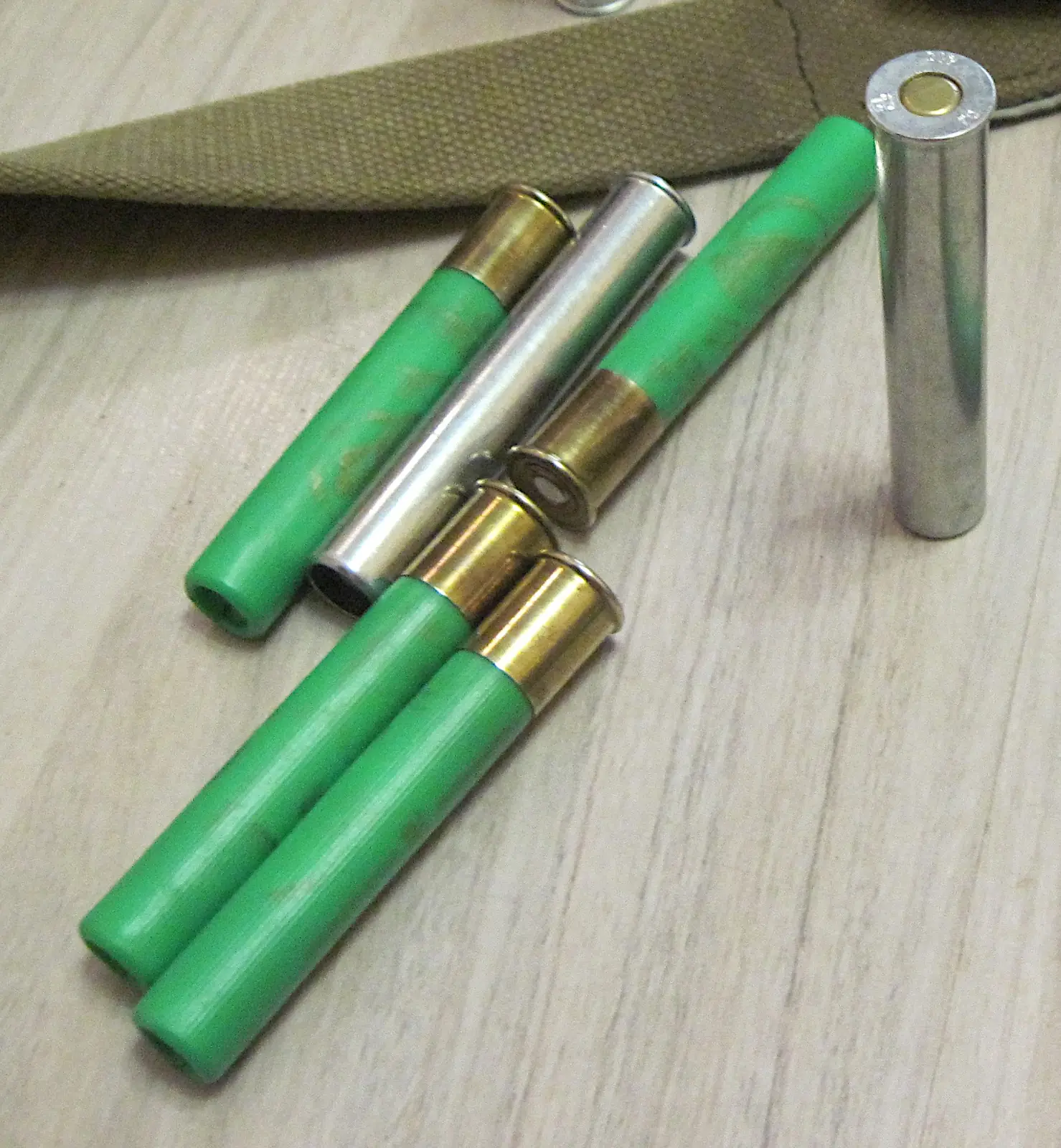
Image credit
- Title
- File:.410 bore cartridges.jpg
- Author
- Yan.gorev(attribution required)
- Licence
- CC BY-SA 4.0
- Source
- https://commons.wikimedia.org/wiki/File:.410_bore_cartridges.jpg

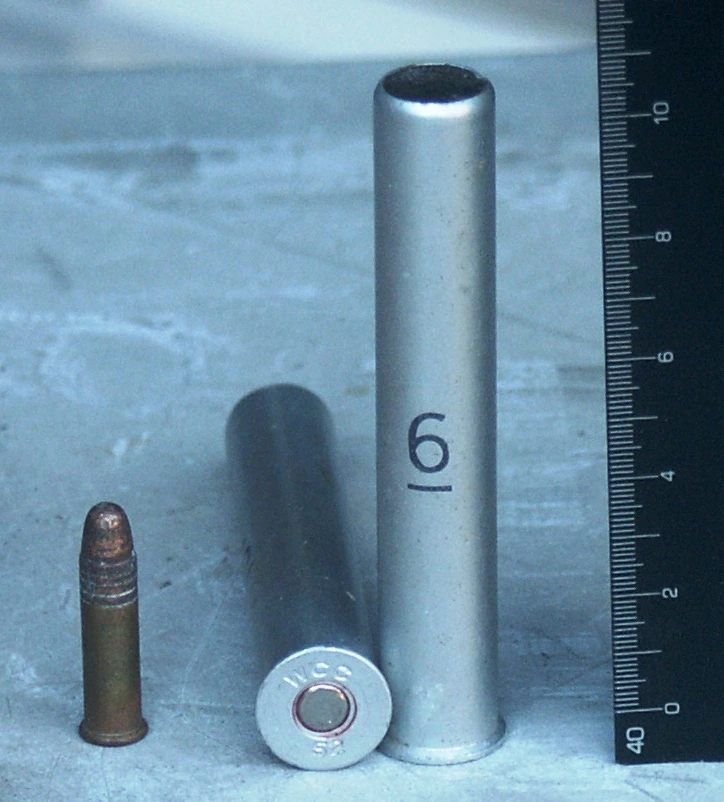
Image credit
- Title
- File:410 bore M-35 shotgun shells.jpg
- Author
- Divingpetrel(attribution required)
- Licence
- CC BY-SA 3.0
- Source
- https://commons.wikimedia.org/wiki/File:410_bore_M-35_shotgun_shells.jpg

Detail
The .410 is the one shotshell that is not named as a gauge. Every other British shot cartridge counts how many bore-diameter lead balls make a pound; this one is simply the bore in inches, because when Eley began loading it in the 1870s it was a small-game and garden-gun cartridge rather than a member of the gauge series. The continental name for it, 36 gauge, is a retrofit, and the arithmetic does not work: a genuine 36-gauge bore would measure about 0.506 in.
Everything about the round follows from a bore narrower than a .45 pistol barrel. A shot column of a given weight can only get taller, so a .410 load stacks its pellets several deep instead of spreading them across the base of the wad, and the column deforms more of them against the barrel wall on the way out. That is why the cartridge is loaded light (a quarter to eleven-sixteenths of an ounce, against an ounce and an eighth in 20 gauge) and why it is a close-range cartridge in practice as well as in reputation. The straight, rimmed case has the same head and rim on every shell in the family; only the length changes, and C.I.P. standardises six of them on one datasheet, from 50.7 mm to 76 mm.
The narrow case head is also what makes the round unusual outside shotguns. It is close enough in rim and base diameter to .45 Colt that a revolver chambered long enough for a .410 shell will accept both, which is the basis of a family of American revolvers and derringers sold as dual-calibre guns, and the 2½ in shell is the one those chambers are usually cut for.
Gaps on this page: the entry records the 63.5 mm shell throughout, because the head dimensions are common to the whole family and the case length is not; the 76 mm magnum shell is rated at 1050 bar rather than 830 on the same C.I.P. sheet, and that figure is noted rather than stored. Federal publishes the slug velocity without naming a test barrel, so the barrel length recorded with it is SAAMI’s 26-inch standard test barrel and is marked as an estimate; the velocity itself is the published one. No shot load is recorded at all, because a shot charge has no single projectile mass to enter and choosing one would be inventing a fact the cartridge does not have.
References
- C.I.P. TDCC datasheet, Cal. 410 · Tab. VII, dated 1984-06-14, revision 2016-05-18 · read 2026-08-31
- ANSI/SAAMI Z299.2, Shotshell Ammunition · Z299.2-2019, approved 2025-09-23 · read 2026-08-31
- Power-Shok Rifled Slug, 410 Bore, 109 grain, 2-1/2 in (F412 RS) · read 2026-08-31
- .410 bore · 1358916918 · read 2026-08-31
Last verified 2026-08-31 · review status: agent-populated