
.32 S&W
Introduced 1878Union Metallic Cartridge CompanyCIP standard
Dimensions and pressure
Generated from the schema, like every specification table on this site, so a figure recorded on this entry cannot be missing from the table.
Identity
- Designed by
- Union Metallic Cartridge Company
- Introduced
- 1878
- Production
- not recorded
- Standards body
- C.I.P.
- Case type
- Rimmed
- Case shape
- Straight
Dimensions
- Bullet diameter
- 8 mm0.3150 insource
Dimension G1.
- Bore diameter
- not recorded
- Case length
- 15.37 mm0.6051 insource
Cartridge maximum, dimension L3.
- Overall length
- 23.62 mm0.9299 insource
Dimension L6.
- Rim diameter
- 9.6 mm0.3780 insource
Dimension R1.
- Neck diameter
- not recorded
- Base diameter
- 8.61 mm0.3390 insource
Dimension P1.
Pressure
- Maximum pressure
- 90 MPa13,053 psisource
Pmax 900 bar, C.I.P. method.
- Pressure standard
- C.I.P.
SAAMI and C.I.P. measure pressure differently and their figures are not interchangeable, which is why the body is always named beside the figure.
Loads
Velocity is recorded per barrel length as published. A gun page interpolates between these points and never projects beyond them.
85 gr Lead
- Bullet mass
- 5.51 g85.03 grestimated
Cartridges of the World, via the Wikipedia infobox. No test-barrel length is stated for the load's published velocity, so velocity is not recorded.
- Cartridge mass
- not recorded
- Bullet type
- Lead
- G1 BC
- not recorded
- G7 BC
- not recorded
98 gr Lead
- Bullet mass
- 6.35 g98.00 grestimated
Cartridges of the World, via the Wikipedia infobox. No test-barrel length is stated, so velocity is not recorded.
- Cartridge mass
- not recorded
- Bullet type
- Lead
- G1 BC
- not recorded
- G7 BC
- not recorded
Chambered in
Computed from every entry that lists this cartridge. Nothing here is hand-maintained.
No entry on the site is chambered in it yet.
Gallery
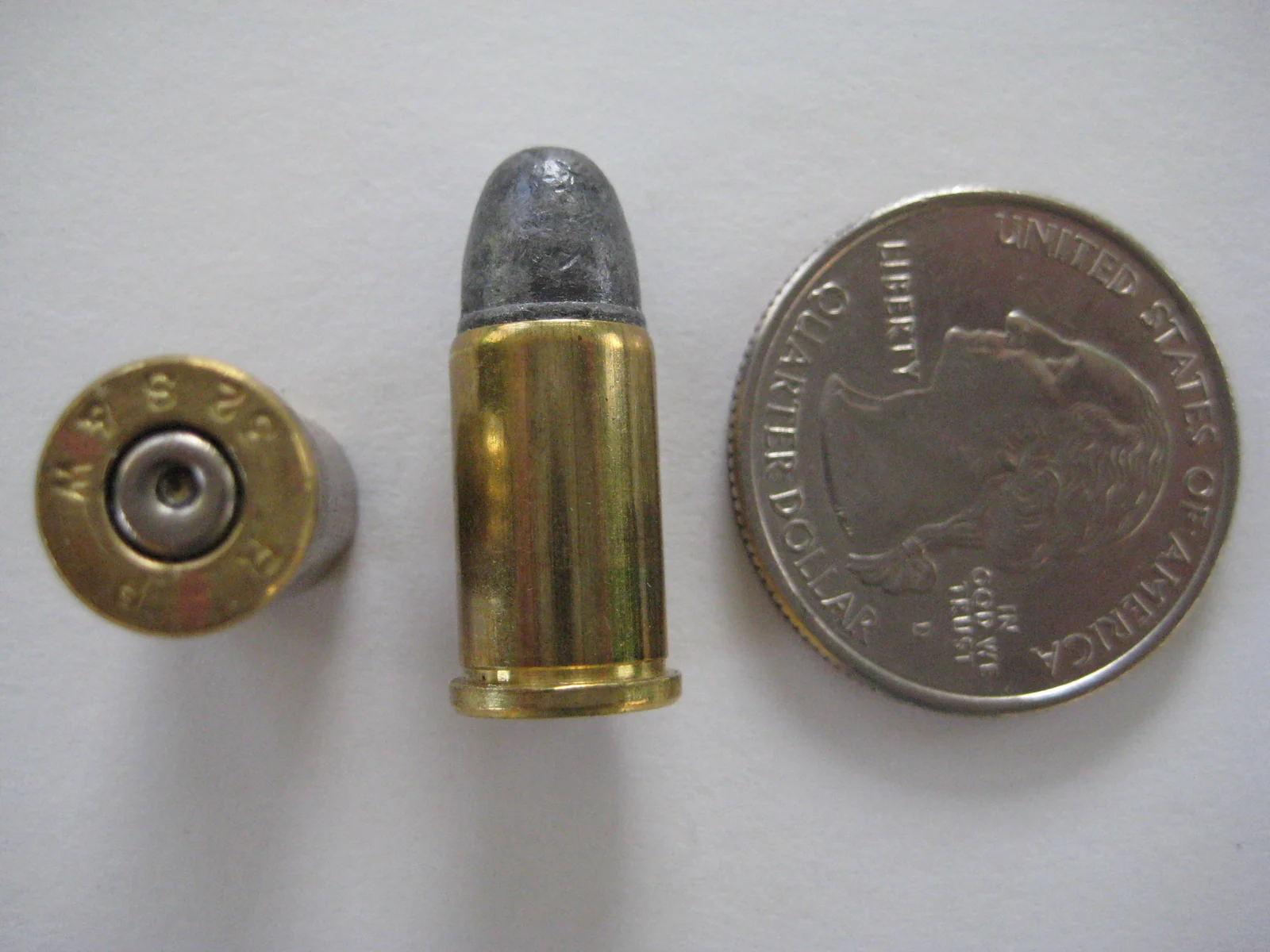
Image credit
- Title
- File:Cartridge32sw.JPG
- Author
- MatthewVanitas(attribution required)
- Licence
- CC BY-SA 3.0
- Source
- https://commons.wikimedia.org/wiki/File:Cartridge32sw.JPG

Detail
The .32 S&W, also known as the .32 S&W Short, is a rimmed, straight-walled revolver cartridge the Union Metallic Cartridge Company designed and Smith & Wesson introduced in 1878 for its pocket revolvers. It was offered to the public as a light defensive cartridge for very short distances, and it remained popular in the United States and Europe long after the revolvers made for it were out of production.
It was the basis for several later .32-calibre handgun cartridges, among them the .32 S&W Long, the .32 H&R Magnum and the .327 Federal Magnum, and it can be fired safely in revolvers chambered for any of the three.
All dimensional and pressure figures on this page come from C.I.P.’s published standard and are recorded as verified. Two bullet weights are recorded from a published loading reference cited by Wikipedia’s infobox, but no test-barrel length is stated for either load’s velocity, so no velocity or energy is recorded for this cartridge. No photograph of a revolver chambered for it appears on this site.
References
- .32 S&W · 1373039544 · read 2026-09-24
- C.I.P. TDCC datasheet — 32 S&W · 2008-09-23 · read 2026-09-24
Last verified 2026-09-24 · review status: agent-populated