
.280 British
Introduced 1945
Dimensions and pressure
Generated from the schema, like every specification table on this site, so a figure recorded on this entry cannot be missing from the table.
Identity
- Designed by
- not recorded
- Introduced
- 1945
- Production
- not recorded
- Standards body
- No standards body
- Case type
- Rimless
- Case shape
- Bottleneck
Dimensions
- Bullet diameter
- 7.21 mm0.2839 inestimated
Converted from .284 in, Cartridges of the World, via the Wikipedia infobox.
- Bore diameter
- not recorded
- Case length
- 43.43 mm1.710 inestimated
Converted from 1.71 in, Cartridges of the World, via the Wikipedia infobox. No free dimensional standard exists for this experimental British military round; it never reached C.I.P. or SAAMI standardisation.
- Overall length
- 64.52 mm2.540 inestimated
Converted from 2.54 in, Cartridges of the World, via the Wikipedia infobox.
- Rim diameter
- 12.01 mm0.4728 inestimated
Converted from .473 in, Cartridges of the World, via the Wikipedia infobox.
- Neck diameter
- 7.95 mm0.3130 inestimated
Converted from .313 in, Cartridges of the World, via the Wikipedia infobox.
- Base diameter
- 11.94 mm0.4701 inestimated
Converted from .470 in, Cartridges of the World, via the Wikipedia infobox.
Pressure
- Maximum pressure
- 310.3 MPa45,005 psiestimated
Converted from a published 45,000 psi figure, Cartridges of the World, via the Wikipedia infobox.
- Pressure standard
- SAAMI
SAAMI and C.I.P. measure pressure differently and their figures are not interchangeable, which is why the body is always named beside the figure.
Loads
Velocity is recorded per barrel length as published. A gun page interpolates between these points and never projects beyond them.
139 gr Ball
- Bullet mass
- 9.01 g139.0 grestimated
139 gr ball bullet, Cartridges of the World, via the Wikipedia infobox. No test-barrel length is stated for the load's published velocity, so velocity is not recorded.
- Cartridge mass
- not recorded
- Bullet type
- Ball
- G1 BC
- not recorded
- G7 BC
- not recorded
140 gr Ball Mk 1Z
- Bullet mass
- 9.07 g140.0 grestimated
140 gr ball bullet, Mk 1Z loading, Cartridges of the World, via the Wikipedia infobox. No test-barrel length is stated, so velocity is not recorded.
- Cartridge mass
- not recorded
- Bullet type
- Ball
- G1 BC
- not recorded
- G7 BC
- not recorded
Chambered in
Computed from every entry that lists this cartridge. Nothing here is hand-maintained.
No entry on the site is chambered in it yet.
Gallery
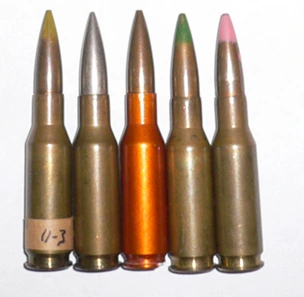
Image credit
- Title
- File:280british.jpg
- Author
- JamesL85 at English Wikipedia
- Licence
- Public domain
- Source
- https://commons.wikimedia.org/wiki/File:280british.jpg

Detail
The British Army designed this cartridge after studying the German 7.92×33mm Kurz encountered during the Second World War, an intermediate round sized between a pistol cartridge and a full-power rifle round that let a shoulder-fired weapon fire automatically with controllable recoil. Britain set out to build its own intermediate round with a longer effective range than the Kurz, and paired it with a purpose-built rifle, the EM-2, alongside trials in the Lee-Enfield, the FN FAL and the Bren.
The round never reached service. Comparative testing against the American T65 cartridge at Aberdeen Proving Ground in 1950 went against it (the US Army held that the .280 British did not meet its requirements, citing accuracy and armour-piercing shortfalls), and a change of British government under Winston Churchill, who prioritised cartridge commonality within NATO, ended the programme. NATO standardised the American design as 7.62×51mm NATO instead.
No free dimensional standard exists for a cartridge that never reached production, so every figure in this
entry is converted from the reference work Cartridges of the World and carries estimated status. No
test-barrel length is published for either of its two loads, so only bullet mass is recorded for each.
References
- .280 British · 1333125650 · read 2026-09-09
Last verified 2026-09-09 · review status: agent-populated