
7.92×33mm Kurz
7,92 × 33 mm Kurz
Introduced 1938Polte ammunition works, MagdeburgCIP standard
Also known as 7.9mm Kurzpatrone, 8mm Kurz: the same cartridge under different names, all of which find this page.
Dimensions and pressure
Generated from the schema, like every specification table on this site, so a figure recorded on this entry cannot be missing from the table.
Identity
- Designed by
- Polte ammunition works, Magdeburg
- Introduced
- 1938
- Production
- not recorded
- Standards body
- C.I.P.
- Case type
- Rimless
- Case shape
- Bottleneck
Dimensions
- Bullet diameter
- 8.22 mm0.3236 insource
C.I.P. G1, maximum bullet diameter.
- Bore diameter
- not recorded
- Case length
- 33 mm1.299 insource
C.I.P. L3, maximum case length.
- Overall length
- 48 mm1.890 insource
C.I.P. L6, maximum cartridge overall length.
- Rim diameter
- 11.95 mm0.4705 insource
C.I.P. R1.
- Neck diameter
- 9.04 mm0.3559 insource
C.I.P. H2.
- Base diameter
- 11.94 mm0.4701 insource
C.I.P. P1.
Pressure
- Maximum pressure
- 340 MPa49,313 psisource
C.I.P. Pmax 3400 bar; 1 bar = 0.1 MPa exactly.
- Pressure standard
- C.I.P.
SAAMI and C.I.P. measure pressure differently and their figures are not interchangeable, which is why the body is always named beside the figure.
Loads
Velocity is recorded per barrel length as published. A gun page interpolates between these points and never projects beyond them.
Service ball
- Bullet mass
- 8.1 g125.0 grsource
Ballistics table of the cited article, which publishes bullet mass in grams.
- Cartridge mass
- not recorded
- Bullet type
- FMJ
- G1 BC
- not recorded
- G7 BC
- not recorded
| Barrel | Velocity |
|---|---|
| 419 mm16.50 in | 685 m/s2,247 fps |
Chambered in
Computed from every entry that lists this cartridge. Nothing here is hand-maintained.
No entry on the site is chambered in it yet.
Gallery
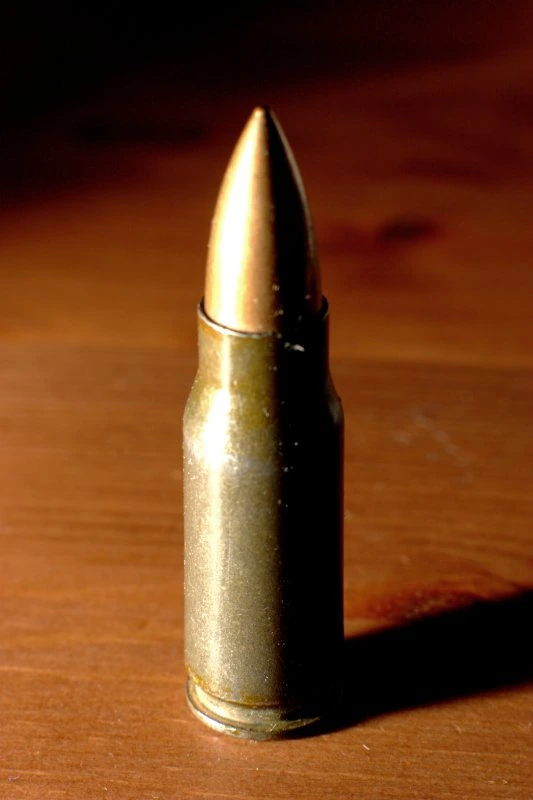
Image credit
- Title
- File:German 7.92x33mm Kurz.jpg
- Author
- User Cbh on en.wikipedia(attribution required)
- Licence
- CC BY-SA 3.0
- Source
- https://commons.wikimedia.org/wiki/File:German_7.92x33mm_Kurz.jpg

Detail
The first intermediate cartridge to be issued in quantity, and the argument that every rifle cartridge since has had to answer. German infantry studies in the 1930s established that almost all rifle fire happened inside 400 m, and that the 7.92×57mm round every soldier carried was specified for four times that. Polte’s answer was to keep the bullet diameter and cut the case nearly in half.
The result gives up roughly half the muzzle energy of the full-power round and becomes controllable in automatic fire from a shoulder weapon, which is the trade the assault rifle is built on. The Soviet 7.62×39mm followed it in 1943 and the American 5.56×45mm followed both, by a different route, twenty years later.
Its name is the argument in miniature: Kurz simply means short, and what was shortened was the case of the cartridge Germany had been issuing since 1888.
References
- C.I.P. TDCC datasheet — 7,92 x 33 kurz · 2014-05-20 · read 2026-08-31
- 7.92×33mm Kurz · 1345370824 · read 2026-08-31
Last verified 2026-08-31 · review status: agent-populated