British · Dessert
Victoria Sponge
Two equal-weight sponge layers, sandwiched with jam and dusted with sugar, with no icing to cover the crumb.
Also known asVictoria sandwich · Britain
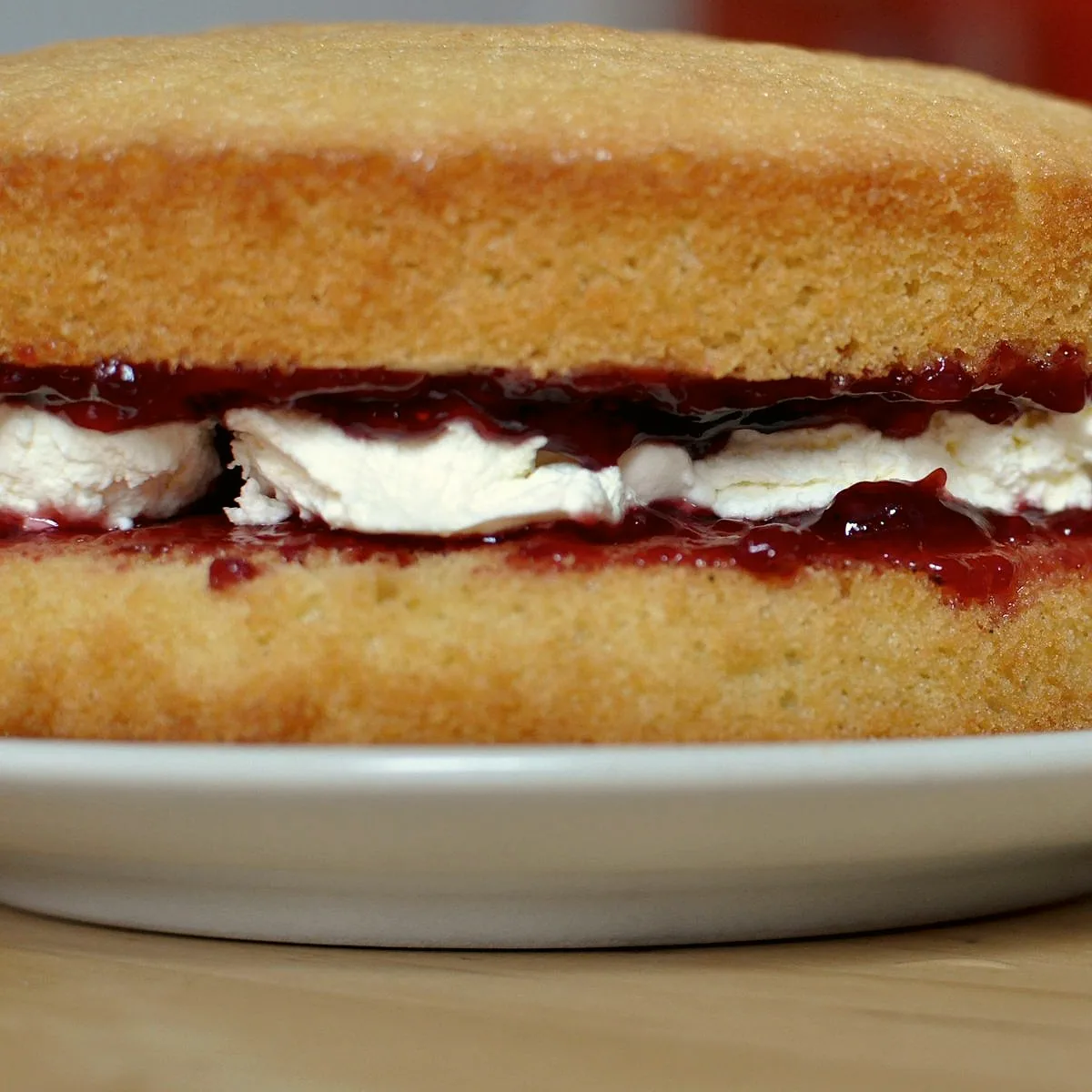

CC BY 2.0. Cropped and colour-adjusted for this site.
Method
Beat the 200 g unsalted butter and the 190 g caster sugar together until pale, light and fluffy.
Creaming the butter and sugar until genuinely pale and fluffy beats air into the fat in tiny bubbles, which is most of the sponge's rise; the raising agent only holds open what creaming has already put there.
Beat in the 4 eggs (200 g) a little at a time, along with the 5 g vanilla extract, beating well between additions.
Sift the 200 g self-raising flour and the 4 g baking powder over the mixture and fold in gently with a large metal spoon until just combined.
Common pitfallStirring the flour in briskly knocks out the air just beaten in and develops gluten, leaving a dense, tough crumb. It is folded in gently, in as few strokes as it takes to disappear.
Divide the batter evenly between two lined sandwich tins and bake at 180 °C for 25m, until well risen, golden, and springing back when pressed lightly in the centre.
Turn out onto a wire rack and leave to cool completely, for 20m, before filling.
Spread the 150 g raspberry jam over the flat side of one sponge, set the second sponge on top, and dust with the 10 g caster sugar.
The buttery sponge now called Victoria sponge is a specifically Victorian invention, and not only because of the queen it is named for. A sponge batter heavy with butter needs more lift than beaten egg alone reliably gives it, and that limitation lifted only in 1843, when the British food manufacturer Alfred Bird invented baking powder, making it possible to add butter and still achieve a high, even rise [1][3]. The cake could not exist in its modern form before the ingredient that defines its texture did.
The cake's association with Queen Victoria herself is the part resting on tradition rather than documentation. It is widely said to have been a favourite of hers at afternoon tea [1][3], and one of the earliest written references to it appears as "Victoria Sandwiches" in Isabella Beeton's Book of Household Management [3]. One complication worth noting: English Heritage's account suggests the cake may first have been devised as a children's alternative to fruit and seed cake, which early Victorian households considered unsafe for young diners, and only later moved from the nursery to the adult tea table [2]. Afternoon tea as a fixed social occasion is itself a later development than popularly assumed; it does not appear to have become established practice until cookery books of the 1870s and 1880s began circulating it [2], which sits awkwardly with the image of a mid-century queen presiding over it from the start.
What has stayed constant is the cake's refusal to dress itself up: two plain layers, jam and nothing else between them, and a dusting of sugar rather than icing on top [1][2]. Whatever the exact path from nursery or drawing room to national institution, that plainness is the whole point; it is a cake built to be judged on crumb alone.
Sources
- Victoria sponge, WikipediaOn the cake's traditional jam-only filling and plain sugar-dusted top.
- The Queen and her Cakes, English HeritageOn the Victoria sponge's likely origin as a safer nursery alternative to fruit and seed cake, and on afternoon tea's spread through cookery books in the 1870s and 1880s.
- Victoria Sponge Cake, Backyard Poultry (Countryside)On Alfred Bird's 1843 invention of baking powder, and on "Victoria Sandwiches" appearing in Mrs Beeton's Book of Household Management.