Chinese · Main Course
Tomato and Egg Stir-Fry
Egg scrambled quickly and set aside, then folded back through tomato cooked down to a loose, savoury-sweet sauce.
Also known asXihongshi chao jidan
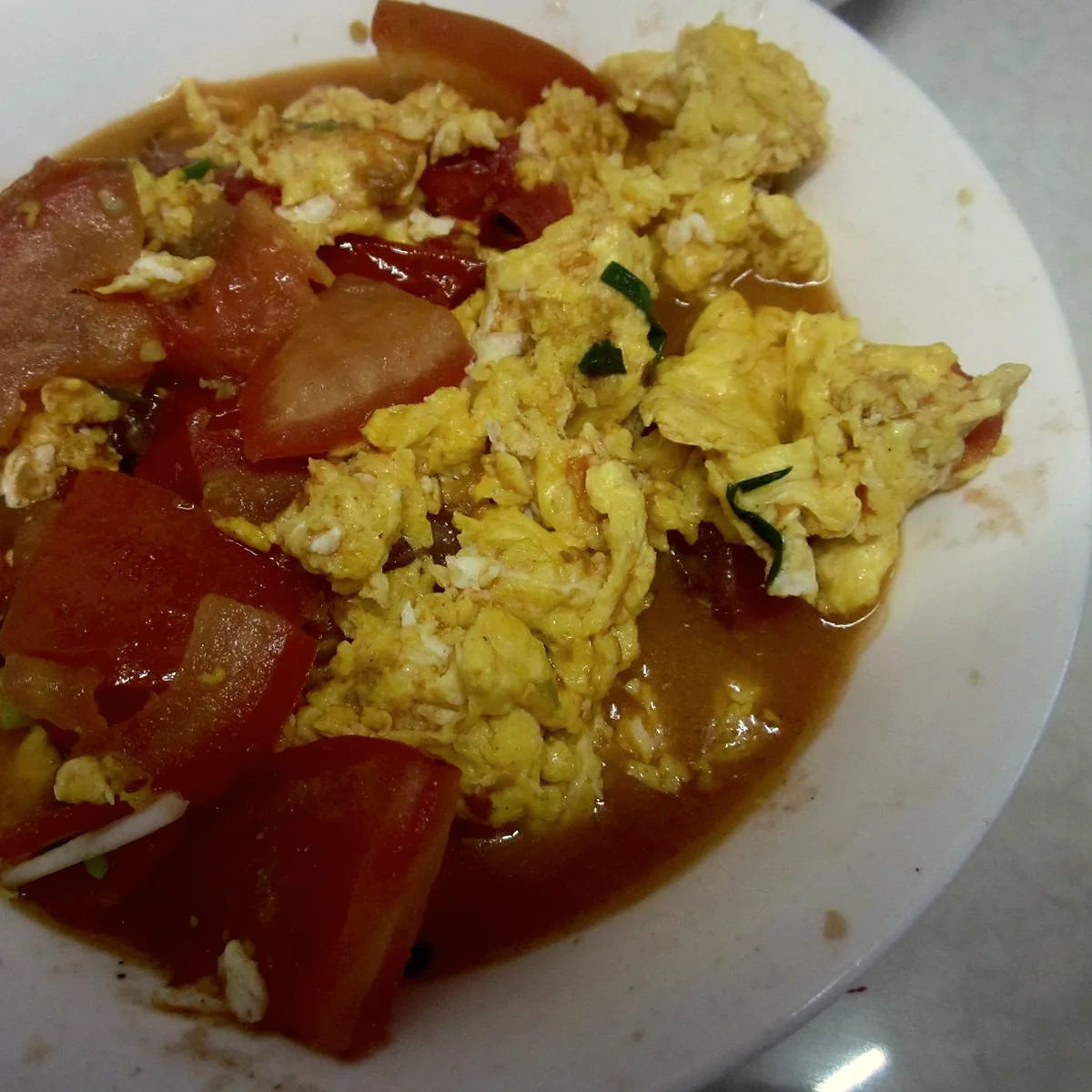

CC BY 3.0. Cropped and colour-adjusted for this site.
Method
Beat the 4 eggs (200 g) with the 2 g fine sea salt. Heat the 20 ml vegetable oil in a wok over high heat and pour in the egg, stirring briefly for 3m to large, soft curds, just set. Lift out and set aside.
Heat the 15 ml peanut oil in the same wok and add the 400 g ripe tomatoes. Cook for 6m, pressing gently, until the wedges soften and slump into their own juice.
Cooking the tomato wedges until they slump and release their juice, rather than stopping while they still hold their shape, is what builds the loose sauce the egg is folded back into; a briefly cooked tomato stays watery and separate instead.
Stir in the 8 g caster sugar and 2 g fine sea salt, then return the scrambled egg to the wok and fold through gently for 2m, until just combined. Finish with the 1 ½ spring onions (20 g).
Eggs have been cooked in China for thousands of years, but the tomato has not: as a fruit native to the Americas, it could not reach a Chinese kitchen before contact with the wider world, which makes this dish, for all its present-day ubiquity, considerably younger than most of what sits beside it on a home table.
The standard account places that contact in Shanghai, where Western-style restaurants serving tomatoes are said to have introduced the ingredient to local cooks, who folded it into their own cooking before the pairing spread from restaurant menus into ordinary home kitchens [1] [3]. That is not the only theory on offer: at least one food historian argues for an older and more eastern route, tracing a family resemblance between this dish and the egg-and-tomato cooking of the Middle East, such as shakshuka, and suggesting the pairing may have travelled along the same trade routes that carried other Silk Road foods into China long before Shanghai's Western restaurants existed [2]. Neither account rests on strong documentary evidence, and the dish's own historians are candid that the record is thinner than its fame would suggest.
What is not in dispute is how completely the dish has settled into home cooking since. It varies by region in small, telling ways (cooked saltier in the north, sweetened with a pinch of sugar in the south), but the basic method, egg scrambled and set aside, then folded back through tomato cooked down to a loose sauce, is recognised everywhere as one of the first dishes a home cook in China learns.
Sources
- Stir-fried tomato and scrambled eggs, WikipediaOn the dish's development in the late Qing and early Republican era through contact with Western restaurants in Shanghai, and its move from restaurant menus to home cooking by the 1940s.
- Culinary History Mystery 6 — Tomato Eggs, Silk Road GourmetProposes a separate route of transmission via Arab shakshuka-style egg-and-tomato dishes carried along trade routes, and notes how thin the documentary record actually is.
- From Tomatl to Stir-Fried Tomatoes and Eggs, Confluence, NYU GallatinCites the writer Lao She's 1935 complaint that tomato had recently begun appearing on the menus of upscale Western-style restaurants in China, corroborating a restaurant-first route into Chinese cooking.