Chinese · Main Course
Steamed Fish with Ginger and Scallion
A whole white fish steamed just to the point of flaking, dressed with soy sauce and finished with a sizzling ladle of hot oil poured over ginger and spring onion.
Also known asChing jing yu
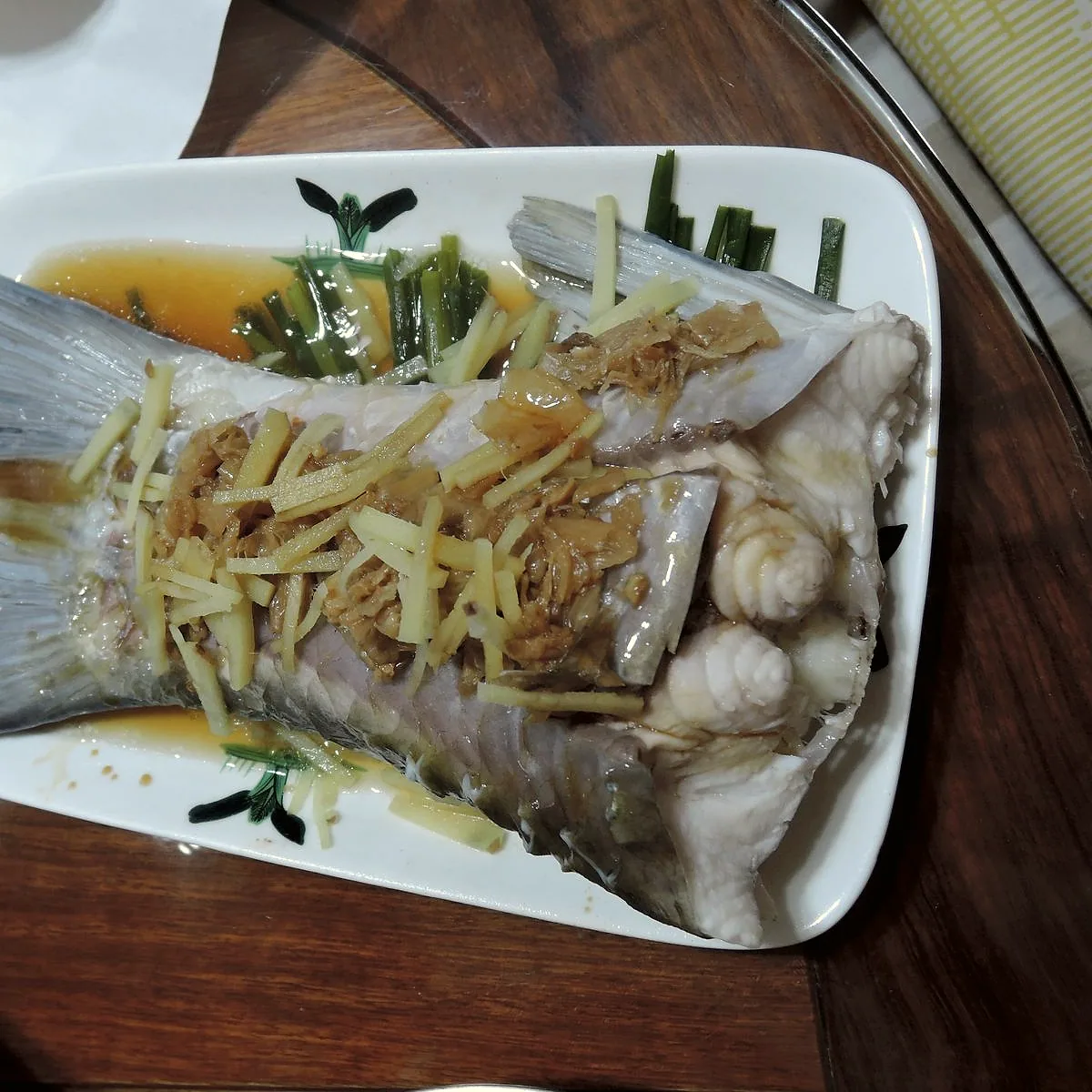

CC BY-SA 2.0. Cropped and colour-adjusted for this site.
Method
Pat the 700 g white fish dry and rub the 3 g fine sea salt over the skin and inside the cavity. Stuff the cavity with the 10 g fresh ginger and ½ spring onions (10 g), taking 8m.
Set the fish on a heatproof plate and steam over rapidly boiling water for 10m, until the flesh just flakes at the thickest part.
Common pitfallA fish left in the steamer even a minute or two past done turns dry and loses the point of the technique. It is better judged early and checked often, since the flesh continues cooking briefly from residual heat once lifted out.
Meanwhile, warm the 40 ml light soy sauce and 5 g caster sugar together gently until the sugar dissolves, taking 3m.
Lift the fish from the steamer, discarding the liquid that has collected on the plate, and pour over the warm soy mixture. Scatter with the 15 g fresh ginger and 1 ½ spring onions (20 g). Heat the 40 ml peanut oil in a small pan until smoking, then pour it directly over the aromatics, taking 3m, so it sizzles as it lands.
Pouring the oil over the ginger and spring onion only once it is smoking hot briefly cooks the aromatics and releases their fragrance in the moment they land, which a cooler oil or a longer cooking time cannot reproduce.
Cantonese steamed fish is built around restraint rather than seasoning: a whole fish, steamed briefly with ginger and spring onion and finished with nothing more than soy sauce and a splash of hot oil, is judged almost entirely on how well the cook has protected the natural texture and sweetness of the fish itself. Any technique that masks the fish's own flavour is, by that standard, a failure rather than a variation.
Serving the fish whole, head and tail intact, is not simply presentation. In Mandarin, yú, "fish," is a homophone for yú, "surplus" or "abundance," a long-recognised pun in Chinese culture [2] [1]. Serving a whole fish at a celebratory meal, most visibly at the Lunar New Year reunion dinner, invokes the wish niánnián yǒu yú, "may there be surplus every year," and families will often deliberately leave part of the fish unfinished, so that the uneaten portion stands for the abundance still to come rather than what has already been used up [1]. Cutting the fish into fillets before serving would break the pun as much as the fish itself, which is one practical reason whole steamed fish, rather than a filleted dish, holds this particular place at the table.
The ginger and spring onion do more than season the dish. Steamed alongside the fish and then finished raw as a garnish under a ladle of smoking-hot oil, they mask any trace of muddiness in the fish's flavour while doing almost nothing to cover its texture. That is the balance the whole method is built to protect.
Sources
- How Whole Fish Became a Symbol for Lunar New Year, Food RepublicOn the yu/surplus homophone, the tradition of deliberately leaving part of the fish uneaten, and the steamed ginger-and-scallion preparation.
- Fish in Chinese mythology, WikipediaOn the long-standing homophonic association between fish and abundance in Chinese culture.