American · Main Course
Shrimp and Grits
Peeled shrimp and andouille sausage in a garlicky pan sauce, spooned over slow-cooked cheddar grits.
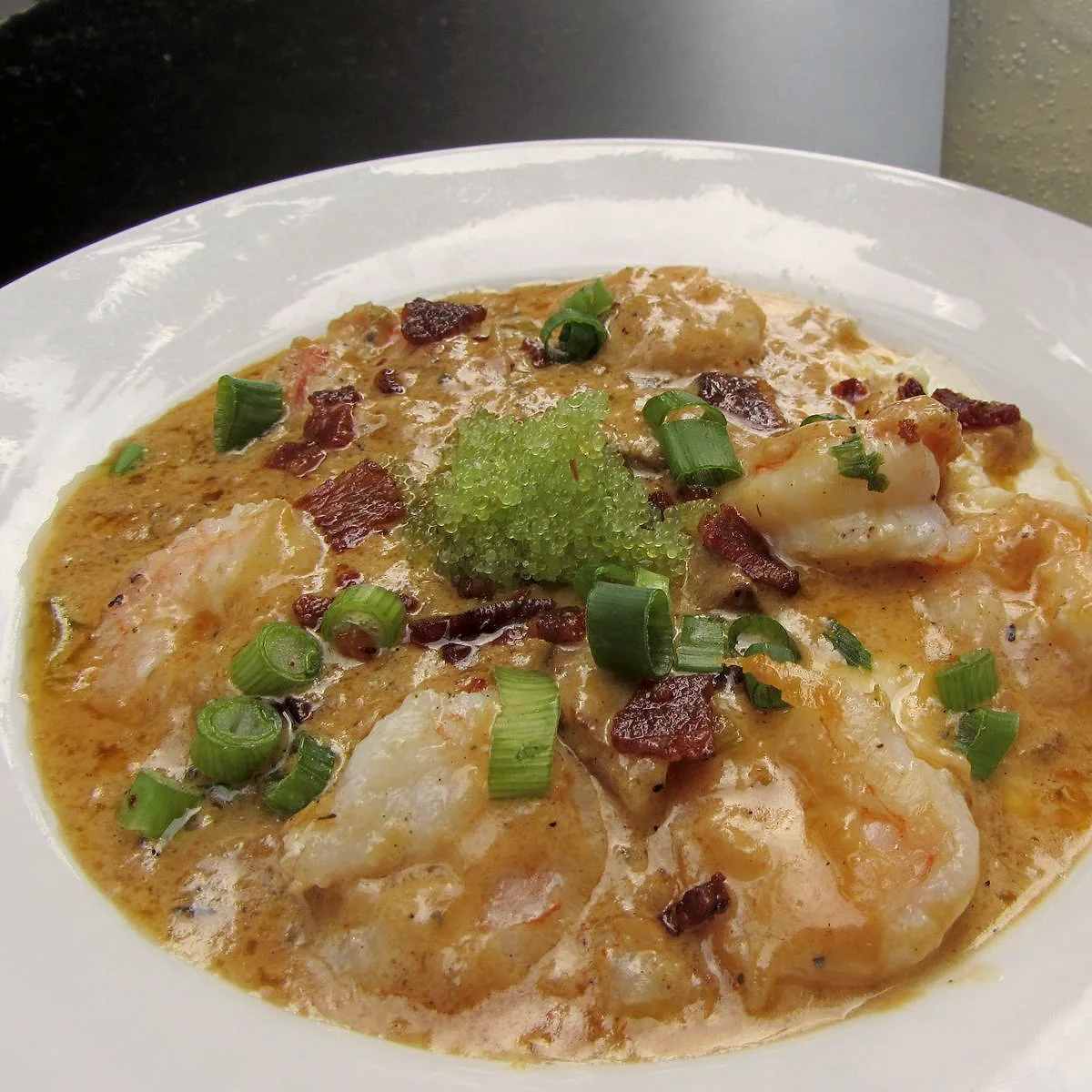

CC BY 2.0. Cropped and colour-adjusted for this site.
Method
Bring the 900 ml water to the boil in a heavy saucepan. Whisk in the 200 g grits in a steady stream, whisking constantly to stop it clumping.
Reduce the heat to the lowest setting and cook for 25m, stirring every few minutes, until the grits are thick, creamy and no longer gritty on the tongue.
Grits need a long, gentle simmer to hydrate the coarse grind evenly. Rushing the heat leaves gritty, undercooked centres inside a paste that looks done on top.
While the grits cook, dice the 150 g andouille, mince the 3 garlic cloves (15 g) and thinly slice the 2 spring onions (30 g).
Off the heat, stir the 20 g unsalted butter, 80 g sharp cheddar and 4 g fine sea salt into the grits until melted and smooth. Cover and keep warm.
Heat a large skillet over a medium-high heat and cook the sausage for 5m, until browned and much of its fat has rendered.
Add the 500 g shrimp and garlic to the skillet and cook for 7m, turning once, until the shrimp are pink and just cooked through. Add the 100 ml water, 15 ml freshly squeezed lemon juice, 20 g unsalted butter, 1 g ground cayenne pepper and 2 g ground black pepper, and swirl the pan until the butter melts into a light sauce. Spoon the shrimp, sausage and sauce over the grits and scatter with the spring onion.
Common pitfallShrimp go from translucent to rubbery within a minute or two of full heat, so they come off the heat the moment they turn pink and curl rather than being left to firm up further.
Shrimp and grits began as a breakfast, not a dinner. It comes from the Gullah Geechee people of the South Carolina Lowcountry, descendants of enslaved West and Central Africans who paired the corn grits ground in the Indigenous manner with the shrimp running thick in the coastal creeks each autumn; it was a dish eaten by fishing families at the start of a working day, long before any restaurant served it [2]. Shrimp itself carried a particular meaning in that kitchen: it had been part of West African diets before the Middle Passage, and its presence on a Lowcountry table has been read as a thread of memory as much as a convenient local catch [2].
For generations the dish stayed a home and dockside meal. That changed in the early 1980s, when chef Bill Neal put a version built on cheddar-and-parmesan grits, jumbo shrimp, mushrooms and bacon on the dinner menu at Crook's Corner in Chapel Hill, North Carolina, after joining the restaurant in 1982 [1]. The turning point for the dish's wider fame came in 1985, when New York Times food editor Craig Claiborne wrote up Neal's recipe, giving a regional breakfast a national readership almost overnight [1]. Restaurants across the South followed with their own versions through the 1990s (Cajun-spiced in Charleston, finished with barbecue sauce in New Orleans), and the dish now carries a range of regional treatments far removed from its plainer origin as a fisherman's morning meal [1].
Sources
- Shrimp and Grits: A History, Deep South MagazineTraces the dish from a Lowcountry breakfast to Bill Neal's 1982 Crook's Corner version and its 1985 New York Times coverage.
- Shrimp and Grits, Levine Museum of the New SouthMuseum account of the dish's Gullah Geechee origins and its shift from breakfast to a national restaurant entrée.