British · Breakfast
Scones
A quick self-raising dough, barely handled and cut into rounds, baked until well risen with a pale, floury top.
Not the same asAmerican biscuit (A savoury, usually unsweetened counterpart made the same rubbed-fat way, eaten with butter or gravy rather than split with jam and cream.)
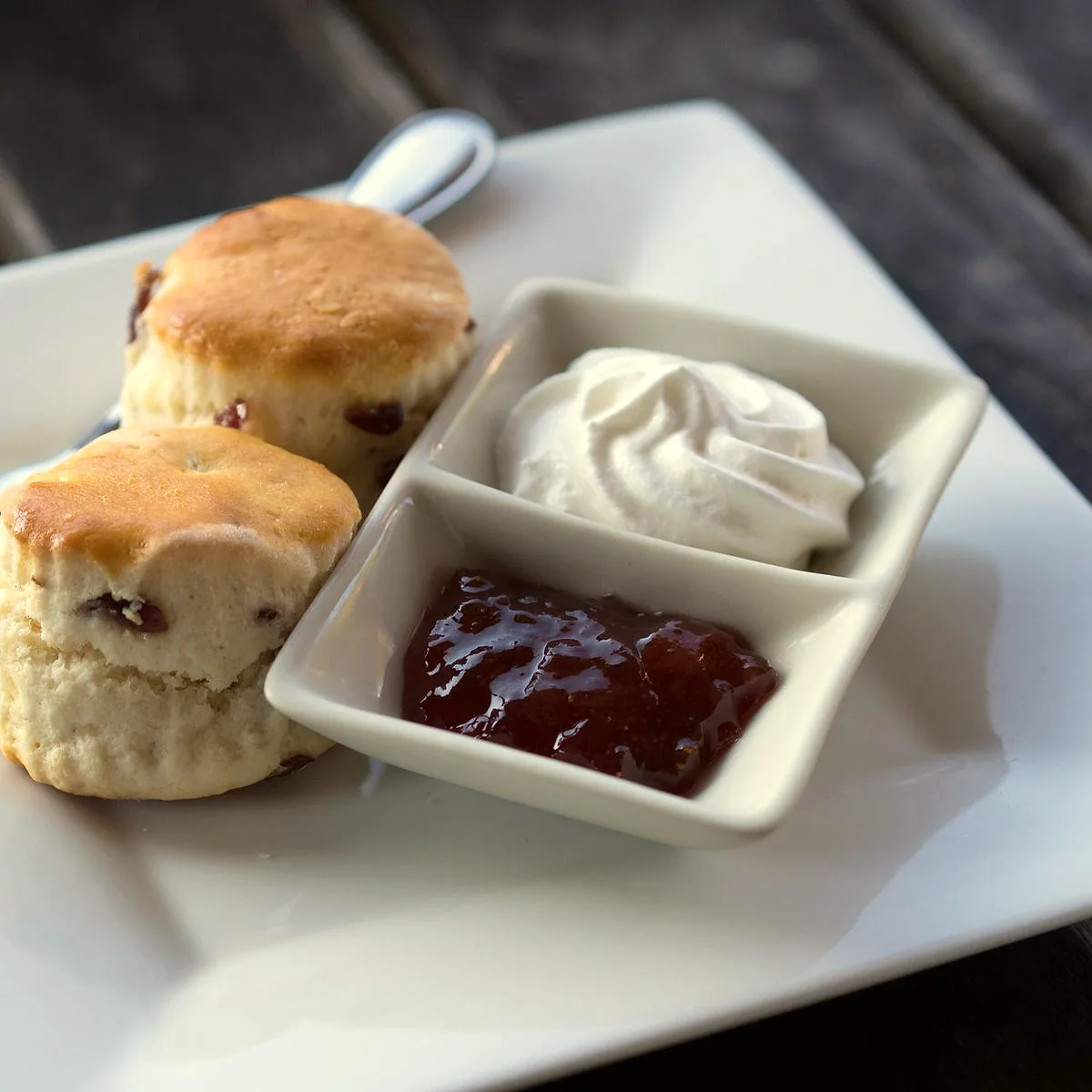

CC BY-SA 3.0. Cropped and colour-adjusted for this site.
Method
Rub the 85 g unsalted butter into the 350 g self-raising flour and the 2 g fine sea salt with the fingertips until the mixture looks like fine breadcrumbs, then stir in the 40 g caster sugar.
Make a well in the centre and add the 130 g milk and the ½ eggs (35 g). Mix with a table knife and then bring together briefly by hand into a soft, slightly sticky dough.
The dough is brought together only until it holds; overworking develops gluten that this bake has no proving time to relax, and the result turns tough rather than staying short.
Turn the dough out onto a floured surface and pat gently to a thickness of about 2 cm. Cut into rounds and set them on a lined tray, spaced well apart.
Common pitfallTwisting the cutter as it goes down seals the edges and stops the dough rising evenly. It goes straight down and straight back up, with a clean push, and any offcuts are pressed rather than rerolled hard.
Brush the tops with the ½ eggs (15 g), taking care not to let it run down the cut sides, which would stop them rising evenly.
Bake at 220 °C for 14m, until well risen and golden on top. Cool on a wire rack and split to serve with the 120 g clotted cream and the 120 g raspberry jam.
The scone is Scottish, and older than the sweet, oven-baked version now sold as a symbol of English afternoon tea. The word itself is documented from at least the early sixteenth century [2].
For most of that history the scone was not what is baked today. Early Scottish versions were cooked on a girdle or bakestone rather than in an oven, made from oats, barley or peasemeal, and leavened (before chemical raising agents were widely available in the later eighteenth century) with sourdough [2]. The dish had not yet reached England in any form Isabella Beeton recognised: her exhaustive Book of Household Management contains no scone recipe at all, and they only begin appearing in English cookbooks from the 1880s and 1890s [2]. The now-familiar oven-baked, wheat-flour scone, risen with baking powder that reached domestic kitchens from the 1840s, displaced the older griddle versions through the early twentieth century [1][2].
Its role in the cream tea is later still. The earliest printed reference anyone has traced to "cream tea" in its modern sense is a 1932 article in the Cornish newspaper The Cornishman, and by that point, on the same account, Devon had already turned to scones ahead of Cornwall, which kept faith with its own soft, split rolls for longer, an adoption gap put down to Cornwall's relative geographic isolation [3]. Devon and Cornwall still disagree about the order of assembly, cream first or jam first, but neither claim is the older tradition: the scone predates the cream tea by centuries, and arrived in the West Country from Scotland by way of England's ordinary kitchens, not the other way round.
Sources
- Scone, WikipediaOn the sweetened scone emerging only after baking powder reached domestic kitchens from 1843.
- Scones: A Brief History, British Food: A HistoryOn the Scottish griddle origins, the absence of scones from Mrs Beeton's 1861 book, and their spread south through late-Victorian cookbooks.
- Cornish Splits (& More on Cream Teas), British Food: A HistoryOn the earliest printed reference to "cream tea," a 1932 Cornishman newspaper article, and on Devon adopting scones before Cornwall.