Austrian · Dessert
Sachertorte
A dense chocolate sponge, split and coated with warm apricot jam, then glazed with a poured chocolate icing that sets to a hard shine.
Not the same asChocolate fudge cake (A softer, more heavily iced cake with buttercream or ganache throughout; Sachertorte is a dense sponge with a thin apricot layer under a single hard, thin chocolate shell.)
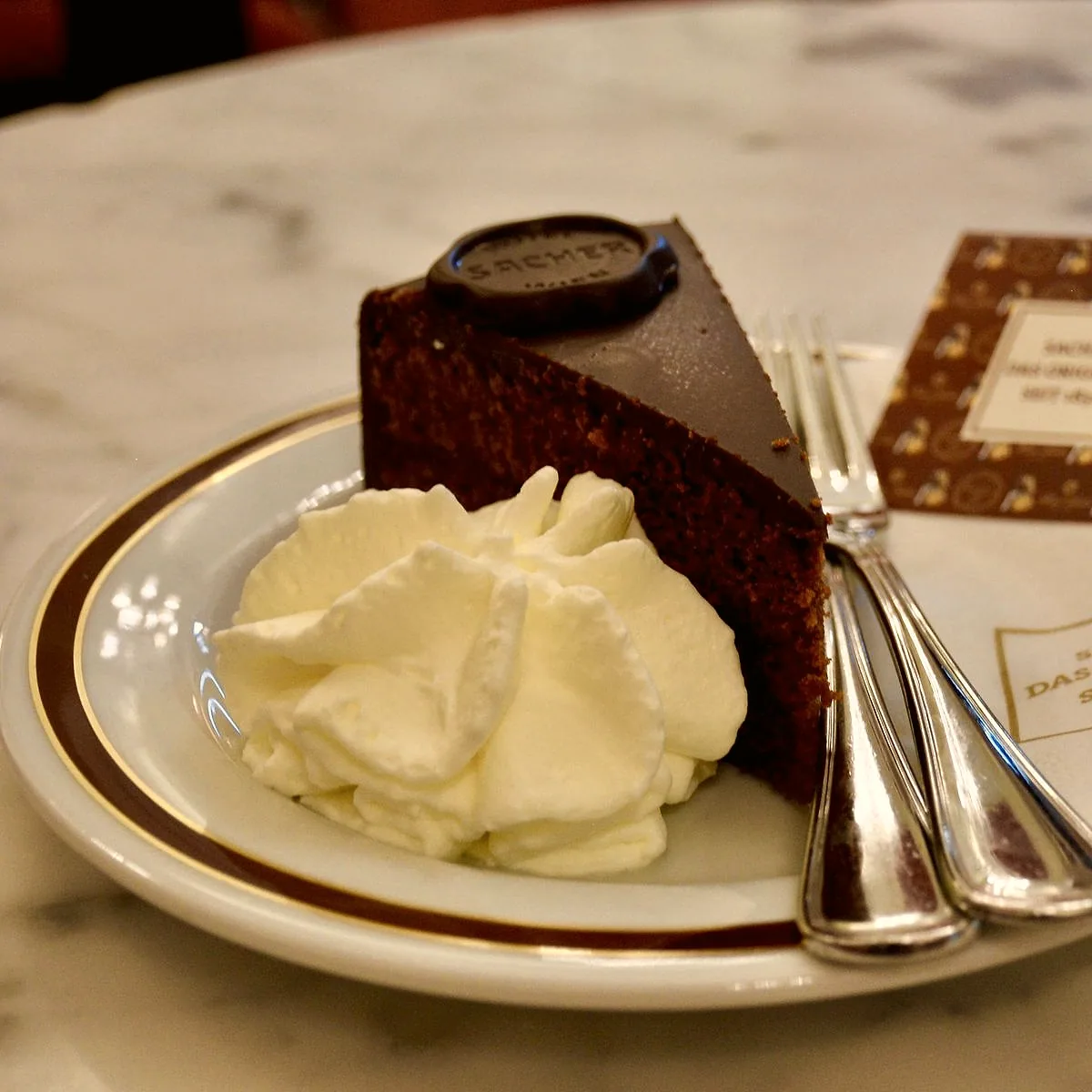

CC BY-SA 4.0. Cropped and colour-adjusted for this site.
Method
Melt the 100 g dark chocolate gently over a pan of simmering water and set aside to cool slightly.
Beat the 100 g unsalted butter and the 80 g icing sugar together until pale, then beat in the 7 egg yolks (120 g) and the melted chocolate.
Whisk the 6 egg whites (200 g) to soft peaks, then whisk in the 80 g caster sugar a little at a time until glossy and firm.
Fold a third of the meringue into the chocolate mixture to loosen it, then fold in the rest along with the 100 g plain flour, keeping as much air in as possible. Pour into a lined tin.
Bake at 170 °C for 50m, until a skewer comes out with a few moist crumbs.
Cool in the tin for 30m, then turn out onto a rack.
Warm the 150 g apricot jam, strain it, and brush it in a thin, even layer over the top and sides of the cooled cake.
The apricot jam layer is warmed and strained before it goes on so it spreads into a thin, even film rather than a lumpy one; that thin layer is also what seals the crumb and stops the poured icing from soaking into the sponge.
Heat the 150 g caster sugar and the 100 g water together until the sugar dissolves and the syrup thickens slightly, then take off the heat and stir in the 150 g dark chocolate until completely smooth. Cook for 10m in total.
Set the cake on a rack over a tray and pour the warm icing over in one motion, tilting to coat the top and sides completely.
Common pitfallIcing that has cooled too far sets in dull, streaky ridges instead of one smooth shell. It needs to be poured while still warm and fluid, in one motion, over a cake set on a rack with a tray beneath to catch the drips.
Leave undisturbed at room temperature for 1h, until the icing has set to a firm, glossy shell.
The story goes that in 1832 Prince Metternich, the Austrian state chancellor, asked his court kitchen to devise a special cake for a banquet. The chef in charge was ill, and the task fell to a sixteen-year-old apprentice pastry cook named Franz Sacher, who improvised the dense chocolate sponge that still carries his name [1][2]. His son Eduard trained at Demel, Vienna's rival pastry shop, before opening his own establishment, the Hotel Sacher, in 1876, where the torte went on the menu [1][2].
Decades later, financial pressure on the hotel led Eduard's own son to sell the recipe on to Demel, and both houses ended up selling their own version of the same cake under competing claims to authenticity [1][2]. The dispute reached court after the Second World War and turned on specifics rather than vague claims of tradition: Demel's cake carried a single layer of apricot jam beneath its chocolate glaze, while Hotel Sacher insisted the authentic recipe used two. The writer Friedrich Torberg, a regular at both establishments, testified that Hotel Sacher itself had used only one layer before the First World War, evidence that told against the hotel's own claim [2]. The case ended in a settlement giving Hotel Sacher the exclusive right to sell its cake as the "Original Sachertorte," while Demel kept the right to sell its own as the "Eduard-Sacher-Torte," marked with a triangular seal rather than the hotel's round one [2].
Both houses still sell their own version today under those separate names. This is a rare case of a dessert's authenticity being settled, however imperfectly, by courtroom testimony rather than by consensus.
Sources
- Sachertorte, WikipediaOn Franz Sacher's 1832 creation story, Eduard Sacher's sale of the recipe to Demel, and the Austrian Supreme Court's 1963 ruling.
- Trademark Protection for Food: The Battle over the Name 'Sachertorte', Finnian & Columba (intellectual property law firm)On Franz Sacher's 1832 creation for Metternich, Eduard Sacher's 1876 opening of the Hotel Sacher, and the trademark dispute's legal specifics, including the one-layer-versus-two-layer jam argument, Friedrich Torberg's courtroom testimony, and the settlement's terms.