American · Dessert
Peach Cobbler
Sliced peaches baked under a buttery batter that rises up around the fruit as it bakes, rather than a rolled crust laid over it.
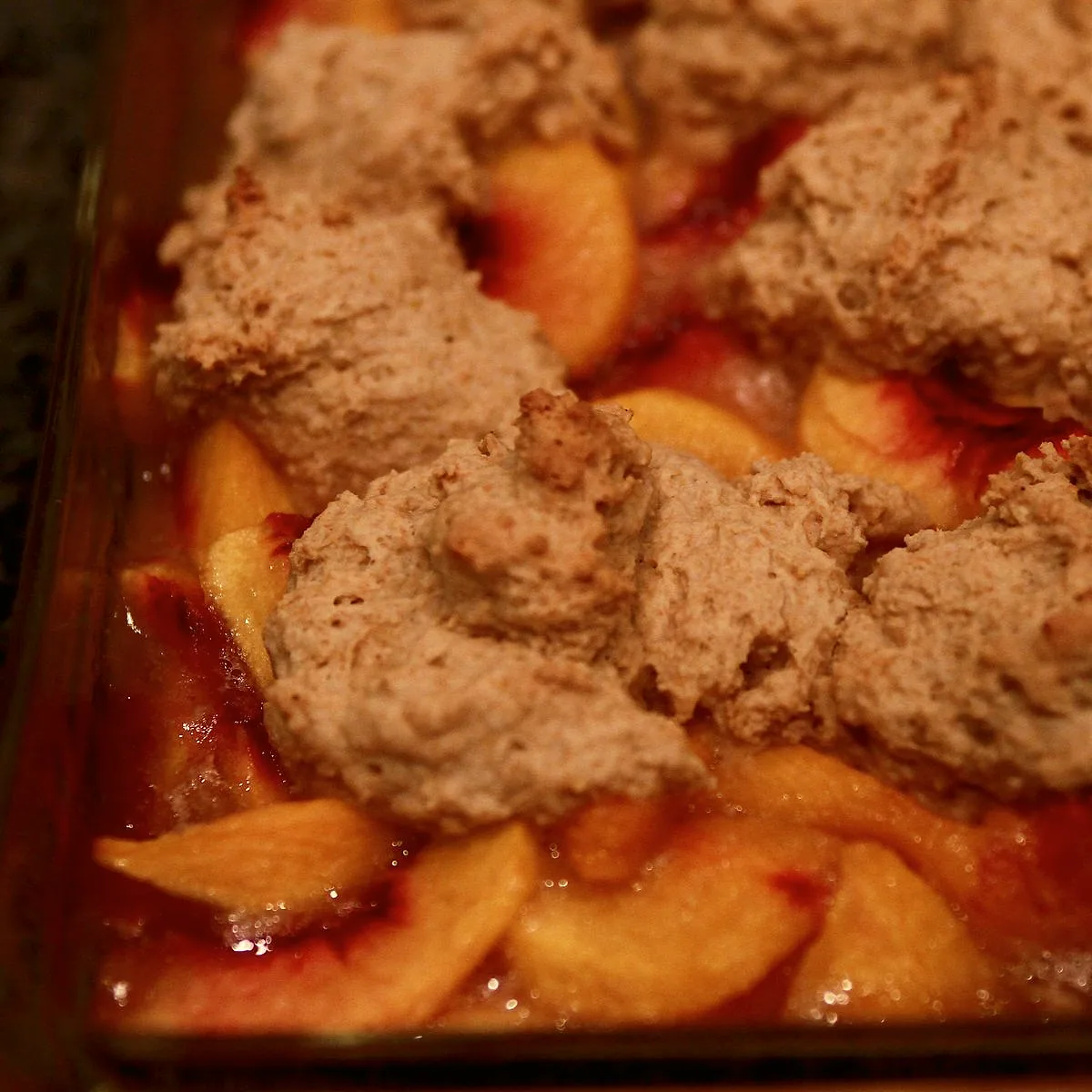

CC0. Cropped and colour-adjusted for this site.
Method
Heat the oven to 180 °C, giving it 15m to settle, and put a deep baking dish inside to warm while the oven comes up.
Toss the 900 g peach with the 100 g caster sugar, the 15 g cornflour, the 15 ml freshly squeezed lemon juice and the 2 g ground cinnamon, and dot with the 20 g unsalted butter. This takes 8m.
Whisk together the 150 g plain flour, the 8 g baking powder, the 3 g fine sea salt and the 100 g caster sugar, then whisk in the 240 ml milk and the 85 g unsalted butter to a smooth, thin batter, over 6m.
Pour the batter into the warm dish, then spoon the peaches and their juices evenly over the top without stirring them in. This takes 4m.
Pouring the batter into the dish first and spooning the fruit on top, rather than the other way round, is what lets the batter rise up around and through the peaches as it bakes, giving the crust its characteristic uneven, self-forming top.
Bake for 45m, until the top is deep golden and risen unevenly around the fruit, and a skewer pushed into the crust comes out clean.
Leave the cobbler to settle for 15m before serving, so the fruit's juices finish thickening.
Common pitfallCut straight from the oven, the fruit's juices are still thin and run everywhere. A short rest lets the cornflour finish thickening them so a spoonful holds together.
Cobbler exists in the form it does because of a piece of colonial kitchen equipment cooks did not have. A proper pie needs an oven and a crust rolled thin enough to hold its shape top and bottom, neither of which an open hearth or a Dutch oven over coals made easy. Settlers baking over fire instead covered stewed or raw fruit with a dough dropped or rolled on top (closer to a savoury pudding topping than to pastry) and cooked the whole pot directly in the embers [1]. That workaround, not a recipe anyone set out to invent, is the origin of the dish's characteristic dropped or cobbled crust.
The fruit came from further away than the dish's Southern reputation implies. Peaches are not native to North America; Spanish expeditions, including Hernando de Soto's, brought them to the continent in 1539, after some eight thousand years of cultivation in China beforehand [2]. They spread through the eastern South substantially by way of Indigenous peoples' own cultivation rather than through English settlement alone, and the orchards most associated today with the fruit, Georgia's among them, came later still [2].
Cobbler stayed a home dish, made from whatever fruit was on hand, for a long time before it reached print in a form specific to peaches: Lettice Bryan's The Kentucky Housewife, published in 1839, carries what is usually cited as the first printed peach cobbler recipe, decades after cooks in the region had plainly been making some version of it [2]. It also began as something closer to a staple than a treat. Cobbler was as likely to appear at breakfast or dinner as at the end of a meal, and it was not firmly classed as a dessert until late in the nineteenth century, around the same period that wider peach cultivation and, later, canning turned what had been a seasonal, sometimes costly fruit into something ordinary households could keep and cook with year-round [1][2].
Sources
- The True Colonial Origin Of Cobbler In The United States, Tasting TableOn cobbler as an improvised response to the difficulty of building a proper pie over an open hearth, and its first published recipe in 1881.
- Peach Cobbler, Levine Museum of the New SouthOn peaches reaching North America with Spanish expeditions in 1539, the first published peach cobbler recipe in Lettice Bryan's 1839 "The Kentucky Housewife", and the dessert's later spread beyond wealthier households once canning made peaches available year-round.