Filipino · Bread
Pandesal
Soft, faintly sweet breakfast rolls, rolled in fine breadcrumbs before baking for their characteristic dry, matte crust.
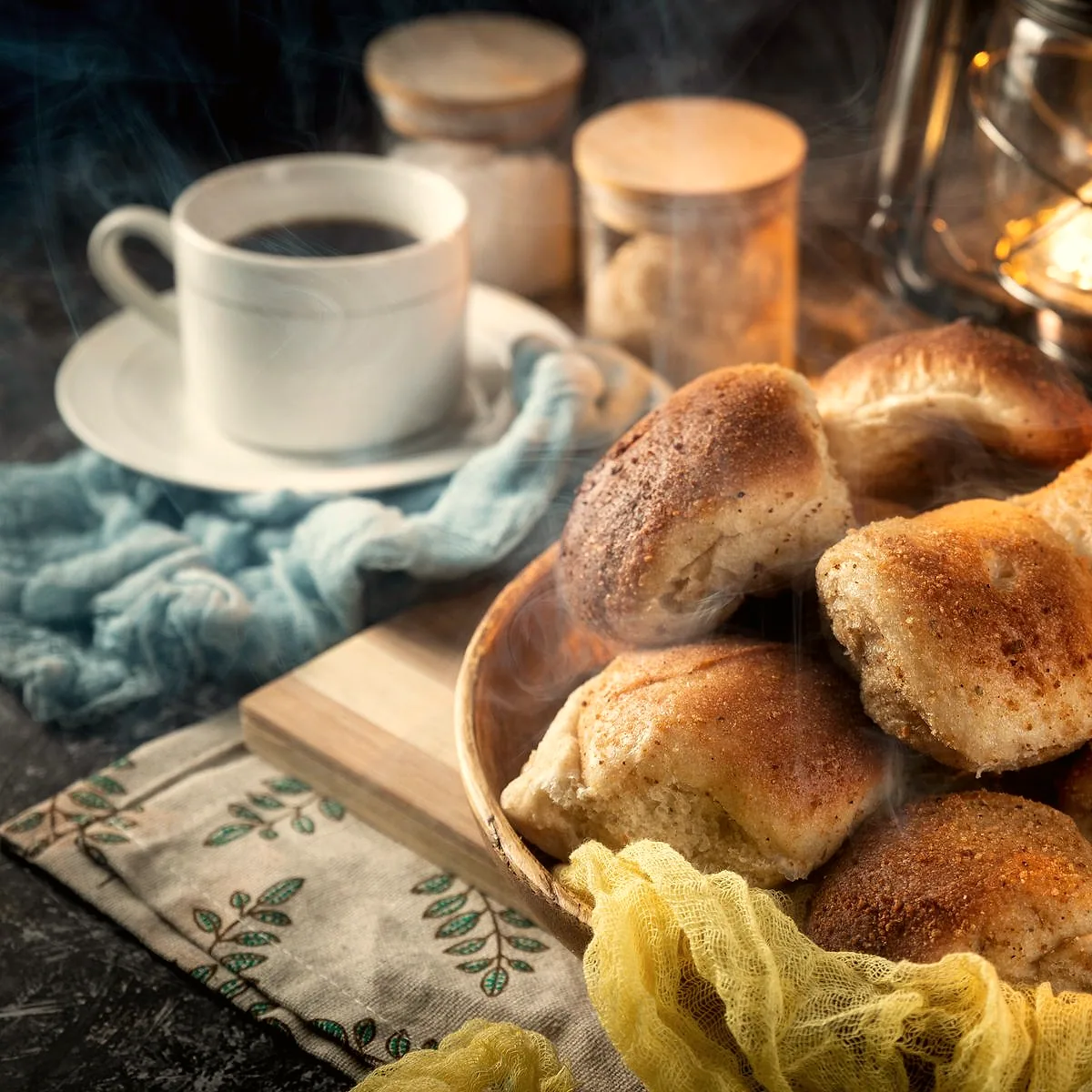

CC BY-SA 4.0. Cropped and colour-adjusted for this site.
Method
Stir the 7 g dried yeast and 10 g caster sugar into the warm 220 ml milk for 5m.
Leave the mixture for 10m, until foamy on top.
Combine the 470 g bread flour, 8 g fine sea salt, 50 g caster sugar, 1 egg (50 g) and 40 g unsalted butter with the yeast mixture and bring together into a dough. Turn out and knead for 10m, until smooth and elastic.
Cover and leave to rise in a warm place for 1h 30m, until doubled in size.
Turn the dough out onto the 30 g bread flour, divide into even pieces and shape into ovals. Roll each piece in the 100 g dried breadcrumbs to coat, working for 20m, and arrange on lined trays.
Rolling each piece in dry breadcrumbs rather than dusting with flour is what gives pandesal its characteristic matte, faintly crunchy crust, distinct from a floured dinner roll.
Cover loosely and leave to rise again for 30m, until visibly puffed.
Bake at 190 °C for 15m, until pale gold and firm.
Common pitfallA hot oven browns the crumb coating before the centre is fully baked. A moderate, even heat is what cooks the crumb through without scorching the coating.
The name promises something the bread does not deliver: pandesal is Spanish for "bread of salt," from pan and sal, but the roll eaten today is mild and faintly sweet rather than salty [1] [4]. That mismatch is a clue to its age: the name is older than the recipe it now describes.
Wheat and bread both arrived with Spanish colonisation: friars grew wheat in Cagayan Valley, the Ilocos provinces and Batangas and milled it for their own bread and communion wafers, teaching the practice to Filipino bakers [2]. Pandesal's earliest form, pan de suelo, is described as closer to a crusty loaf baked directly on the oven floor than to the soft roll sold today [1] [2]. Wheat itself was never grown at scale in the Philippines for long, so the bread's ingredients stayed an import rather than a local crop, which left it exposed to whatever flour happened to be cheap and available. As cheaper, softer American wheat flour became widely available during the American colonial period, bakers shifted toward it, and the bread's texture softened into the fluffy, slightly sweet roll associated with pandesal now [1] [4].
What survives from the earlier savoury version is mostly the name. Modern pandesal is typically rolled in fine breadcrumbs rather than salt before baking [1] [3], and its appeal now rests on being soft, warm and cheap enough to eat daily: an everyday breakfast bread rather than the salted loaf its name still describes.
Sources
- Pandesal, WikipediaGives the Spanish etymology, the crustier pan de suelo precursor, and the shift toward a softer roll as cheaper American wheat flour became available.
- Filipinos' love for Pandesal began during Spanish colonial times, Manila StandardCovers Spanish friars introducing wheat cultivation to Cagayan Valley, Ilocos and Batangas and milling it for bread and communion wafers, and names pan de suelo among the early Spanish-derived local breads.
- Pandesal, The Nosey ChefFilipino-recipe history site; describes coating the shaped rolls in breadcrumbs before baking and covers the bread's postwar refinement.
- The Evolution of Pandesal: How the Philippines' Beloved Bread Roll Has Transformed in Taste, Lola InayStates that by the 1920s-1930s pandesal had become lightly sweet rather than pronouncedly salty, and that American-era refined wheat flour and sugar made the bread softer and sweeter.