Indian · Breakfast
Medu Vada
A Tamil Nadu doughnut-shaped fritter of soaked, whipped urad dal, deep-fried until the outside crisps dark gold around a soft, savoury crumb.
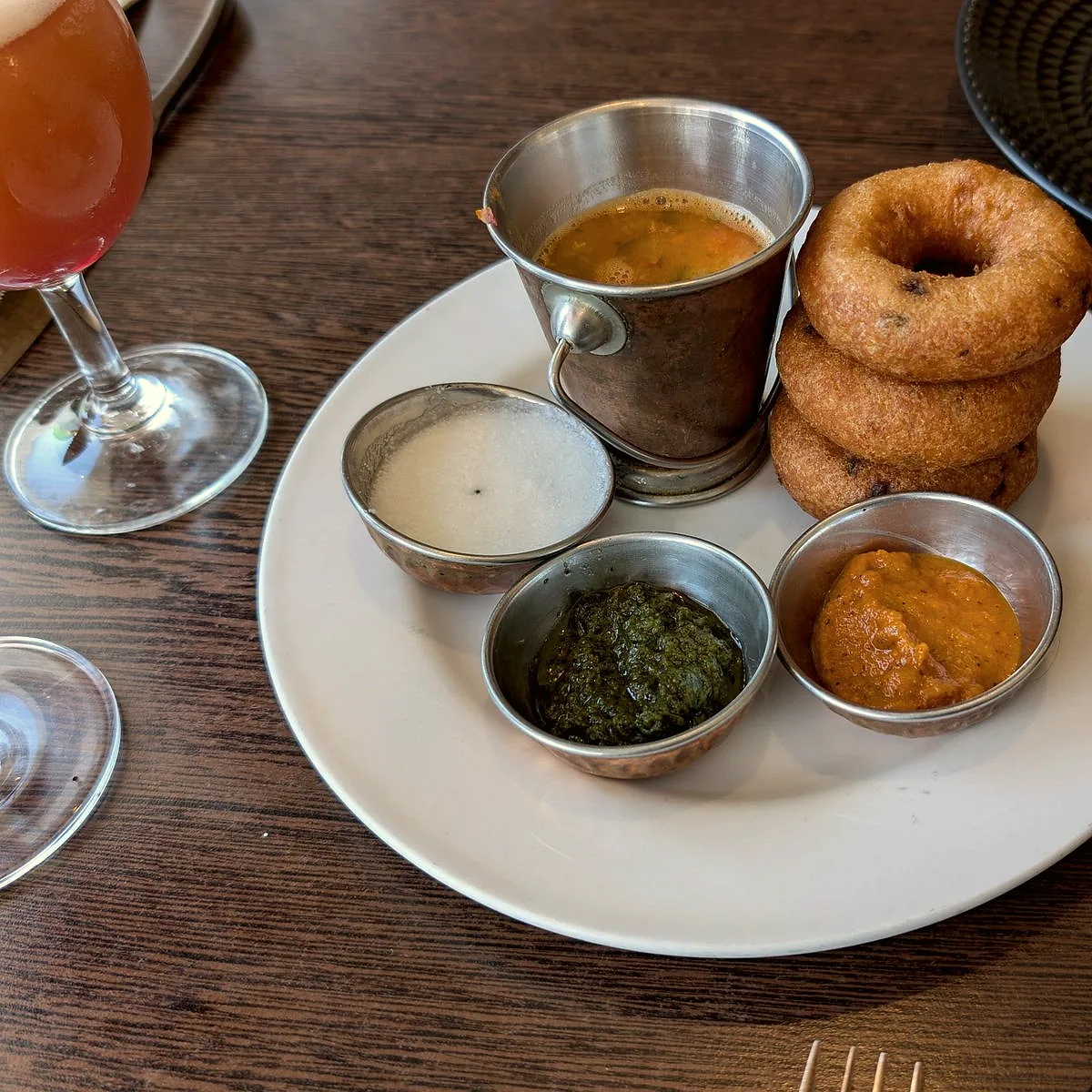

CC0. Cropped and colour-adjusted for this site.
Method
Cover the 300 g urad dal with the 700 ml water and leave to soak for 4h, then drain thoroughly.
Grind the drained dal with as little added water as possible into a thick, smooth paste, then beat it hard by hand for a share of 15m until it lightens and holds its shape on a spoon. Fold in the 8 g fresh ginger, 3 g curry leaves, 1 serrano chilli (8 g), 3 g ground black pepper and 6 g fine sea salt.
The dal is ground with almost no water and beaten hard afterwards, which is what lets it hold both its ring shape and enough trapped air to fry light rather than dense.
Heat the 1 L peanut oil in a deep pan to a steady, gentle bubble. With wet hands, shape portions of the batter into flattened discs and punch a hole through the centre of each to make a ring, then slide them into the oil. Fry for 20m, turning occasionally, until deep golden-brown and crisp all over. Lift out and drain.
Common pitfallWet hands rather than oiled or water-slicked ones make the batter stick and drag out of shape when punching the centre hole. A little oil or water on the palms and fingers lets each vada release cleanly into the pan.
Vada as a category has a genuinely old textual trail. K. T. Achaya dated mentions of it to Sangam-era Tamil literature, broadly placed between 100 BC and 300 AD, and a specific recipe for something called vataka (beans soaked, ground and deep-fried into balls) appears in the Manasollasa [1], an encyclopedic Sanskrit text commissioned for the court of the Western Chalukya king Someshvara III, who reigned from 1127 to 1138, and now considered the earliest surviving non-medical Indian text devoted to food. Its version of the recipe is specific enough to describe: dumplings of urad dal and pepper soaked in yoghurt, closer to today's dahi vada than to the drier, deep-fried medu vada this page treats [2]. That gives the wider family of lentil fritters, of which medu vada is one member among many across the subcontinent, a long and reasonably well-attested history, even though the earliest recorded version was a yoghurt-soaked dish rather than the crisp fried ring eaten dry today.
The specific dish this page describes (a ring rather than a ball, made from dehusked urad dal rather than mung, whipped light before frying) is harder to date to a single point. Its name is straightforward: medu means soft in both Kannada and Tamil, describing the fritter's texture rather than naming a place or a person, and its many regional names (uzhunnu vadai in Tamil, uddina vade in Kannada, garelu in Telugu) are essentially the same word for the same food in different South Indian languages [3]. The food writer Vir Sanghvi has traced this particular version with some confidence to the Karnataka town of Maddur, though the wider vada tradition it draws on long predates any single town's claim to it [3].
The ring shape is not decorative. A flat disc of the same batter fries through unevenly, dense at the centre and overdone at the edge; punching a hole through the middle before frying gives it a consistent thickness all the way round, so the whole vada crisps and cooks at close to the same rate.
Sources
- Vada (food), WikipediaOn the Sangam-era literary reference to vada, the twelfth-century Manasollasa recipe for vataka, and the dish family's later spread through indentured migration.
- What Indians Ate in the 12th Century, Live History IndiaOn the Manasollasa itself, commissioned for the Western Chalukya king Someshvara III's court (r. 1127–1138) and described as the earliest known non-medical Indian text on food, and on its specific vada recipe, dumplings of urad dal and pepper soaked in yoghurt, a forerunner of today's dahi vada.
- Medu Vada, WikipediaOn the Kannada and Tamil etymology of "medu" and the dish's regional names, and on food writer Vir Sanghvi's attribution of the specific medu vada to the Karnataka town of Maddur.