Italian · Main Course
Margherita Pizza
Tomato, mozzarella and basil on a dough left to ferment slowly and baked in the fiercest heat available.
Also known asPizza Margherita · Italy
Not the same asPizza marinara (No cheese at all: tomato, garlic and oregano only. The other classic Neapolitan pizza, and the older of the two.)
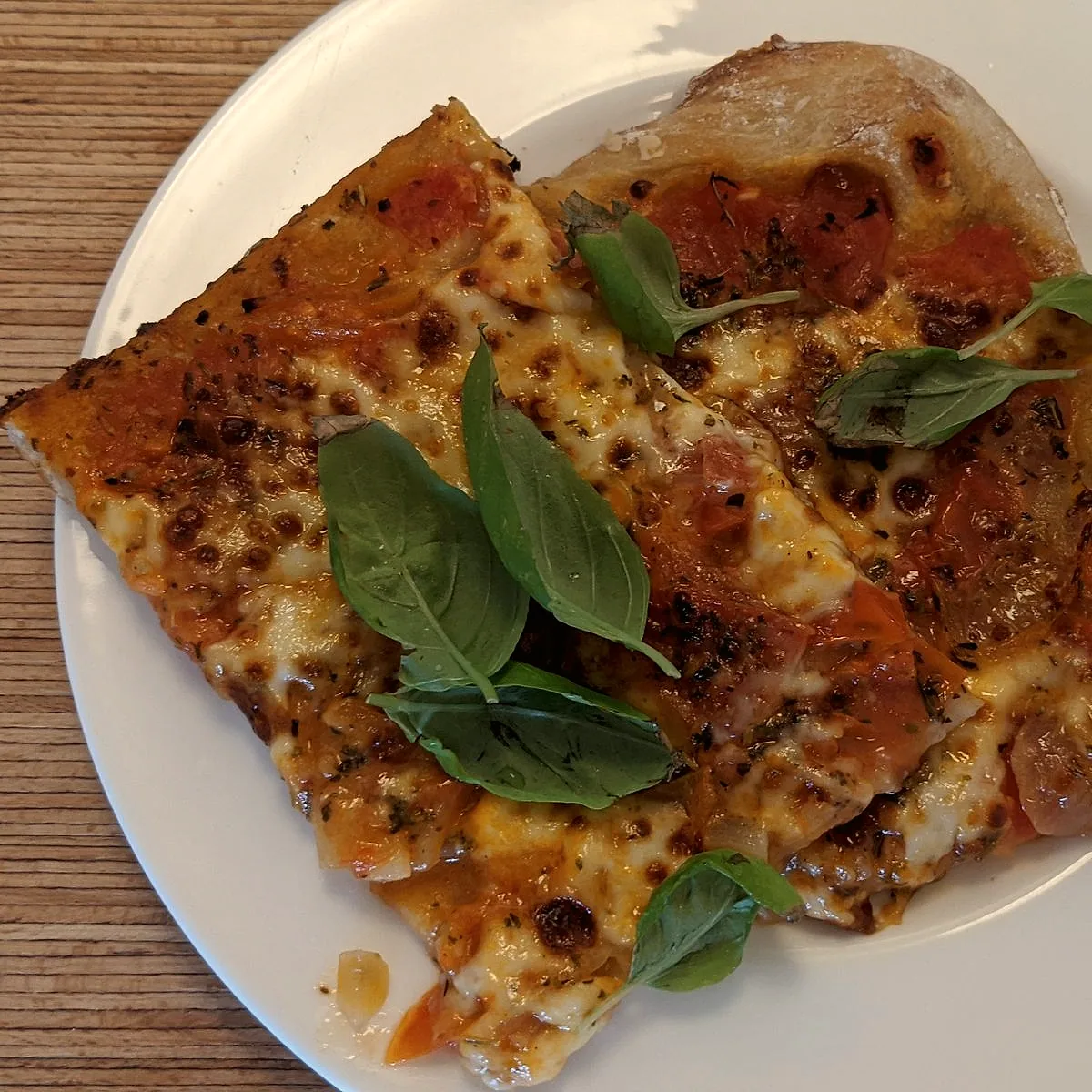

CC BY 4.0. Cropped and colour-adjusted for this site.
The same dish, adapted. Every quantity, time and figure below changes with the version.
Method
Dissolve the 0.5 g dried yeast in the 220 ml water, then work in the 320 g 00 flour a handful at a time until no dry flour remains. Rest the shaggy dough for 10m, then add the 10 g fine sea salt.
Knead for 12m. The dough starts slack and tacky and finishes smooth and slightly resistant; it is ready when a pulled corner stretches thin enough to see light through before it tears.
Cover and leave at room temperature for 8h, until roughly doubled and domed.
Turn the dough out and divide it into two equal pieces. Shape each into a tight ball by dragging it against the bench until the surface is under tension.
Cover the balls and prove for 4h. They should spread and soften but still hold their shape when nudged.
Meanwhile bring the oven to its absolute maximum, with a stone or steel in place, and give it 1h to saturate. A true Neapolitan oven runs at 450 °C; a domestic one will not, which is what the home-oven version of this recipe is for.
Working with the 20 g 00 flour, press each ball out from the centre with your fingertips, leaving the outer rim untouched, then stretch it over your knuckles to a 28 cm round. Leave it thicker at the edge.
The rim is never touched by a rolling pin or a knuckle. Pressing the gas out of the outer inch is what costs a Neapolitan pizza its cornicione.
Crush the 200 g tinned San Marzano tomatoes by hand, season them with nothing, and spread a thin film to within a finger's width of the rim. Scatter the 170 g fresh mozzarella over, add most of the 8 g fresh basil, and thread the 20 ml extra-virgin olive oil across in a spiral.
Common pitfallToo much tomato and the base steams instead of baking. It should be a thin, uneven film with the dough showing through in places.
Launch onto the stone and bake for 2m, turning once, until the rim has blistered and charred in spots and the centre is set. Finish with the remaining basil.
Method
Dissolve the 1 g dried yeast in the 235 ml water, then work in the 320 g bread flour a handful at a time until no dry flour remains. Rest the shaggy dough for 10m, then add the 10 g fine sea salt.
Knead for 12m. Bread flour takes longer to come together than 00 and fights back more; work it until the surface is smooth and a pulled corner stretches thin without tearing.
Cover and refrigerate at 4 °C for 24h. The dough will rise slowly and smell faintly of beer when it is ready.
A domestic oven cannot supply the colour a wood fire gives in ninety seconds, so the flavour has to come from somewhere else. A full day in the fridge is where.
Turn the dough out and divide it into two equal pieces. Shape each into a tight ball by dragging it against the bench until the surface is under tension.
Cover and leave at room temperature for 3h, until the chill has gone out of the dough and it has softened and spread.
Meanwhile set the oven to its maximum with a stone or steel on the upper shelf, and give it 1h. Most domestic ovens reach 250 °C; use the grill element for the last stretch if yours has one.
Common pitfallA stone that has been in a hot oven for ten minutes is not hot. It needs the best part of an hour to hold enough heat to set the base before the top overcooks.
Working with the 20 g bread flour, press each ball out from the centre, leaving the rim untouched, and stretch it to a 26 cm round (slightly smaller than the Neapolitan, which helps the base set before the top dries).
Crush the 200 g tinned San Marzano tomatoes by hand and spread a thin film to within a finger's width of the rim. Scatter the 170 g fresh mozzarella over, add most of the 8 g fresh basil, and thread the 20 ml extra-virgin olive oil across.
Bake for 7m on the stone, switching to the grill for the final minute so the top colours before the base overcooks. Finish with the remaining basil.
The story is that on the tenth of June 1889 the Neapolitan pizzaiolo Raffaele Esposito baked three pizzas for Queen Margherita of Savoy, that she preferred the one in the colours of the new Italian flag (red tomato, white mozzarella, green basil), and that it took her name [2].
It is a very good story and it does not survive much examination. No newspaper of the period reports the visit, and both the story and the name appear to have been promoted only in the 1930s and 1940s, decades after the fact [2]. The document usually offered as proof, a thank-you note from the royal household, has had its authenticity seriously questioned, and the historian Zachary Nowak has examined the seal it carries against other seals of the period as part of a broader argument that the whole episode is an invented tradition [1].
The more telling problem is that the pizza is older than its own origin story. In 1849 Emanuele Rocco described Neapolitan pizza topped with basil, tomatoes and thin slices of mozzarella, and Francesco De Bourcard recorded the same combinations in 1866 [2]. Whatever happened in 1889, it was not the invention of this pizza. At most a name was attached to something Naples had been eating for forty years.
None of which makes the dish less itself. What the Margherita actually is, is a demonstration of how little is needed: a dough given time, tomatoes that are not cooked before they go on, cheese that is torn rather than grated, and heat violent enough to finish the whole thing before the base dries out. The reason it travels so badly is that the last of those is the one thing a domestic kitchen cannot supply, which is why the home-oven version here trades ninety seconds of ferocious heat for a day of cold fermentation.
Sources
- Folklore, Fakelore, History: Invented Tradition and the Origins of the Pizza Margherita, Food, Culture & Society, vol. 17 no. 1 (Taylor & Francis), 2014Zachary Nowak's examination of the creation myth, including analysis of the seal on the thank-you note attributed to the royal household.
- Pizza Margherita, WikipediaCollates the earlier documentary record, including Emanuele Rocco's and Francesco De Bourcard's descriptions.