Caribbean · Breakfast
Mangú
Green plantains boiled until soft and mashed smooth with butter and their own cooking water, topped with red onion sautéed in vinegar.
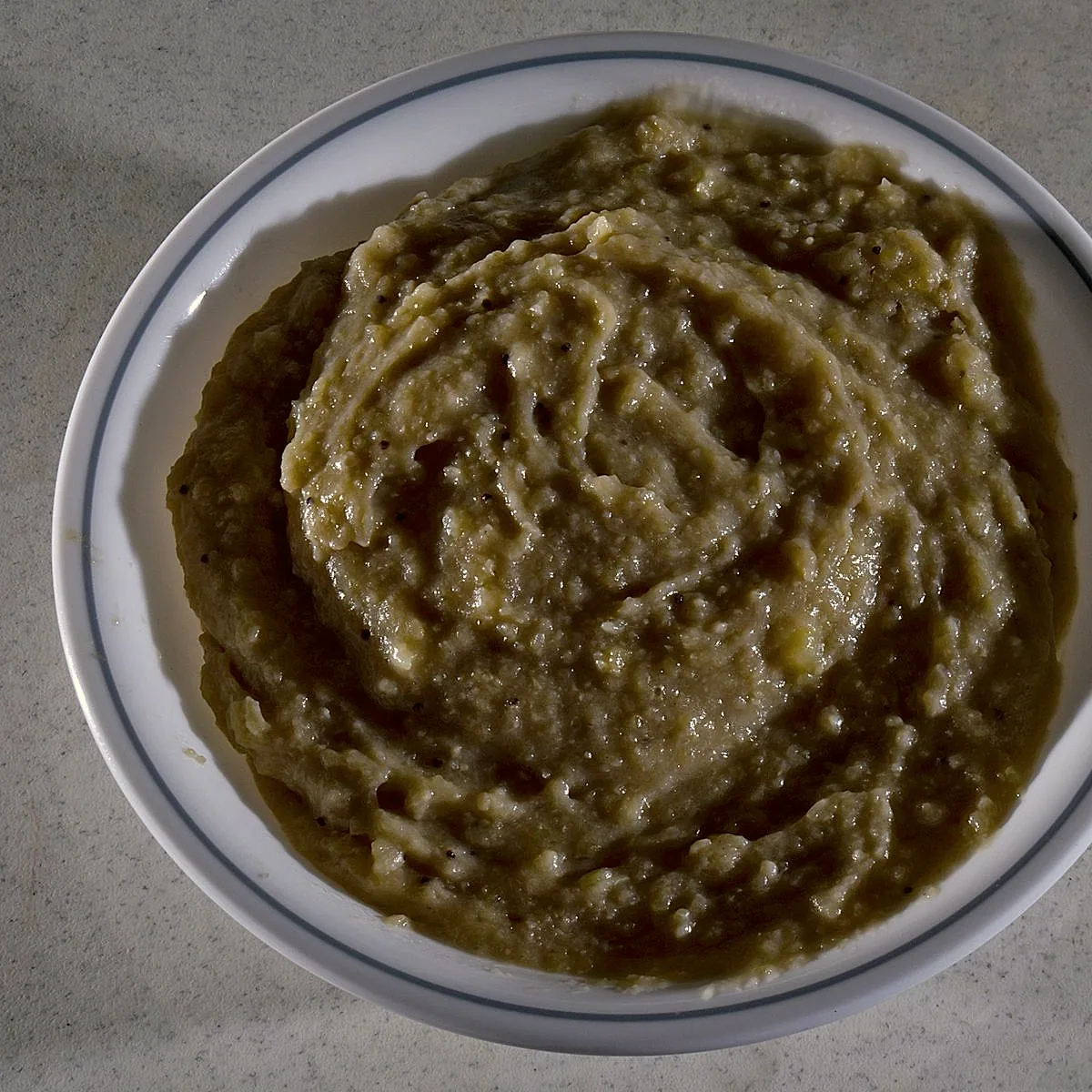

CC0. Cropped and colour-adjusted for this site.
Method
Put the 700 g green plantain in a pot with the 1.5 L water and 6 g fine sea salt and bring to a boil, then cook for 25m, until completely tender. Reserve some of the cooking water, then drain.
Common pitfallPlantains left even slightly underdone mash into a gluey, lumpy paste rather than a smooth one; they should be fork-tender all the way through before draining.
Heat the 20 ml vegetable oil in a pan over a medium heat and cook the 150 g red onion for most of 8m, until softened, then add the 30 ml white vinegar and simmer briefly until it reduces slightly.
Mash the drained plantains with the 40 g unsalted butter and enough of the reserved cooking water to make a smooth, soft mash, working for about 6m.
Mashing the plantains while they are still hot, with a little of their own cooking water rather than milk or stock, keeps the texture smooth without masking the plantain's own flavour.
Spread the mash onto plates and spoon the sautéed onions over the top; serve at once.
Mangú is Dominican plantain fufu: green plantains boiled soft and mashed to a smooth paste, a technique most food historians trace to West Africa, where pounded and mashed starchy staples were already a staple. Plantains themselves were a Spanish import to Hispaniola from the Canary Islands, so the plant and the technique that turns it into mangú arrived from opposite directions and met on the same island.
The dish's name is where the story gets contested rather than settled. The most repeated version holds that an American soldier during the 1916–1924 occupation of the Dominican Republic tried the mashed plantain and declared "Man, good!", which Dominicans supposedly turned into "mangú" [1] [2]. A second, less-repeated story instead traces the word to Haitian Creole, with a mother mashing plantain for a child who exclaimed "¡Maman gou!" [2]. A third theory ties "mangú" to "mangusi," a supposed Bantu word for any mashed tuber, but an exhaustive search of academic dictionaries and reference works on Bantu and Congolese vocabulary has turned up no entry for the word at all, leaving that theory without documentary support [2]. None of the three stories is confirmed by the written record: the earliest documented print appearance of "mangú" found so far is not a newspaper account of a soldier or a folk tale but a 1939 Dominican cookbook, Eulalia Cordero Infante's La cocina dominicana, which simply uses the word without explaining it [2]. What survives all three unverified etymologies is the plainer explanation: an African-descended word for a dish with clear African-descended roots, its exact derivation lost the way most everyday food vocabulary is lost, without a paper trail.
Mangú is eaten as breakfast most often, and most completely in the form called los tres golpes, "the three hits", where the mash is served alongside fried cheese, fried eggs and fried Dominican salami.
Sources
- Mangú, WikipediaDescribes mangú as boiled, mashed green plantain topped with sautéed red onion and vinegar, its likely descent from West African fufu, and the tres golpes accompaniment of fried cheese, egg and salami.
- Mangú, tradición que alimenta cuerpo y alma, Diario LibreReports the "Man, good!" story as recounted in Kepner Clement's "Sueños de la Hispaniola," a rival Haitian "¡Maman gou!" naming story, states that exhaustive searching finds no dictionary or academic record of the Bantu word "mangusi" some claim as the source, and dates the earliest documented print use of "mangú" to a 1939 Dominican cookbook.