Turkish · Dessert
Künefe
Buttered kadayıf packed around melting cheese, baked until the strands crisp and drenched in hot sugar syrup. One serving is a wedge cut from the tray.
Also known asKunefe · International
Not the same asKnafeh Nabulsieh (The Nablus version of the same syrup-on-hot-pastry idea, built on a semolina crust rather than shredded kadayıf and layered with akkawi rather than Hatay's own unsalted cheese; treated here as a separate dish.)
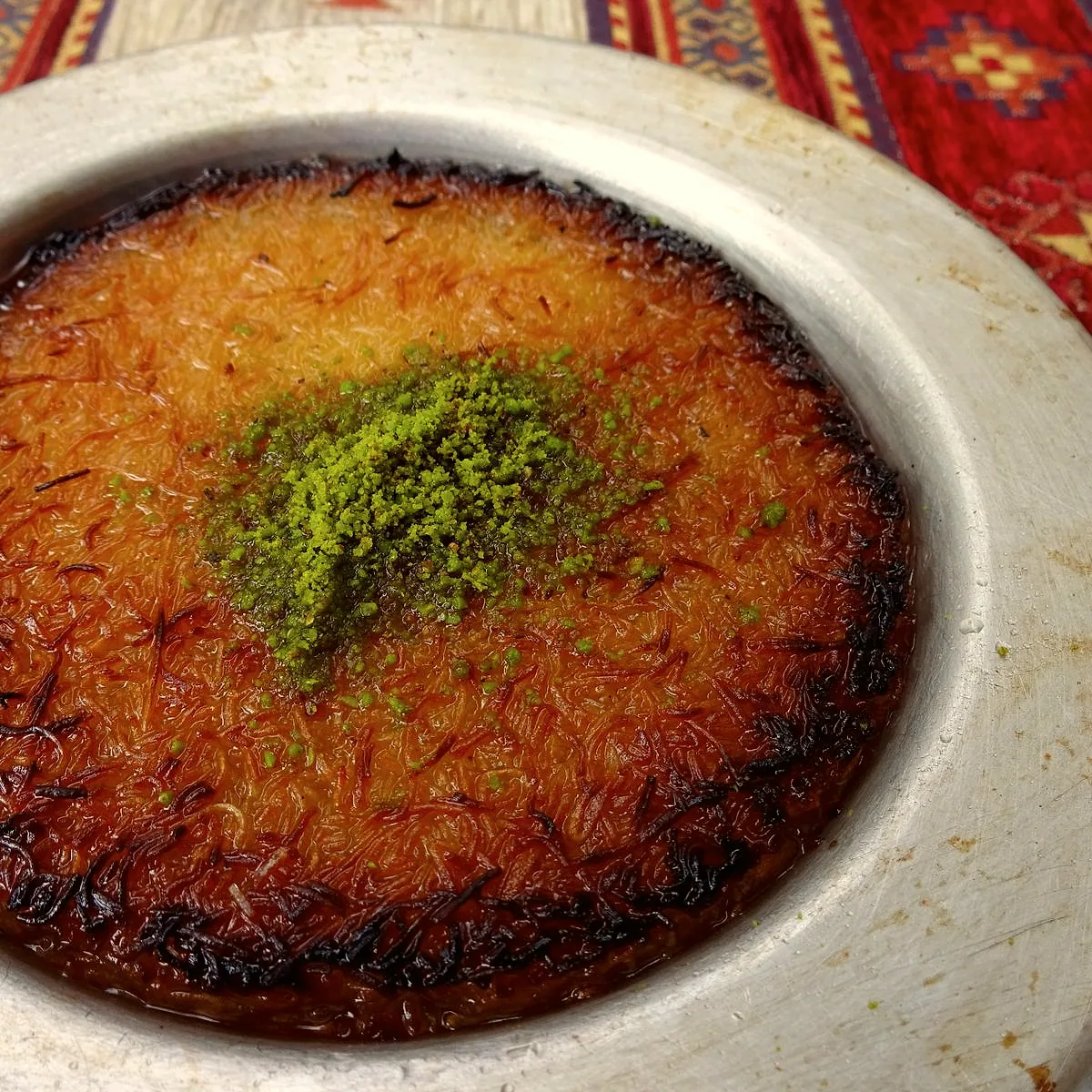

CC BY 3.0. Cropped and colour-adjusted for this site.
Method
Combine the 350 g caster sugar, 220 ml water and 15 ml freshly squeezed lemon juice in a small pan and bring to the boil, stirring until the sugar has dissolved. Simmer for 8m, then take off the heat and set aside to cool.
Meanwhile, pull the 400 g kadayıf apart into short lengths and work the 180 g unsalted butter through it with your fingers until every strand is coated. This takes 10m.
Working the butter through every strand before it goes near the heat is what lets the kadayıf crisp evenly instead of scorching in patches while the rest stays limp.
Grease a round baking tray with the 20 g unsalted butter. Press half the buttered kadayıf firmly into the base, lay the sliced 400 g künefe cheese evenly over it, then cover with the remaining kadayıf, pressing it down so the cheese is fully enclosed. This takes 12m.
Bake at 200 °C for 30m, until the top is deep golden and the cheese has melted and is bubbling at the edges.
Pour the cooled syrup evenly over the tray while the künefe is still hot, then scatter over the 30 g raw pistachios. Cut into wedges once the syrup has soaked in, after 5m.
Common pitfallPouring the syrup on while the tray is still searingly hot boils it straight back out. It goes on the moment the künefe comes out of the oven, but only once the worst of the sizzle has settled.
Künefe belongs to the same wide family of syrup-soaked cheese pastries found across the Levant, and the version eaten in Turkey is specifically Hatay's: it is generally described as having developed in the province around Antakya, just across the border from Syria, where the broader kanafeh tradition is strongest [1]. What distinguishes it from its Arab relatives is less the syrup, which is much the same sugar-and-lemon mixture used throughout the family, than the pairing of shredded kadayıf with a specific local cheese rather than a semolina crust or a Palestinian brined cheese.
That specificity is now written into law rather than left to custom. Hatay's künefe received geographical-indication protection from Turkey's own patent office, and in March 2023 the European Commission followed with a Protected Geographical Indication for "Antakya Künefesi", the ninth Turkish product to receive the designation [1][2]. The registered specification names four ingredients (künefelik kadayıf, fresh Antakya cheese made specifically for künefe, butter and syrup) and ties the recipe to production methods passed down through master-and-apprentice relationships within Hatay province, rather than to any single documented inventor or date [2]. That absence of a founding story is itself informative: unlike baklava's contested Ottoman-versus-Greek origin, künefe's identity rests on a living, protected regional practice rather than a disputed history.
Sources
- Künefe, WikipediaDescribes künefe as a Hatay-originated variant of the broader kanafeh family and covers the 2012 Turkish and 2023 EU geographical-indication protections for Antakya Künefesi.
- EU grants protected status for Turkish sweet 'Antakya Künefesi', Daily SabahReports the March 2023 EU Protected Geographical Indication decision and the product specification naming künefelik kadayıf, fresh Antakya cheese, butter and syrup as the defining ingredients.