Chinese · Starter
Har Gow
Whole shrimp and bamboo shoot wrapped in a translucent starch skin, steamed until the dough turns glassy enough to show the filling through it.
Also known asCrystal shrimp dumplings · International
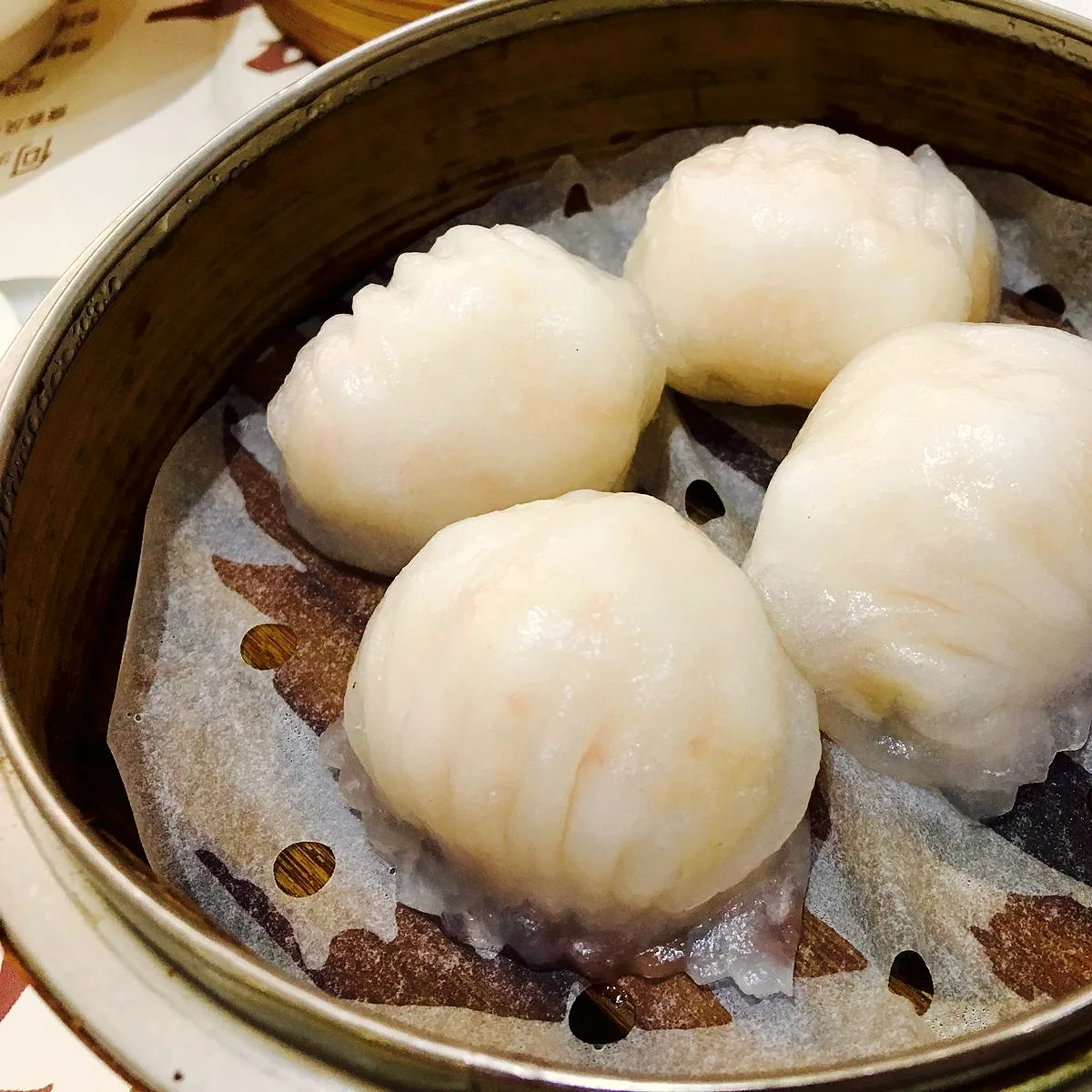
.jpeg)
CC BY-SA 4.0. Cropped and colour-adjusted for this site.
Method
Combine the 150 g wheat starch and 50 g tapioca starch in a heatproof bowl. Pour in the 180 ml water in a steady stream while stirring hard, until the mixture turns from cloudy and loose to translucent and clumped together. Once cool enough to handle, knead in the 15 ml peanut oil and 2 g fine sea salt for 12m, until smooth and pliable.
Scalding the starches with boiling water gelatinises them immediately, which is what makes the dough translucent once cooked. A wheat-flour dough gelatinises only under sustained heat and would stay opaque.
Cover the dough tightly with a damp cloth or clingfilm (it dries and cracks fast) and rest it for 15m.
Meanwhile, combine the 300 g shrimp, 60 g tinned bamboo shoots, 1 spring onion (15 g), 5 g fresh ginger, 5 ml toasted sesame oil, 3 g caster sugar, 1 g ground white pepper, 3 g fine sea salt and 10 g tapioca starch in a bowl and stir until the mixture turns sticky and holds together.
Pinch off small, even pieces of dough, keeping the rest covered. Press each piece flat under the broad side of a wide knife blade into a thin, near-transparent round about 7 cm across. Spoon filling into the centre and pleat one edge into a tight fan against the other, sealing the dumpling into a crescent that stands on its flat base.
Common pitfallStarch dough has no gluten to hold it together, so rolling it with a pin the way a wheat dough is rolled tears it. It presses flat instead, under the broad, flat side of a knife blade.
Line a steamer basket so the dumplings cannot stick to the metal or bamboo directly, and set them in with space between each. Steam over rapidly boiling water for 8m, until the wrapper has turned fully translucent and the shrimp inside is opaque and pink.
Har gow belongs to a specific place and a specific kind of kitchen: the teahouses of Guangzhou in the early twentieth century, where dim sum developed as a genre of small, shareable dishes built to be judged one plate at a time [2]. Within that world, credit for har gow itself usually goes to the Yi Zhen teahouse in Wufeng village, on the edge of the city, where a chef with a river of fresh shrimp on his doorstep worked out a dumpling to show it off with nothing standing in the way [1]. As with a great many teahouse-dumpling stories, the restaurant credit is more solidly attested than any precise date: no one publishes the year Yi Zhen first served it, and the dish is better understood as an emergent product of Guangzhou's teahouse dim sum culture than as a single afternoon's invention.
The dumpling's defining feature is not the shrimp but the wrapper around it. Har gow's skin is wheat starch and tapioca starch scalded with boiling water (no wheat flour, and so no gluten), which is what gives it a wrapper that turns glossy and faintly see-through once steamed, showing the pink of the shrimp through the dough instead of hiding it. That translucency is the whole design brief: a dumpling built to prove, at a glance, that the kitchen is not skimping on the filling. Cantonese dim sum menus still treat it as a benchmark dish: the wrapper thin enough to see through, robust enough not to split, and pleated by hand into a tight fan along one edge, a piece of handwork that separates a competent dim sum kitchen from an ordinary one.
Sources
- Har gow, WikipediaNames Yi Zhen teahouse in Wufeng village, Guangzhou, as the credited originating restaurant.
- Har Gow — History of Cantonese Shrimp Dumpling, RimpingPlaces the dish's emergence in early twentieth-century Guangzhou teahouse culture.