Filipino · Dessert
Halo-Halo
Sweetened beans, banana and ube halaya, layered under shaved ice and finished with evaporated and condensed milk, mixed together at the table.
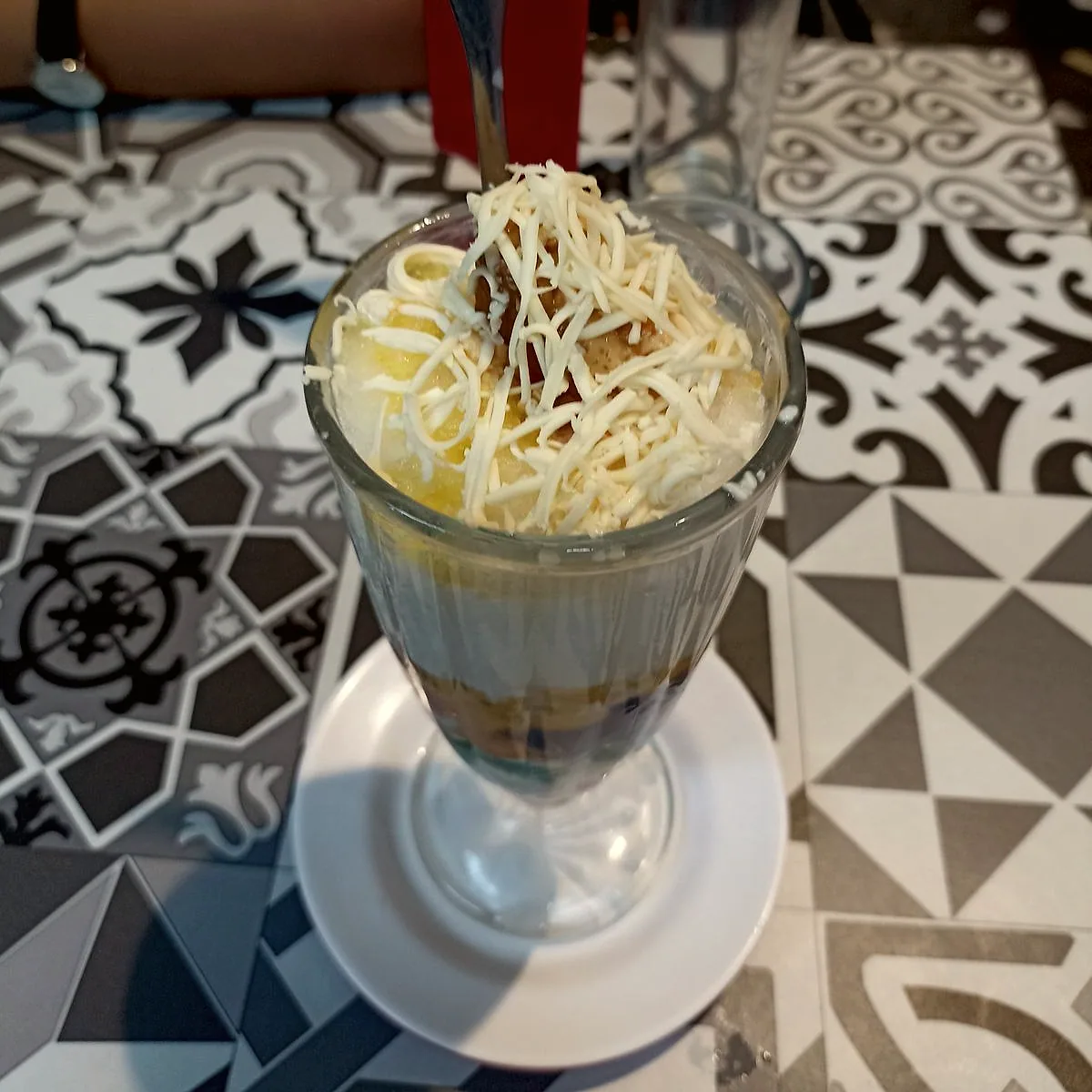

CC BY-SA 4.0. Cropped and colour-adjusted for this site.
Method
Drain the soaked 100 g dried kidney beans, cover with the 600 ml water and simmer for most of 1h 5m, until tender. Drain again, return to the pan with the 40 g caster sugar and a splash of water, and simmer for the remaining few minutes until syrupy.
Meanwhile, cover the 300 g ube with the 400 ml water and simmer for most of 30m, until fork-tender. Drain, mash while hot with the 50 g caster sugar and 60 g condensed milk, and continue cooking briefly over a low heat, stirring, until thick and glossy.
Simmer the 200 g banana with the 30 g caster sugar and 50 ml water for 10m, until the banana has softened and the liquid has thickened into a light syrup.
Divide the sweetened beans, banana syrup and ube halaya between glasses. Mound shaved ice on top and pour over the 300 ml evaporated milk and 140 g condensed milk. Stir together at the table before eating.
Common pitfallPiling all three components into the glass before the ice, rather than under it, buries them where they never get seen or stirred through evenly. Ice goes on top, mounded high, with the milk poured last.
The name describes the eating, not any one ingredient: halo-halo comes from the Filipino verb halò, "to mix," reduplicated into "mix-mix," an instruction as much as a title: everything in the glass is meant to be stirred together before it is eaten [1] [3].
Before it had that name, or its present crowd of toppings, it was a much simpler snack made by the Japanese who lived in the Philippines before the Second World War: a version of Japan's own shaved-ice kakigōri, sweet beans heaped with ice [3] [1]. The cold snack was called mongo-ya, after its main ingredient, the mung bean. It was a predecessor recorded by the Japanese businessman Kiyoshi Osawa in his memoir, A Japanese in the Philippines [2] [1].
Filipino vendors kept building on that base rather than leaving it as it was, substituting and adding local ingredients until the single-bean snack had become the crowded, many-layered dessert now sold under its present name [1] [3].
Sources
- Halo-halo, WikipediaGives the Filipino reduplicative etymology, the monggo con hielo predecessor, and the 1920s-1930s Japanese-migrant, Quiapo-market account of its early development.
- Did you know that halo-halo was inspired by Japan's kakigori?, GMA News OnlineCites Kiyoshi Osawa's memoir "A Japanese in the Philippines" on the original mongo-ya stalls that preceded halo-halo.
- Beating the heat and more: How well do you know your halo-halo?, SBS FilipinoCorroborates the "mix-mix" etymology and the dessert's development from Japanese kakigori by Filipino vendors substituting and adding local ingredients.