Mexican · Starter · Condiment
Guacamole
Ripe avocado crushed into a ground paste of white onion, green chilli, coriander and salt, and sharpened with lime.
Not the same asAvocado dip (Commercial dips are usually thinned with soured cream, mayonnaise or vegetable oil and stabilised so they will not brown, which is a different food with a similar colour.)
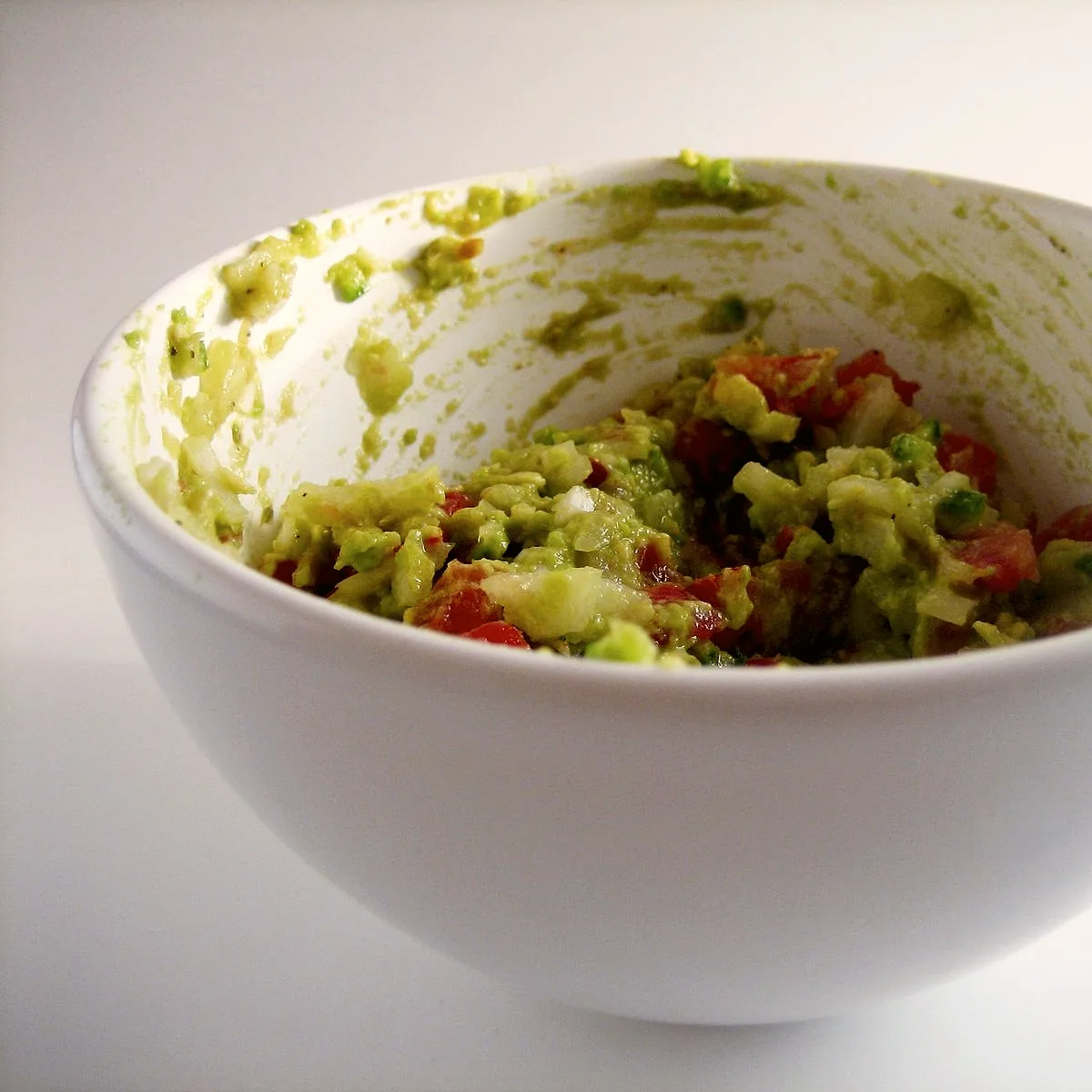

CC BY-SA 2.0. Cropped and colour-adjusted for this site.
Method
Grind the 50 g white onion, the 2 serrano chillies (16 g), the 10 g fresh coriander and the 5 g fine sea salt together in a mortar (a basalt molcajete if there is one), working for 5m until they collapse into a coarse green paste and the onion has given up its juice. It should smell of all four at once rather than of each in turn.
The onion, chilli, coriander and salt are ground to a paste before the avocado goes anywhere near them. The salt acts as an abrasive and the grinding ruptures cells that chopping only cuts past, which is the difference between a seasoned avocado and a seasoning that has become part of it.
Halve the 3 avocados (420 g), lever out the stones and scoop the flesh in on top. Crush it into the paste with a fork or the pestle for 3m, turning it over rather than beating it, until it is bound but still plainly in pieces. Fold through the 20 ml fresh lime juice, scatter the 5 g fresh coriander over the top and serve it in the mortar.
Common pitfallA food processor turns guacamole into a smooth pale purée that tastes flat. It is crushed by hand and left visibly lumpy, because the pieces of intact avocado are most of the texture.
The name is Nahuatl and entirely literal: āhuacamōlli, from āhuacatl, avocado, and mōlli, sauce [1]. It reached English through American Spanish, where the Online Etymology Dictionary records its first appearance in 1891 [2].
The ingredient is very much older than the word. Avocado remains from caves in the Tehuacán Valley have been dated to nine or ten thousand years ago, and the tree was under cultivation across Mesoamerica by around 5000 BCE [1].
What is missing from all of this is a recipe. Two sixteenth-century Spanish sources record the food without recording its making: Alonso de Molina's Nahuatl vocabulary of 1571 notes a delicacy of avocados with ground dried chillies, and Bernardino de Sahagún's history describes three kinds of avocado and a range of medicinal uses for the tree, but neither says how the sauce was prepared or how it was eaten [3]. No original recipe survives. What does survive is the equipment: the ingredients were ground together in a molcaxitl, the basalt mortar still in daily use as the molcajete [3].
The earliest description in English belongs to a buccaneer. William Dampier's A New Voyage Round the World of 1697 has avocado flesh "mixed with sugar and lime-juice and beaten together in a plate" [3]. It is the same operation performed on the same fruit, and sweet rather than salted.
The Aztec pedigree is therefore real at the level of the ingredient, the name and the tool, and thin at the level of the dish. Guacamole as it is made now (avocado crushed into a ground paste of onion, chilli, coriander and salt) is a modern Mexican preparation standing on a very old foundation, not a reconstruction of anything anyone wrote down.
Sources
- Guacamole, WikipediaOn the Nahuatl etymology, the archaeological dates for avocado in Mesoamerica, and Dampier's account.
- guacamole (n.), Online Etymology DictionaryDates the word's first appearance in English and gives the Nahuatl components.
- A Brief History of Guacamole (And It's Not What You'd Expect!), TheCollector, 2024Kristen Jancuk, on Molina's 1571 vocabulary, Sahagún's account of avocados, the molcaxitl, and the absence of any surviving original recipe.