British · Main Course
Fish and Chips
Battered, deep-fried white fish with thick-cut, twice-fried chips and mashed marrowfat peas.
Not the same asAmerican fish fry (Usually made with cracker meal or cornmeal breading rather than a wet batter, and served without chips or mushy peas.)
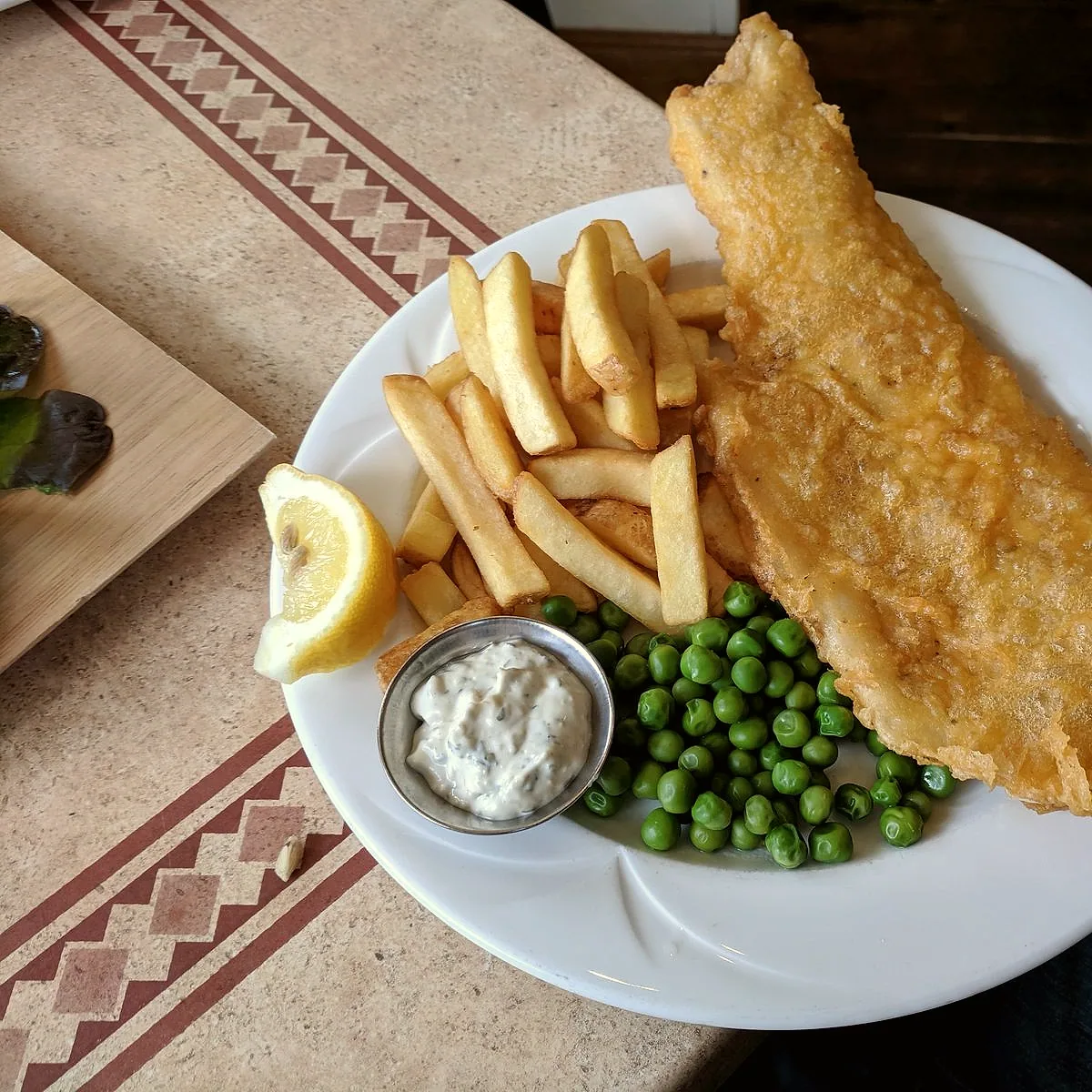

CC BY-SA 4.0. Cropped and colour-adjusted for this site.
The same dish, adapted. Every quantity, time and figure below changes with the version.
Method
Cover the 150 g dried marrowfat peas with the 400 g water and leave to soak for 8h.
Peel the 700 g potato and cut into thick batons.
Drain the soaked peas, cover with the 100 g water, add the 2 g bicarbonate of soda and the 2 g fine sea salt, and simmer for 45m, until completely soft, then mash roughly with a fork or potato masher, leaving some texture.
Heat the 1.5 kg vegetable oil to a moderate temperature of about 130 °C and fry the chips in batches for 8m, until soft all the way through but still pale. Lift out and drain.
Leave the chips to cool and dry out on a wire rack for 15m.
Frying the chips twice, with a rest in between, is what gives a soft interior and a shatter-crisp outside; the first fry cooks them through at a lower temperature, and the rest lets the surface dry before a much hotter second fry crisps it.
Whisk the 150 g plain flour, the 5 g baking powder and the 3 g fine sea salt together, then whisk in the 220 g beer until just combined into a thick, slightly lumpy batter.
Raise the oil to 190 °C and fry the chips a second time, in batches, for 7m, until deep golden and crisp. Drain and season with the 5 g fine sea salt.
Pat the 400 g cod dry, dip each fillet in the batter to coat completely, and lower into the 190 °C oil. Fry for 9m, until the batter is deep golden and crisp and the fish is opaque all the way through.
Common pitfallA batter mixed too far ahead, or overworked, loses the carbonation that keeps it light and develops gluten that makes it chewy. It is mixed just before frying and left a little lumpy.
Serve the fish and chips at once with the mashed peas and the 20 g malt vinegar alongside.
Method
Cover the 150 g dried marrowfat peas with the 400 g water and leave to soak for 8h.
Peel the 700 g potato and cut into thick batons.
Drain the soaked peas, cover with the 100 g water, add the 2 g bicarbonate of soda and the 2 g fine sea salt, and simmer for 45m, until completely soft, then mash roughly with a fork or potato masher, leaving some texture.
Heat the 1.5 kg vegetable oil to a moderate temperature of about 130 °C and fry the chips in batches for 8m, until soft all the way through but still pale. Lift out and drain.
Leave the chips to cool and dry out on a wire rack for 15m.
Whisk the 150 g self-raising flour, the 30 g cornflour and the 2 g fine sea salt together, then whisk in the 220 g water until just combined into a thin, smooth batter.
Common pitfallUsing flour straight from the cupboard rather than well-chilled water and a cold bowl gives a duller, less crisp crust. Ice-cold water is what keeps the batter's rise sharp when it hits the hot oil.
Raise the oil to 190 °C and fry the chips a second time, in batches, for 7m, until deep golden and crisp. Drain and season with the 5 g fine sea salt.
Pat the 400 g cod dry, dip each fillet in the batter to coat completely, and lower into the 190 °C oil. Fry for 9m, until the batter is pale gold and crisp and the fish is opaque all the way through.
Serve the fish and chips at once with the mashed peas and the 20 g malt vinegar alongside.
The fish and the chips arrived in Britain by separate routes, and only joined forces well over a century apart. Frying fish in a floured coating, then eating it cold, was a Sephardic Jewish practice brought to England by refugees fleeing the Portuguese Inquisition from the sixteenth century onward, useful precisely because oil-fried fish, unlike fish cooked in hard fat, keeps well enough to serve at room temperature. This was a practical answer to the prohibition on cooking on the Sabbath [2].
The practice was well established in London by the early nineteenth century. Charles Dickens mentions a "fried fish warehouse" in Oliver Twist [1][3], and in 1845 the French chef Alexis Soyer published a recipe titled "Fried Fish, Jewish Fashion" [1][2]. Fried chipped potatoes appear in the English record at almost the same moment and independently of the fish. The pairing of the two into a single dish is usually dated to the 1860s, credited variously to Joseph Malin, an Ashkenazi Jewish immigrant who opened a fish and chip shop in London's East End, and to John Lees, who is separately said to have sold the combination from a stall in Mossley, Lancashire, by 1863 [1][2][3]. Both claims rest on oral tradition and trade-body recognition rather than contemporary documentation, and there is no way to settle which came first.
What is well documented is the dish's later status as a fixture of British life: it was kept exempt from rationing through both World Wars, a choice remembered as a matter of civilian morale as much as nutrition [1][2][3]. A dish built from two unrelated immigrant and industrial food trends, joined in shops with no fixed single founder, ended up as close to an official national dish as Britain has.
Sources
- Fish and chips, WikipediaOn the Jewish fried-fish tradition, Charles Dickens's references in Oliver Twist and A Tale of Two Cities, Joseph Malin's and John Lees's shops of the 1860s, and the dish's exemption from wartime rationing.
- The Surprising Jewish History Behind Fish 'n' Chips, The Times of IsraelOn Sephardic Jewish settlement, Alexis Soyer's 1845 "Fried Fish, Jewish Fashion" recipe, Joseph Malin's shop, and the wartime rationing exemption.
- The History of Fish and Chips, Historic UKOn Dickens's "fried fish warehouse" reference, John Lees's 1863 stall in Mossley and Joseph Malin's London shop, and the wartime rationing exemption.