Persian · Main Course
Chelo Kabab Koobideh
Lamb and beef mince pounded with grated onion until it clings to a flat skewer unaided, then grilled over charcoal to a deep, even char.
Also known asKabab koobideh · Iran
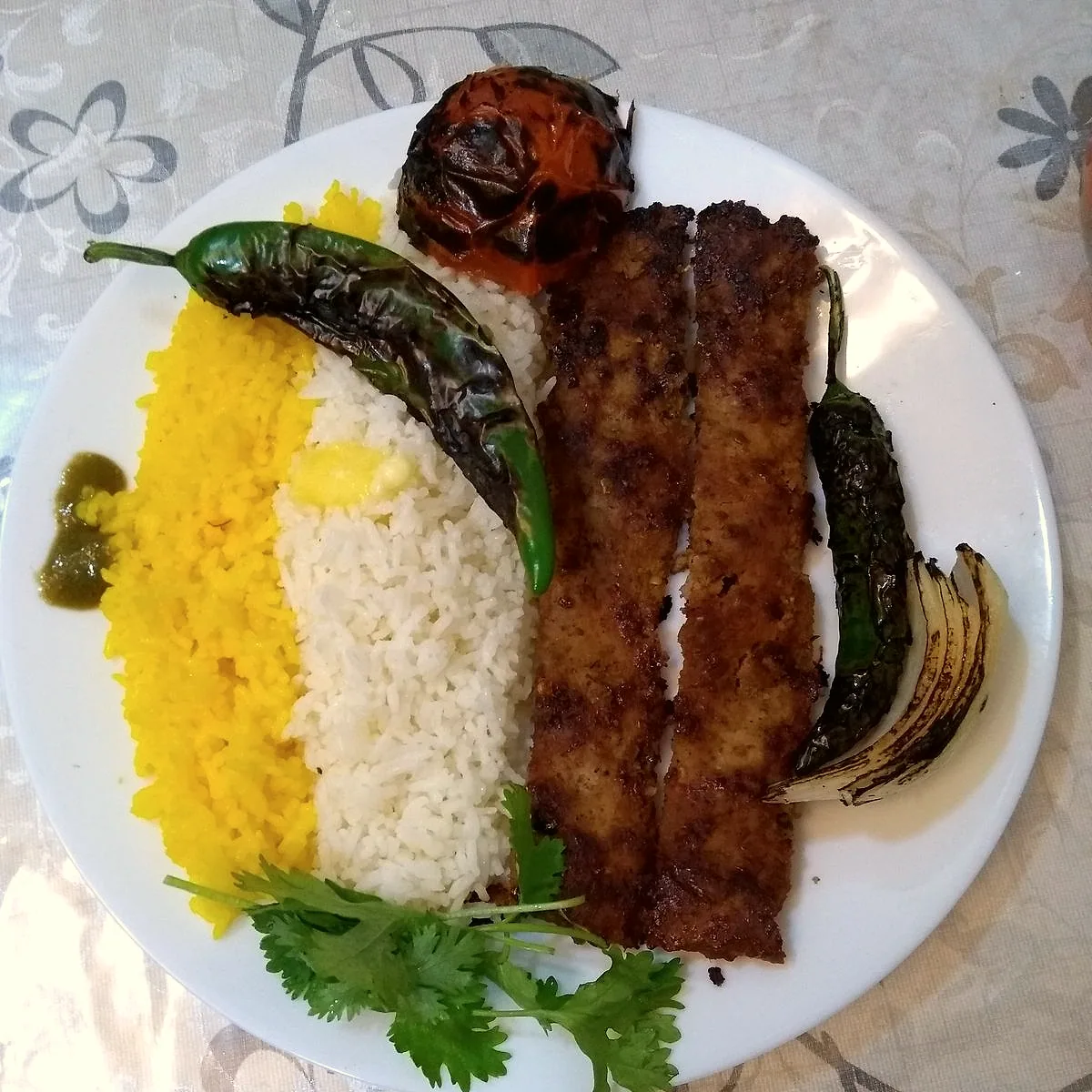

CC BY-SA 4.0. Cropped and colour-adjusted for this site.
Method
Squeeze the grated 100 g yellow onion firmly to remove excess liquid, then combine the pulp with the 250 g lamb mince, 250 g beef mince, 8 g fine sea salt, 3 g ground black pepper and 1 g bicarbonate of soda in a wide bowl. Knead and pound the mixture by hand for 10m, until it turns dense, sticky and uniform.
The mince is pounded and squeezed by hand, not just stirred, until the proteins break down enough to bind the meat into a paste that holds its shape on the skewer with no egg or breadcrumb added.
Cover the mince and chill it for 30m, so it firms up and is easier to mould onto the skewers.
Divide the mince into even portions. With wet hands, mould each portion around a broad, flat metal skewer, pressing and smoothing it into a long, even ribbon that grips the blade. Work for 10m in total.
Common pitfallOnion left wet makes the mince slack and prone to sliding off the skewer or splitting on the grill. Squeezing it dry before it goes into the mince is what keeps the paste firm enough to hold its shape.
Grill the skewers over fierce, direct charcoal heat, turning them often, for 12m, until evenly charred outside and cooked through with no pink remaining at the centre.
The name of the dish is a description of how it is made. Koobideh is the past participle of the Persian verb koobidan, "to pound" [1], and that is the traditional method behind the modern kneading and squeezing by hand: the meat was once laid on a flat stone or log and beaten with a wooden mallet until it bound into a paste that would hold its own shape on a skewer with no egg or breadcrumb added [1].
Where in Iran the technique was first used this way is not settled. Three places are each named as the dish's home (Golpayegan, Tehran and Bonab), and the available record does not adjudicate between them or supply a date for when any of them arrived at it [1]. Bonab's claim rests on its own named kebab, pounded from mutton with onion and salt and served on a scale large enough to be the dish's defining feature, which suggests a genuinely separate local tradition rather than a simple relabelling of koobideh [2].
A separate account puts the wider chelo-kabab tradition's arrival in Iran in the Qajar era, crediting either Caucasian people directly or Nasser al-Din Shah's own taste for what he encountered on his travels to Russia and the Caucasus, as recorded by the nineteenth-century writer Mirza Mohammad Reza Mo'tamed-ul-Ketab Shams Larijani [3]. That account is offered as one telling among others rather than a settled fact, and it concerns chelo-kabab as a whole rather than koobideh's pounding technique specifically, so it does not resolve the Golpayegan-Tehran-Bonab question above [3].
What is better documented is the kebab's place in a wider family: kabab koobideh is one of several skewered minced-meat preparations across Iran and its neighbours built on the same pounding technique, distinguished from one another mainly by the ratio of lamb to beef, the seasoning, and how the meat is bound to the skewer rather than by a separate invention each time.
Sources
- Kabab koobideh, WikipediaGives the Persian etymology from koobidan, "to pound," and names Golpayegan, Tehran and Bonab as competing regional claimants.
- Bonab kababi, WikipediaIndependently confirms Bonab's own named kebab tradition (mutton pounded with onion and salt) as a separate article from kabab koobideh, supporting that Bonab's claim rests on a genuinely distinct large-format kebab rather than an identical dish.
- History of Chelo Kabab, Iran Chamber SocietyA cultural-reference site on Iranian history and society; gives the Qajar-era account of chelo-kabab reaching Iran from the Caucasus and names the nineteenth-century writer credited with recording it.