American · Dessert · Snack
Brownies
A dense, low-flour chocolate square baked just until it sets, with no leavening to lighten it.
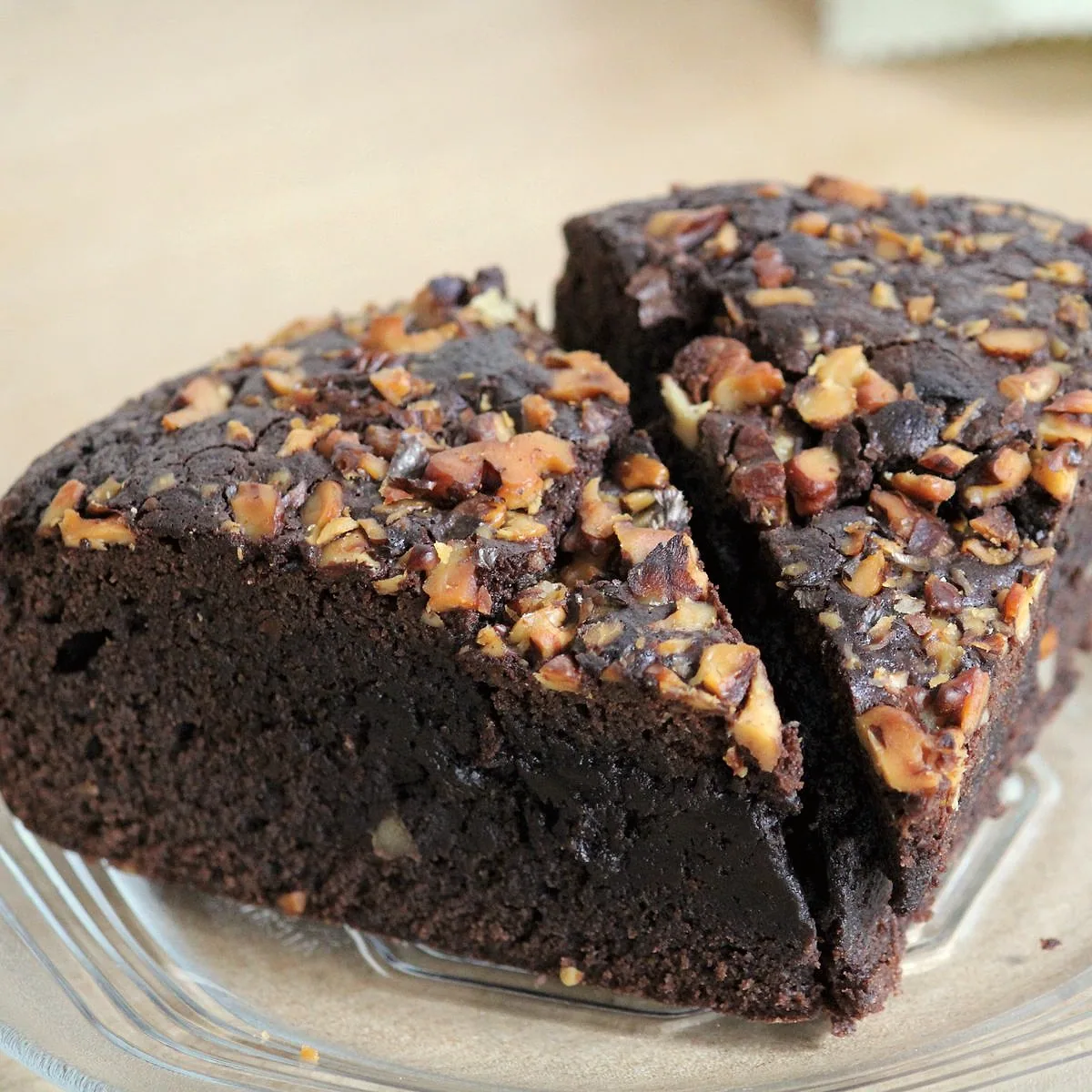

CC BY-SA 4.0. Cropped and colour-adjusted for this site.
The same dish, adapted. Every quantity, time and figure below changes with the version.
Method
Melt the 200 g dark chocolate with the 170 g unsalted butter together over a low heat or in short bursts in a microwave, stirring until smooth. This takes 5m; let it cool slightly while the oven heats.
Heat the oven to 175 °C, giving it 15m to settle, and line a square baking tin with paper, leaving an overhang on two sides to lift the brownies out later.
Whisk the 300 g caster sugar into the 3 eggs (150 g) and the 8 ml vanilla extract for the whole of 5m, until the mixture is pale, thick and holds a ribbon briefly when the whisk is lifted.
Whisking sugar into egg until it lightens and thickens is what gives a fudgy brownie its thin, crackled top crust; that surface is dissolved sugar, not a separate glaze.
Fold the cooled chocolate mixture into the egg mixture over 3m, mixing just until the streaks disappear.
Sift the 90 g plain flour, the 30 g cocoa powder and the 4 g fine sea salt over the batter and fold them through with 3m, stopping the moment no dry patches remain: overworking it here is what turns a fudgy brownie cakey.
Pour into the lined tin and bake for 25m, until the top has set to a thin, crackled crust and a skewer pushed into the centre comes out with a little wet batter still clinging to it.
Common pitfallA skewer test written for cake fails a fudgy brownie, since the right texture still looks under-set at the centre. Pull the tin when the edges are firm and the middle only just stops looking wet.
Leave the tray to cool completely, for 30m, before lifting out and cutting into squares. Cutting warm brownies tears the crumb rather than slicing it.
Method
Beat the 140 g unsalted butter with the 250 g caster sugar for 4m, until pale and fluffy.
Meanwhile heat the oven to 175 °C, giving it 15m to settle, and line a square baking tin with paper, leaving an overhang on two sides.
Beat in the 2 eggs (100 g) and the 8 ml vanilla extract a little at a time over 3m, letting each addition disappear before the next goes in.
Sift the 180 g plain flour, the 40 g cocoa powder, the 6 g baking powder and the 3 g fine sea salt together. Fold them into the batter in two additions, alternating with the 60 ml milk, over 4m, finishing on the dry ingredients and stopping as soon as the batter is smooth.
Pour into the lined tin and bake for 30m, until a skewer pushed into the centre comes out clean and the top springs back when pressed lightly.
Common pitfallThis crumb bakes more like a cake than the fudgy version, so a skewer really should come out clean here; pulling it early on the assumption that all brownies stay wet in the centre leaves this version gluey rather than fudgy.
Leave the tray to cool for 20m before lifting out and cutting into squares.
The most polished account of the brownie's invention names a place, a date and a patron. Bertha Palmer, whose husband had given her Chicago's Palmer House Hotel, is said to have asked its pastry chef for a small, packable dessert for the boxed lunches served to women visiting the 1893 World's Columbian Exposition. The result was a dense, fudgy square finished with walnuts and an apricot glaze [1]. The chef who is supposed to have made it is not named in any surviving account, which is exactly the kind of gap that separates a documented recipe from a good story about one.
A second, more folksy version places the invention in Bangor, Maine, where a housewife baking a chocolate cake is said to have forgotten the baking powder; the batter never rose, she cut it into squares anyway, and a dessert was born by accident [1]. The story attaches itself to a real, dated document (a "Bangor Brownies" recipe printed in the Boston Globe in 1905), but the connection between the recipe's name and the accident it is supposed to explain is not established; nothing in the record confirms a specific Bangor housewife as the dessert's inventor [1]. What can be dated is the print trail either side of it: a molasses cake recipe appeared in the Boston Cooking School Cookbook in 1896, and by 1905 Fannie Farmer had adapted her own chocolate cookie dough into a sheet-pan format close to a modern brownie [1].
What the competing stories agree on, more than any inventor, is that the brownie took shape in the United States in the closing years of the nineteenth century as chocolate confections and cake batters were pushed toward a single dense, cuttable square, a form with no close equivalent in the British or European baking that most other American desserts of the period still borrowed from [2]. Even the name is unsettled: it may simply describe the colour, or it may owe something to a set of mischievous "Brownie" characters popular in children's books of the period [1].
Sources
- The Confusing Origin Story Of Brownies, Tasting TableOn the Bertha Palmer / Palmer House account, the Bangor "accidental cake" story and the 1905 "Bangor Brownies" recipe it grew up around, and the documented 1896 and 1905 print recipes.
- Brownies, US History SceneOn the brownie's development as an American dessert distinct from British and other national baking traditions.