Turkish · Dessert
Baklava
Buttered sheets of filo layered with pistachio, cut into diamonds and soaked in cold sugar syrup straight from the oven. One serving is one piece from the tray.
Also known asAntep baklavası · Turkey
Not the same asIranian baghlava (Cut into much smaller diamonds and scented with cardamom, its syrup finished with rosewater. It is a related but separate pastry, not a version of this dish.)Azerbaijani pakhlava (Stamped with a lozenge pattern and topped with a whole walnut in each piece, its syrup tinted and scented with saffron. It is a separate national dish rather than a version of this one.)
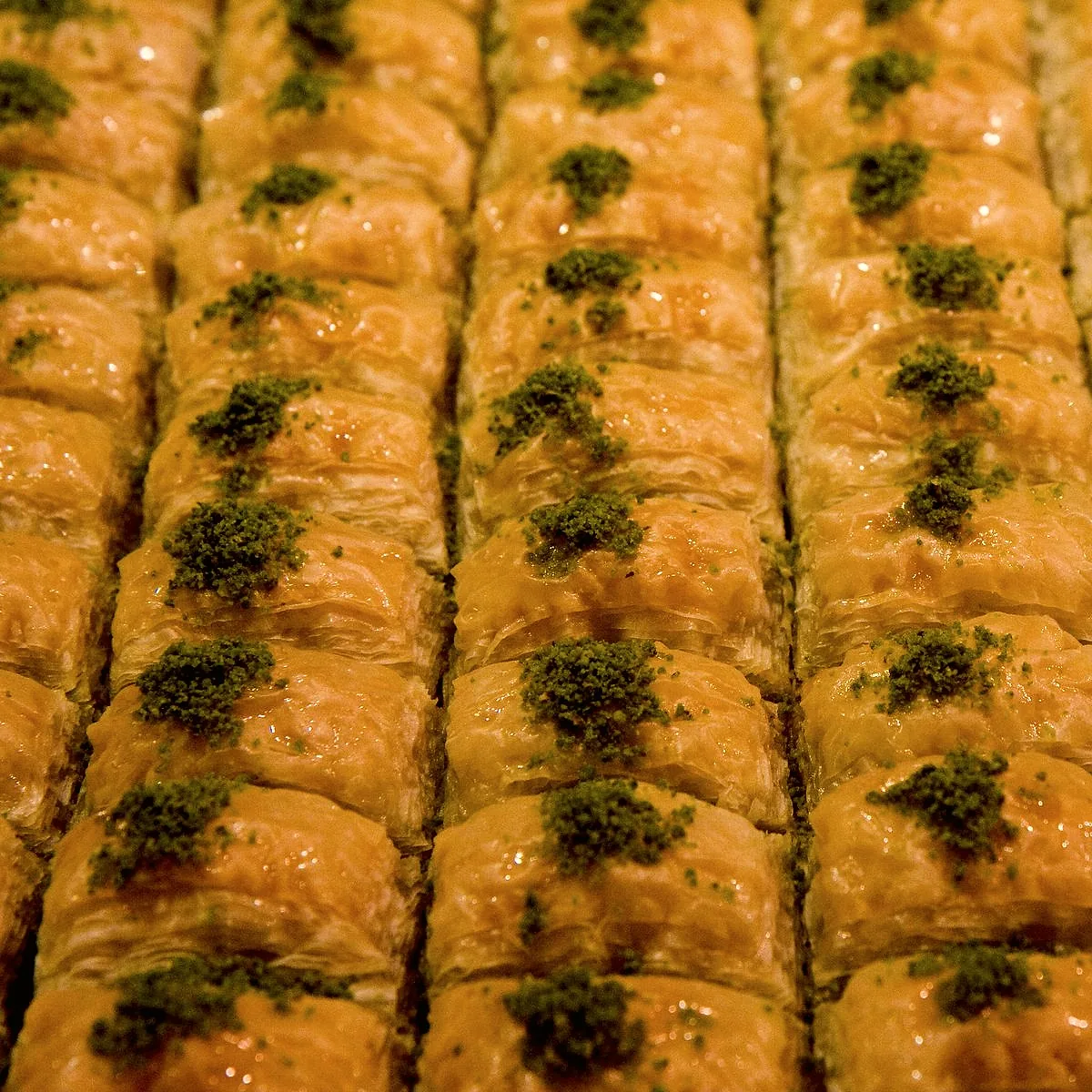

CC BY-SA 4.0. Cropped and colour-adjusted for this site.
The same dish, adapted. Every quantity, time and figure below changes with the version.
Method
Combine the 400 g caster sugar, 240 ml water and 15 ml freshly squeezed lemon juice in a small pan and bring to the boil, stirring until the sugar has dissolved. Simmer for 8m, then take off the heat and set aside to cool completely while the baklava layers and bakes.
Brush the base of a baking tray with the 250 g unsalted butter. Lay in half of the 450 g filo pastry, sheet by sheet, brushing each one with butter before adding the next. Scatter the 250 g raw pistachios evenly over the stack, then layer the remaining filo on top in the same way, brushing every sheet, finishing with a well-buttered top layer. Spend the whole of 30m keeping the sheets flat and the butter even, since a dry patch anywhere will not soften once baked.
Using a sharp knife, cut all the way through the layered pastry into even diamonds, working from one edge of the tray to the other. This takes 3m done carefully, and it is the last chance to fix the shape of the pieces before the oven sets them.
Common pitfallCutting after baking shatters the crisp top layers. The tray is scored into diamonds while the pastry is still raw, so the syrup can later run cleanly down cuts that already exist.
Bake at 160 °C for 40m, until the top is deep golden and the edges have pulled slightly away from the tray.
Take the tray straight from the oven and immediately pour the cooled syrup evenly over the hot pastry, working corner to corner so every piece gets its share. Scatter over the 50 g raw pistachios and leave the tray to sit undisturbed for 3m before lifting the pieces out along their cut lines.
Pouring cold syrup over baklava straight from a hot oven is the whole method; the temperature gap between the two is what drives the syrup into the layers without collapsing them into a soggy mass.
Method
Stir the 300 g chopped walnuts and 6 g ground cinnamon together and set aside; this takes 4m.
Combine the 300 g caster sugar and 200 ml water in a small pan and bring to the boil, stirring until the sugar has dissolved. Simmer for 8m, then take off the heat, stir in the 150 g honey and the 15 ml freshly squeezed lemon juice, and set aside to cool completely while the baklava layers and bakes.
Brush the base of a baking tray with the 250 g unsalted butter. Lay in half of the 450 g filo pastry, sheet by sheet, brushing each one with butter before adding the next. Scatter the walnut and cinnamon filling evenly over the stack, then layer the remaining filo on top in the same way, brushing every sheet, finishing with a well-buttered top layer. Spend the whole of 30m keeping the sheets flat and the butter even, since a dry patch anywhere will not soften once baked.
Using a sharp knife, cut all the way through the layered pastry into even diamonds or rectangles, working from one edge of the tray to the other. This takes 3m done carefully, and it is the last chance to fix the shape of the pieces before the oven sets them.
Common pitfallCutting after baking shatters the crisp top layers. The tray is scored into diamonds while the pastry is still raw, so the syrup can later run cleanly down cuts that already exist.
Bake at 160 °C for 40m, until the top is deep golden and the edges have pulled slightly away from the tray.
Take the tray straight from the oven and immediately pour the cooled honey syrup evenly over the hot pastry, working corner to corner so every piece gets its share. Leave the tray to sit undisturbed for 3m before lifting the pieces out along their cut lines.
Pouring cold syrup over baklava straight from a hot oven is the whole method; the temperature gap between the two is what drives the syrup into the layers without collapsing them into a soggy mass.
Method
Combine the 400 g caster sugar, 240 ml water and 10 ml freshly squeezed lemon juice in a small pan and bring to the boil, stirring until the sugar has dissolved. Simmer for 8m, then take off the heat, stir in the 15 ml orange blossom water and set aside to cool completely while the baklava layers and bakes.
Common pitfallBoiling the orange blossom water along with the sugar cooks off its scent. It goes in only once the syrup is off the heat and no longer boiling.
Brush the base of a baking tray with the 250 g unsalted butter. Lay in half of the 450 g filo pastry, sheet by sheet, brushing each one with butter before adding the next. Scatter the 250 g raw pistachios evenly over the stack, then layer the remaining filo on top in the same way, brushing every sheet, finishing with a well-buttered top layer. Spend the whole of 30m keeping the sheets flat and the butter even, since a dry patch anywhere will not soften once baked.
Using a sharp knife, cut all the way through the layered pastry into even diamonds, working from one edge of the tray to the other. This takes 3m done carefully, and it is the last chance to fix the shape of the pieces before the oven sets them.
Bake at 160 °C for 40m, until the top is deep golden and the edges have pulled slightly away from the tray.
Take the tray straight from the oven and immediately pour the cooled ater evenly over the hot pastry, working corner to corner so every piece gets its share. Scatter over the 50 g raw pistachios and leave the tray to sit undisturbed for 3m before lifting the pieces out along their cut lines.
Pouring cold syrup over baklava straight from a hot oven is the whole method; the temperature gap between the two is what drives the syrup into the layers without collapsing them into a soggy mass.
Few desserts carry as contested an origin as baklava, and the argument is not only historical: Turkish newspapers speculated about the matter in 2012 after a sitting American president was photographed eating baklava at a Greek Independence Day dinner [2]. A Greek claim points to the ancient "placenta cake" described by Roman writers (a baked, honey-soaked layered dough the food historian Patrick Faas has read as a direct ancestor) while a Turkish claim rests on Ottoman kitchens rather than antiquity: the pastry as it is eaten today is generally held to have been developed in the imperial kitchens of Topkapı Palace in Constantinople [1]. A third account traces the layering technique to the flatbreads of nomadic Turkic cooks in Central Asia, carried west long before the Ottoman court ever served it [1]. None of the three is settled, and the word itself is no help in choosing between them: the earliest known written use of "baklava" is not a recipe at all but a line in a poem by the 15th-century mystic Kaygusuz Abdal [1].
The Ottoman court's own regard for the dish is better documented than its invention. From 1520 the sultan marked the fifteenth day of Ramadan with the "Baklava Procession", sending trays of it out to the Janissary Corps at a rate of one tray for every ten soldiers, a custom that continued until the corps was disbanded in 1826 [2].
Gaziantep's modern claim to the pistachio version is comparatively recent and comparatively well documented. The city sits inland from Turkey's pistachio-growing region, and the Güllüoğlu family, who trace their baklava back to training in Aleppo and Damascus, describe adding local pistachio to the family recipe around 1871 [2]. Gaziantep baklava (thinner layers, a denser pistachio filling, syrup rather than honey) was registered as a geographical indication by Turkey's patent office in 2008 and then granted Protected Geographical Indication status by the European Commission in 2013, the first Turkish product to receive it, a decision that reportedly disappointed baklava producers elsewhere, Greece included [1][2]. That recognition covers the Gaziantep style specifically rather than baklava as a whole, which is why the walnut-and-honey version associated with Greece and the ater-soaked, orange-blossom-scented version found across the Levant are treated here as the same family of pastry rather than the same recipe: three regional answers to one layering technique, none of them the one true original.
Sources
- Baklava, WikipediaSets out the Assyrian, Greek and Ottoman origin claims, the 15th-century Kaygusuz Abdal reference, and the 2013 EU Protected Geographical Indication for Gaziantep baklava.
- The Sticky History of Baklava, Smithsonian MagazineCovers the ongoing Greek-Turkish dispute over the dessert, the Ottoman court's Ramadan-season "Baklava Procession" to the Janissary Corps, and the Güllüoğlu family's account of adding Gaziantep pistachio to their baklava around 1871.