Argentine · Dessert
Alfajores de Maicena
Cornflour shortbread rounds sandwiched with dulce de leche and rolled at the edge in coconut.
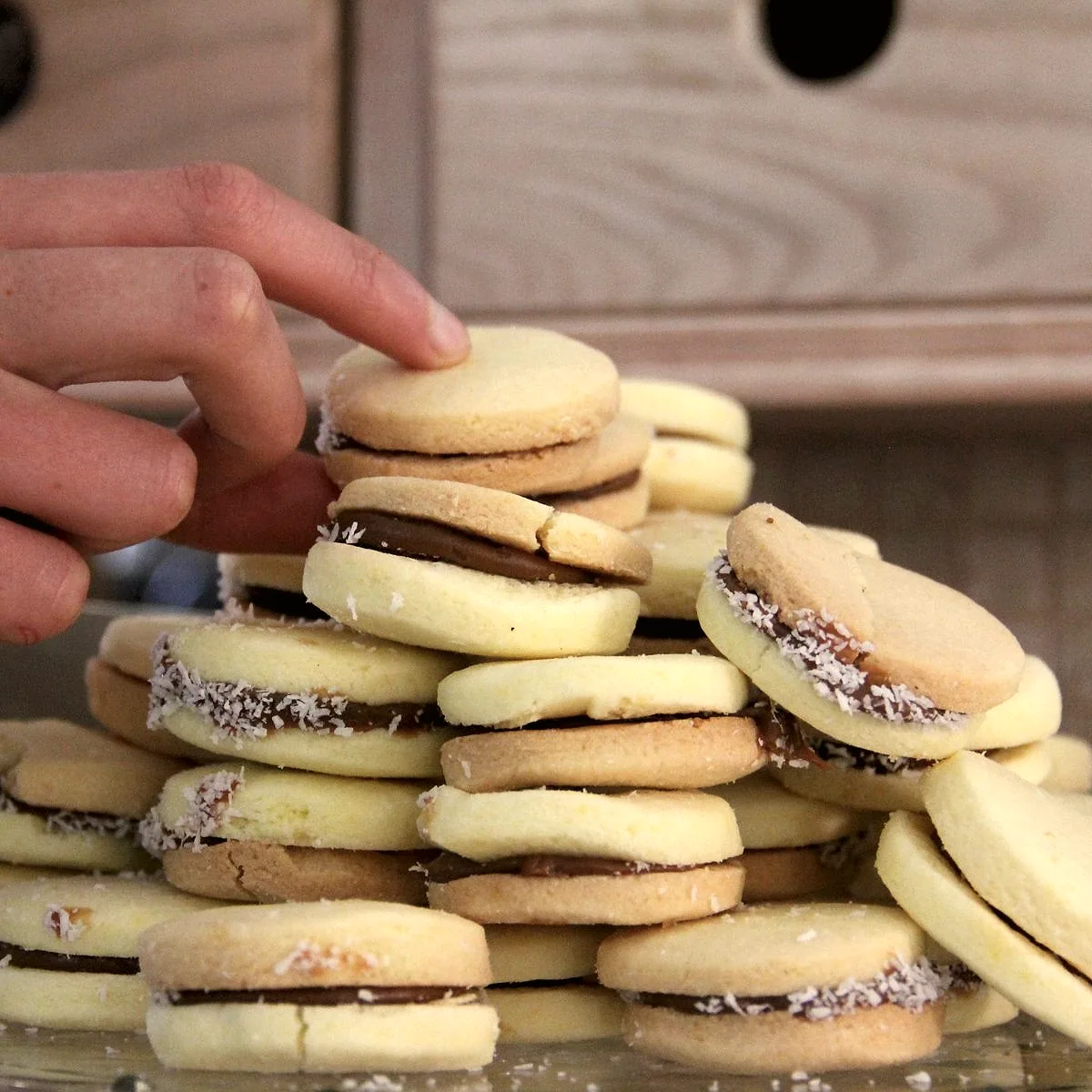

CC BY-SA 3.0. Cropped and colour-adjusted for this site.
Method
Beat the 150 g unsalted butter and 90 g caster sugar together until pale and fluffy.
Beat in the 3 ½ egg yolks (56 g) and 6 g vanilla extract until fully combined.
Sift the 200 g cornflour, 100 g plain flour, 5 g baking powder, 3 g bicarbonate of soda and 2 g fine sea salt together, then fold into the butter mixture just until a soft dough comes together. Avoid overworking it.
Wrap the dough and chill it for 30m, until firm enough to roll.
The dough is soft from the high proportion of cornflour and butter to gluten-forming flour. Chilling it firms the butter enough to roll and cut cleanly without the rounds spreading and losing their shape in the oven.
Roll the dough between two sheets of baking paper to the thickness of a coin and cut into small rounds, gathering and re-rolling the scraps. Set the rounds on lined trays, spaced well apart, since they spread very little and are cut close together to keep an even thickness.
Bake at 170 °C for 12m, until the tops look dry and set rather than coloured. The rounds will still feel soft in the centre; they firm up entirely as they cool.
Common pitfallThese are pale cookies by design: cornflour does not brown the way wheat flour does, so colour is not a useful guide to doneness. They are done when the tops look dry and set rather than when they take on colour, and a batch left in until it looks golden is already overbaked and crumbly instead of tender.
Slide the rounds onto a rack and cool completely, for 15m, before filling: a warm cookie melts the dulce de leche straight through it.
Spread half the rounds generously with the 280 g dulce de leche and sandwich with the remaining rounds, pressing gently so the filling meets the edge all the way round. Roll the exposed rim of filling in the 120 g desiccated coconut to coat it.
The alfajor's name and its first form both come from al-Andalus, the Muslim territories of medieval Spain. The philologist Manuel Alvar López traced the word to Andalusian Arabic, and its first recorded appearance in a Spanish dictionary is as alfaxor in the grammarian Antonio de Nebrija's Latin-Spanish dictionary, usually dated to around 1495 [1][3]. The word's documented meaning shifted over the centuries that followed: Spain's Royal Academy defined it in its Diccionario de autoridades of 1726–39 as a paste of almonds, nuts, toasted breadcrumbs and fine spices bound with honey, closer to a dense nougat than to the biscuit sold under the name in Argentina today [3].
Spanish colonists carried the sweet to South America, where it took root in the Río de la Plata region and was reshaped over generations by cooks of European, Indigenous and African descent into something distinct from its Iberian original [2]. Bakeries built around it in the nineteenth century (among them Casa Chammas in Córdoba, founded in 1869) turned it from a home confection into a commercial one, and the industry it founded expanded through the twentieth century with mass-market producers including the Havanna brand, launched in 1947 [2].
The cornflour version eaten today (a pale, crumbly round bound with maicena rather than wheat flour, filled with dulce de leche and finished with coconut pressed around the rim) is a later, specifically Argentine refinement rather than a form that travelled directly from Spain. It is also only one of several regional doughs the country still makes: Argentina's own tourism authority lists corn flour as the defining dough of Catamarca's alfajor de capia and ground walnuts as a Cuyo variant, alongside fillings that range from yerba mate in the Litoral to Malbec-spiked dulce de leche in Mendoza [4]. Exactly when the cornflour dough itself was first adopted is not established in any of these sources, and no reliable date for that specific innovation could be found; what the record supports is the broader shift from Andalusian sweet to Argentine bakery staple, made distinct region by region, rather than the precise recipe that made any one version standard.
Sources
- Alfajor, WikipediaTraces the word to Andalusian Arabic via the philologist Manuel Alvar López, and records its first appearance in Nebrija's 1495 Latin-Spanish dictionary.
- Round, Sweet, and an Argentinian Icon: the Alfajor in all its Forms, Google Arts & CultureCovers the alfajor's establishment in Río de la Plata bakeries and the named nineteenth- and twentieth-century Argentine confectioners who built its modern industry.
- Alfajores, suspiros y cordiales: historia de tres palabras en tiempo de Navidad, The ConversationAcademic account of the word's documentary trail, from Nebrija's circa-1495 dictionary through the RAE's 1726–39 Diccionario de autoridades to Manuel Alvar Ezquerra's 2000 lexicon of Andalusian speech.
- Alfajores, Argentina.gob.ar (Secretaría de Turismo)Official government tourism page listing regional dough and filling variants, including corn flour in Catamarca and ground walnuts in Cuyo.