The Smart Materials Era (2000-2015)
Quantum Dot Polymers
Where Nano Meets Glow
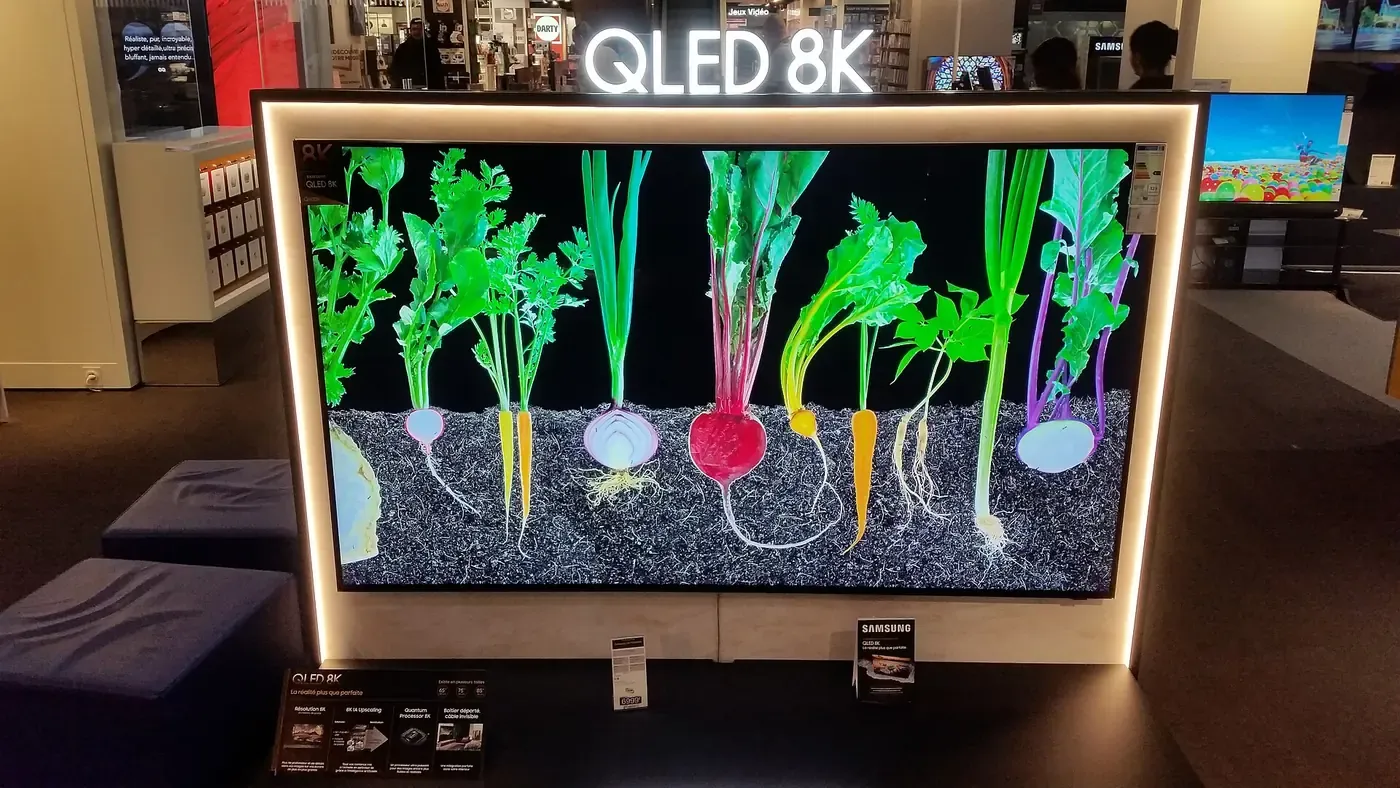
By 2020, quantum dot televisions had already been on shop floors for years, their marketing built around one word, colour, and one long-standing limitation the marketing never mentioned. Red and green quantum dots had been bright and stable for a decade. Blue was the hold-out: the shortest wavelength, the hardest to make efficient without falling back on cadmium, a heavy metal that the European Union had been steadily legislating out of consumer electronics since the original RoHS directive of 2006. A cadmium-free blue emitter that actually worked was the one piece manufacturers still lacked, and on 14 October 2020 a team at the Samsung Advanced Institute of Technology published one in Nature: a zinc-selenide-based blue quantum dot with essentially none of the light lost to internal defects, stable enough to sit in a screen for years rather than months. It closed out the set. For the first time, a full red-green-blue quantum dot display could in principle be built without cadmium at all.
Plate I
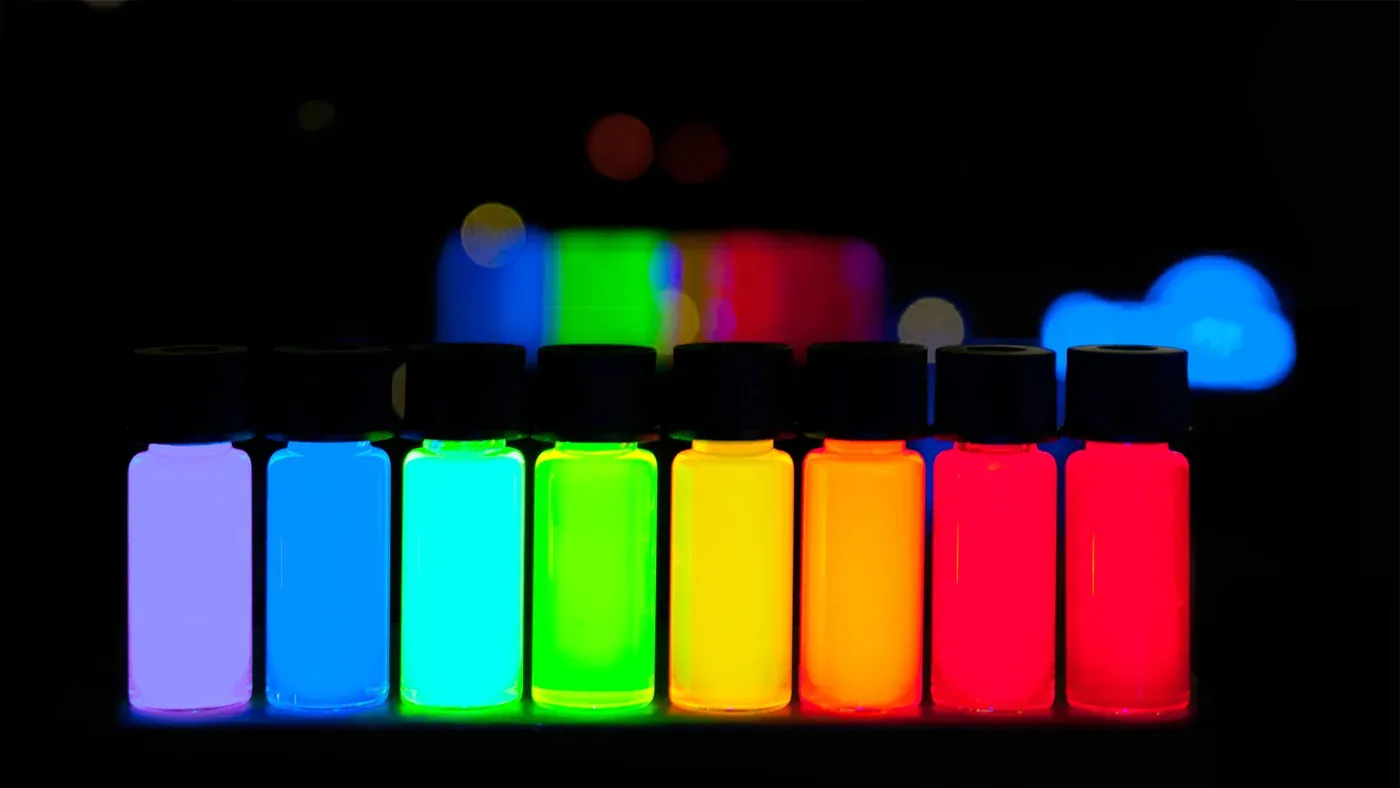

That 2020 result was the last chapter of a much older story, one that had already been quietly settled in the world’s eyes three years later. In 1981, in a Soviet glass factory’s research laboratory, Alexei Ekimov noticed that the colour of copper chloride crystals grown inside glass depended on how large the crystals were allowed to get, not on their chemistry, which never changed. At Bell Labs soon after, Louis Brus showed the same size-dependent colour in nanocrystals floating free in solution, and gave the effect its physical explanation: confine an electron to a box small enough, and the box’s size, not the atom’s identity, decides how much energy it takes to excite it. Both had found the phenomenon; neither had a reliable way to manufacture a nanocrystal to an exact, repeatable size. That practical problem fell to Moungi Bawendi, whose 1993 method of injecting organometallic precursors into a hot solvent produced batches of nanocrystals uniform enough, for the first time, to sell, to coat, and to build a product line around. In 2023 the Nobel Prize in Chemistry went to all three, “for the discovery and synthesis of quantum dots”. This was recognition, decades on, of the work the whole display industry now sitting in living rooms actually depends on.
Plate II

.jpg)
What a Quantum Dot Actually Is
A quantum dot is a crystal of a semiconductor (cadmium selenide, indium phosphide, lead sulfide, among others) grown to a size measured in a handful of nanometres, small enough that it behaves less like a chunk of bulk material and more like an oversized atom with its own discrete energy levels. Shine light on it, or run a current through it, and an excited electron leaves behind a positively charged “hole”; when the two recombine, the dot releases the difference in energy as a photon of a specific colour. Because the confinement is what sets that energy, the colour is a function of size rather than of composition: a smaller dot of the same material emits bluer light, a larger one redder, which is the entire reason a manufacturer can offer a full spectrum from one chemistry just by controlling how long a batch is left to grow.
On its own, a quantum dot is an inorganic nanocrystal with no polymer in it at all. It becomes a “quantum dot polymer” only once it is put to work: dispersed through a plastic matrix, printed into an ink, or laminated inside an optical film, with organic ligands on its surface holding it apart from its neighbours so it does not simply clump into a single crystal and lose the size-dependence that makes it useful. The polymer’s job is almost entirely custodial (keep the dots isolated, keep them where light can reach them, keep oxygen and moisture off a surface that degrades quickly if left bare) rather than chemical. That division of labour, host material doing the protecting while an entirely separate inorganic particle does the actual glowing, is why this entry carries no chemical formula and no single repeat unit: the notation would describe a matrix polymer that varies by product, sitting beside a semiconductor that is not a polymer species at all.
Plates III & IV


Properties: Borrowed, Not Shared
Because the light-emitting particle and the surrounding plastic are chemically unrelated, a quantum dot polymer’s behaviour splits cleanly along that same line. Everything about how the material handles (whether it can be injection moulded or has to be solvent-cast, how it responds to heat, how it wears) comes from whichever host polymer was chosen, and that choice varies enormously by product: an encapsulant destined for a television film behaves nothing like a printable ink matrix. What the quantum dots contribute is purely optical, layered on top of that host’s ordinary mechanical life: a narrow, size-tunable emission colour and a conversion efficiency that, in a well-made dot, loses very little of the light it absorbs to heat or defects. That optical performance is also the most fragile part of the material. Bare quantum dots degrade quickly on contact with oxygen and moisture, which is precisely why they are almost never used unprotected; the polymer matrix functions as much as a barrier coating as it does a structural host, and a formulation that lets damp air reach the dots will dim long before the plastic around it shows any wear at all.
Applications Beyond the Screen
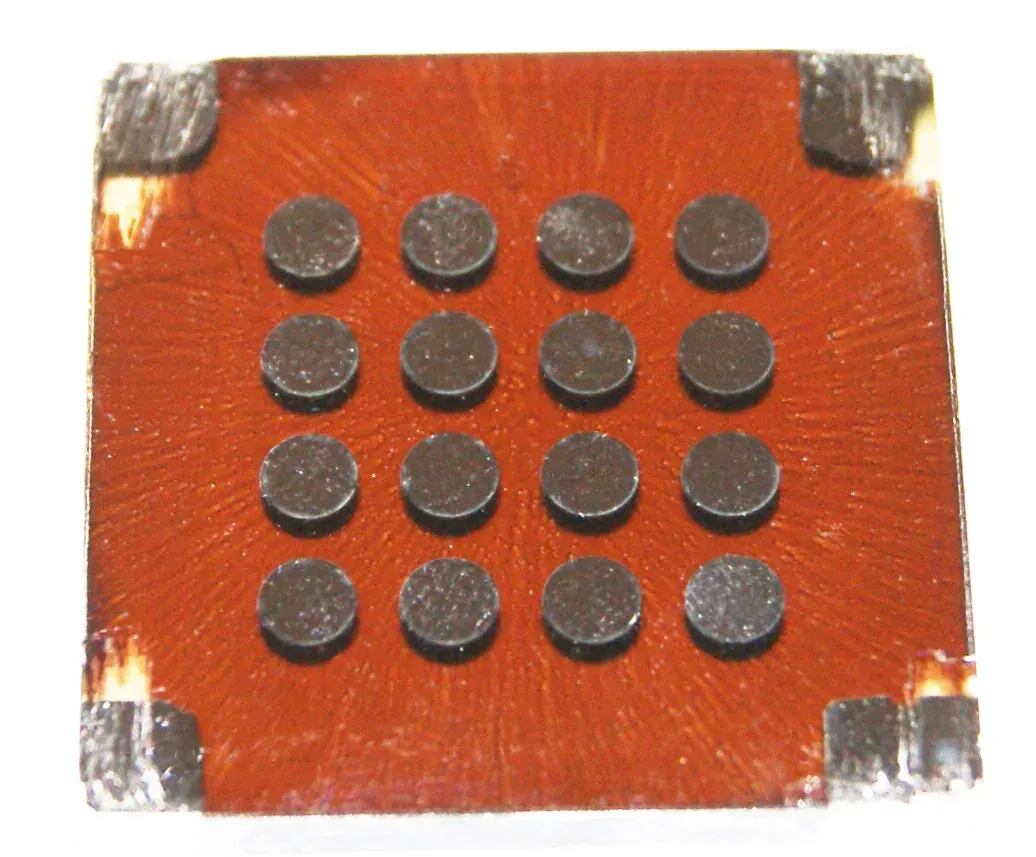
Displays remain the application quantum dot polymers are known for, but they are not the only one. In biomedical imaging, quantum dots tagged onto antibodies give researchers a fluorescent label that stays bright and resists photobleaching far longer than the organic dyes it replaces, useful for tracking a single cell or process over an extended experiment rather than a brief exposure. In photovoltaics, stacking several layers of differently sized dots lets a single cell absorb a wider slice of the solar spectrum than one semiconductor alone could manage. That is the principle behind the experimental Toronto device shown above, though quantum dot solar cells remain a research technology rather than a commercial one. Quantum dots are also finding narrower niches in security inks and anti-counterfeiting marks, where an emission colour tuned to a wavelength outside normal viewing conditions is difficult to forge without the same nanocrystal synthesis behind it.
A Note on What Didn’t Make the Cut
Some claims that circulate about quantum dot polymers do not hold up on inspection, including, in an earlier version of this page, a claim that quantum dot polymer masks were built to detect COVID-19 in 2020. Colour-changing diagnostic masks were a real and active line of pandemic-era research, but the ones documented in the literature relied on gold nanoparticles or CRISPR-based chemistries, not quantum dots, and the claim has been removed rather than repeated on faith.
values with [n] cite the numbered references·estimates are flagged·“not yet available” and “N/A” are honest states, not gaps
- Abbreviation
- —
- Type
- polymer family (hub)
- CAS number
- None (heterogeneous class or not assigned)
- Resin ID code
- none assigned
- Formula
- A hybrid nanocomposite rather than a polymer chemistry itself: inorganic semiconductor quantum dots (a few nanometers, e.g. CdSe, InP) dispersed/embedded in a polymer host matrix; the host polymer varies by application (encapsulant resins, printable matrices) and the quantum dots are not a polymeric species at all.
- Repeat unit (BigSMILES)
- A hybrid nanocomposite rather than a polymer chemistry itself: inorganic semiconductor quantum dots (a few nanometers, e.g. CdSe, InP) dispersed/embedded in a polymer host matrix; the host polymer varies by application (encapsulant resins, printable matrices) and the quantum dots are not a polymeric species at all.
- IUPAC name
- —
- Synonyms
- —
- Also known as
- —
- Chemical family
- —
- Backbone class
- —
- Polymerization mechanism
- —
- Constitutional monomer
- None (no single constitutional monomer)
- Polymer class
- —
- Year of origin
- 2020
- Era
- The Smart Materials Era (2000-2015)
- Key figures
- Alexei Ekimov · Louis Brus · Moungi Bawendi
- Events referenced
- Samsung Advanced Institute of Technology publishes an efficient, stable cadmium-free blue quantum dot LED in Nature (14 October 2020) · 2023 Nobel Prize in Chemistry awarded to Ekimov, Brus and Bawendi for the discovery and synthesis of quantum dots
- Polymerization type
- not yet available
- Common monomers (feedstocks)
- not yet available
- Catalysts
- not yet available
Quantum dots are colloidally synthesized semiconductor nanocrystals, typically surface-passivated with organic ligands (e.g. oleic acid), then dispersed into a polymer matrix or ink via solution processing techniques such as spin coating or inkjet printing. Their defining property is size-tunable fluorescence from quantum confinement: larger dots (5–6 nm) emit longer wavelengths (orange/red), smaller dots (2–3 nm) emit shorter wavelengths (blue/green), independent of chemical composition.
- Tacticity
- not yet available
- Crystal structure
- The quantum dots themselves are crystalline semiconductor nanocrystals behaving as 'artificial atoms' with discrete, size-tunable energy levels due to quantum confinement; the surrounding polymer host is typically amorphous and serves as an optically transparent, processable matrix/encapsulant rather than contributing to the optical behavior.
- Typical crystallinity
- Not applicable
Molecular weight
- Number average (Mn)
- not yet available
- Mass average (Mw)
- not yet available
- Dispersity (Mw/Mn)
- not yet available
Mark-Houwink constants
not yet available
- Density
- Not applicableDepends on host polymer and quantum-dot loading; not a single value for the class.
- Melt flow index
- Not applicable
- Refractive index
- Not applicable
- Transmittance
- not yet available
- Haze
- not yet available
- Gloss
- not yet available
- Water absorption
- not yet available
- Dielectric constant
- Not applicable
- Dielectric strength
- not yet available
- Electrical conductivity
- Not applicable
- Glass transition (Tg)
- Not applicable
- Melting temperature (Tm)
- Not applicable
- Crystallization (Tc)
- Not applicable
- Heat deflection (HDT)
- Not applicable
- Decomposition onset
- Not applicable
- Thermal conductivity
- Not applicable
- Tensile modulus
- Not applicable
- Yield strength
- Not applicable
- Tensile strength at break
- Not applicable
- Elongation at break
- Not applicable
- Impact strength (Izod)
- Not applicable
- Impact strength (Charpy)
- Not applicable
- Hardness
- Not applicable
- Flexural modulus
- Not applicable
- Poisson's ratio
- not yet available
- Coefficient of friction
- not yet available
- Weathering / UV
- Not applicable
- Hydrolysis resistance
- Not applicable
- Flammability (UL94)
- Not applicable
- Limiting oxygen index
- not yet available
- Solubility parameter (δ)
- not yet available
Gas permeability
not yet available
Polymer-solvent interaction parameter (χ)
not yet available
- Processing methods
- colloidal synthesis (quantum dots)spin coatinginkjet printingpolymer encapsulation/lamination
- Drying required
- not yet determined
- Processing temperature
- Not applicable
- Shrinkage rate
- Not applicable
- Display technologyQLED displaysConvert blue backlight into precisely tuned colors, improving color accuracy over conventional LED backlighting.
- Biomedical imagingfluorescent cell tracking and medical imagingReported ~20x brighter and ~100x more photostable than traditional fluorescent reporters.
- Energyquantum dot photovoltaicsTunable absorption spectra; reported power conversion efficiencies up to ~10.7% in optimized configurations.
- Recyclable
- not yet determined
- Biodegradable
- not yet determined
- Degradation pathway
- not yet available
Some quantum dot chemistries (e.g. cadmium-based) raise toxicity/disposal concerns distinct from the host polymer's own environmental profile; cadmium-free formulations (e.g. InP-based) are an active area of development.
- LD50 (oral, rat)
- not yet available
- NFPA health
- not yet available
- NFPA flammability
- not yet available
- NFPA reactivity
- not yet available
- Carcinogenic classification
- not yet available
- [1]Quantum dotWikipediaAccessed 2026-07-14https://en.wikipedia.org/wiki/Quantum_dot[wiki-quantum-dot]
Illustrations
- Plate IColloidal quantum dots of the same core semiconductor, each vial a different size, photographed under ultraviolet light. Size alone sets the colour; nothing about the chemistry changes between one vial and the next.Wikimedia Commons
- Plate IIMoungi Bawendi (centre) at the US Embassy's reception for the 2023 Nobel laureates in Stockholm. His 1993 synthesis method is why quantum dots could be manufactured to a reliable size at all. That was the step that turned Ekimov's and Brus's discovery into an industry.Wikimedia Commons
- Plate IIIA Samsung QLED television on display, its quantum-dot film delivering the saturated colour these sets are marketed on: the display application quantum dots reached shop floors through years before the 2020 blue breakthrough closed out the cadmium-free set.Wikimedia Commons
- Plate IVAn experimental quantum dot solar cell from the University of Toronto's Sargent Group, its eight stacked layers of differently sized dots each tuned to absorb a different slice of the solar spectrum.Wikimedia Commons