
Skip to content
Markey
Theme: System (currently light)
Volkswagen VW roundel

Generation

Volkswagen Up

Volkswagen up!, 2011-2023

Produced
2011–2023
Designer
Klaus Bischoff; Oliver Stefani; Marco Antonio Pavone
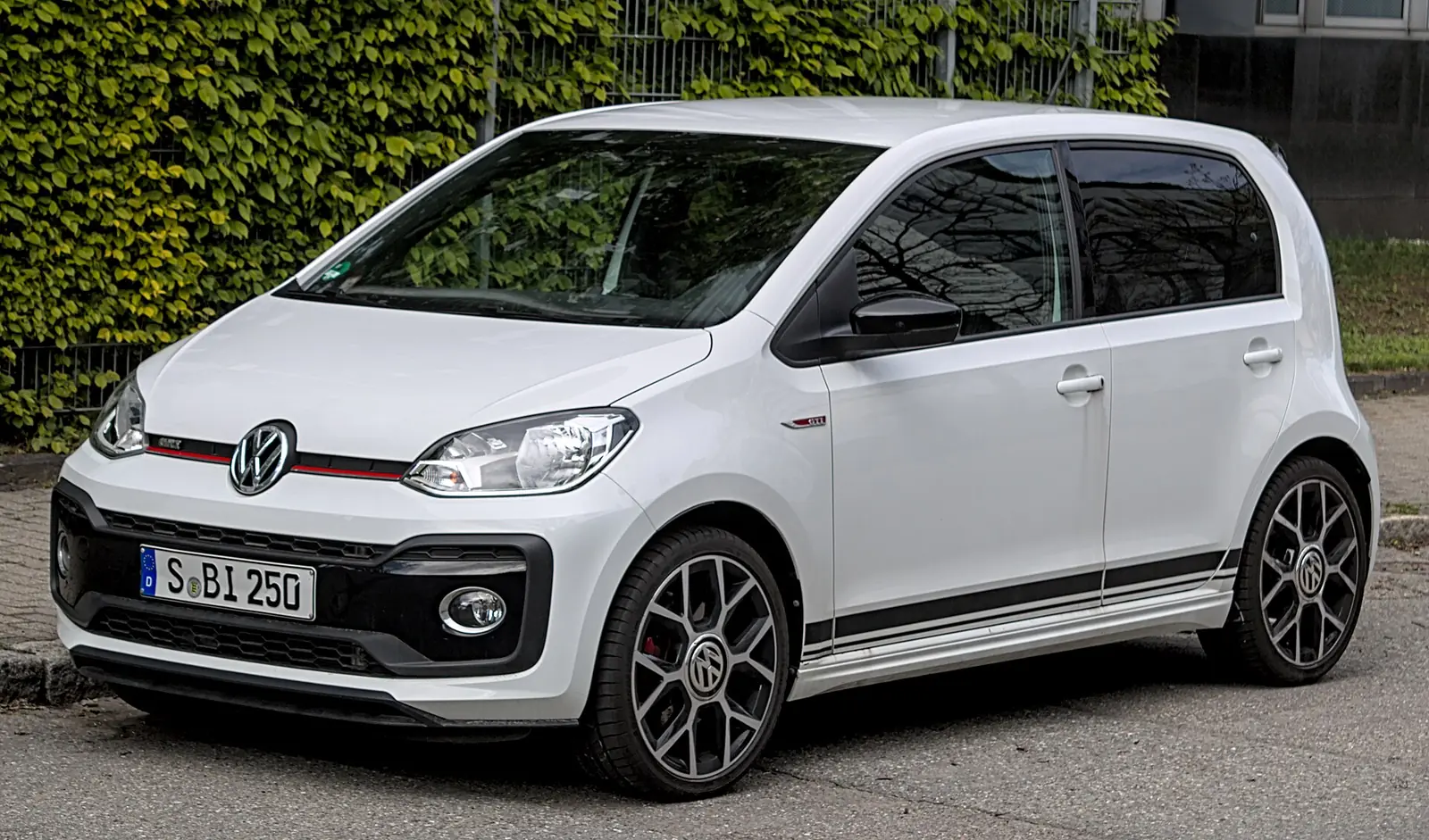
White Volkswagen Up GTI hot hatch photographed from the front three-quarter angle in front of a hedge, with red grille trim and black alloy wheels

Image credit

File
File:Volkswagen up! GTI IMG 4177.jpg
Author (attribution required)
Alexander Migl
Test Drive this car

Designed by a team under Klaus Bischoff, the Up launched in late 2011 as Volkswagen’s answer to the city-car class it had largely ceded since the original Lupo, sharing its NSF platform with the Škoda Citigo and SEAT Mii built alongside it in Bratislava.[1] Volkswagen kept adding to the range for over a decade: a CNG-capable Eco Up, a jacked-up Cross Up, and, in December 2016, the Up GTI, a proper hot hatch on a car that size, using a high-pressure turbo version of the same 999 cc three-cylinder engine and the only Up ever sold with a six-speed manual.

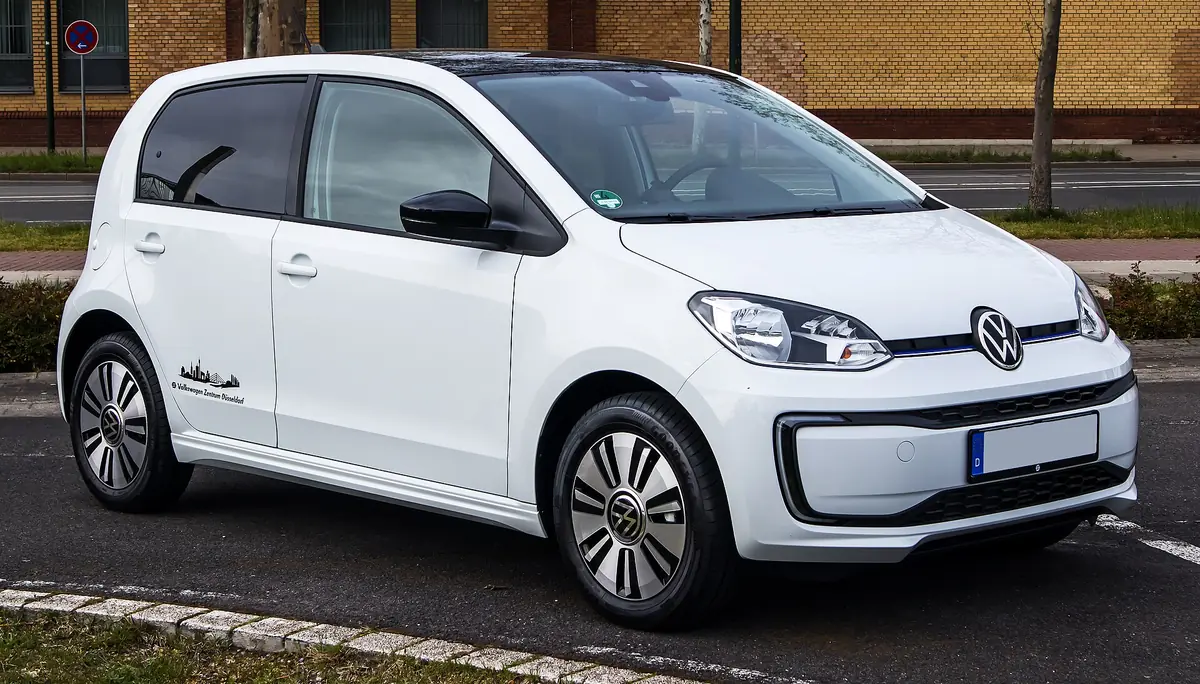
An electric e-up! arrived alongside the launch range and was substantially revised in 2019 with a larger 36.8 kWh gross battery pack (32.3 kWh usable) in place of the original 18.7 kWh unit, extending its range by roughly 60%. Four trims are recorded here: the base 1.0 MPI, the mainstream 1.0 TSI, the Up GTI, and the second-generation e-up!. Every power figure in the source’s own tables is already given directly in kW, so no PS conversion or reading ambiguity applies to any of them, unlike several other cars in this catalogue from the same era.
Overview

Manufacturer
Volkswagen
Produced
2011–2023
Designer
Klaus Bischoff; Oliver Stefani; Marco Antonio Pavone
Segment
A-segment (Europe) / Minicompact (US)
Positioning
Economy
Assembly
  • Bratislava, Slovakia (Volkswagen Bratislava Plant)
  • Taubaté, Brazil (Volkswagen do Brasil)

Dimensions

Length
3,540 mm

Published as a 3540-3563 mm range across body styles and facelifts; the lowest figure is recorded here.

[1]

Width
1,641 mm

[1]

Height
1,478 mm

Published as a 1478-1489 mm range; the lowest figure is recorded here.

[1]

Wheelbase
2,420 mm

[1]

Kerb weight
929 kg

Published in the infobox as a 929-997 kg range across the petrol/CNG range (the electric e-up! is considerably heavier still, at up to 1229 kg); the lowest figure across the petrol range is recorded here at generation level.

[1]

1.0 MPI (60 PS)

Trim · 2011–2023

Power
44 kW

44 kW (60 PS) at 5,000 rpm, published directly in kW in the source's powertrain table.

[1]

Torque
95 N⋅m

95 N⋅m across a 3,000-4,300 rpm plateau.

[1]

Kerb weight
Not yet available
0–100 km/h
14.4 s

[1]

Top speed
161 km/h

[1]

Fuel economy
4.5 L/100 km

EU-norm combined figure, cycle not further named in the source.

[1]

CO₂
105 g/km

105 g/km for the standard car; the BlueMotion version of the same engine is rated 96 g/km.

[1]

Drag coefficient
Not yet available
Frontal area
Not yet available
Displacement
999 cc

[1]

Boot volume
Not yet available
Engine
inline-3, multi-point fuel injection
Drivetrain
Front-wheel drive

1.0 TSI (90 PS)

Trim · 2016–2023

Power
66 kW

66 kW (90 PS) at 5,000-5,500 rpm, published directly in kW in the source's powertrain table.

[1]

Torque
160 N⋅m

160 N⋅m across a 1,500-3,000 rpm plateau.

[1]

Kerb weight
Not yet available
0–100 km/h
9.9 s

[1]

Top speed
185 km/h

[1]

Fuel economy
4.4 L/100 km

EU-norm combined figure, cycle not further named in the source.

[1]

CO₂
101 g/km

[1]

Drag coefficient
Not yet available
Frontal area
Not yet available
Displacement
999 cc

[1]

Boot volume
Not yet available
Engine
inline-3 turbocharged, direct injection
Drivetrain
Front-wheel drive

Up GTI

Trim · 2018–2023

Power
85 kW

85 kW (115 PS) at 5,000 rpm, published directly in kW in the source's powertrain table. The only Up sold with a six-speed manual gearbox.

[1]

Torque
200 N⋅m

200 N⋅m at 2,000 rpm.

[1]

Kerb weight
997 kg

[1]

0–100 km/h
8.8 s

[1]

Top speed
192 km/h

[1]

Fuel economy
Not yet available
CO₂
Not yet available
Drag coefficient
Not yet available
Frontal area
Not yet available
Displacement
999 cc

[1]

Boot volume
Not yet available
Engine
inline-3 high-pressure turbocharged, direct injection
Drivetrain
Front-wheel drive

e-up! (2019)

Trim · 2019–2023

Power
60 kW

[1]

Torque
210 N⋅m

[1]

Kerb weight
1,229 kg

Curb weight with all fluids and 50% fuel, as published in the source's technical-data table.

[1]

0–100 km/h
12.4 s

[1]

Top speed
130 km/h

[1]

Electric consumption
14.9 kWh/100 km

[1]

Battery capacity
32.3 kWh

32.3 kWh usable (net) capacity; the pack's total (gross) capacity is 36.8 kWh.

[1]

Electric range
258 km

258 km in the source's own technical-data table; the article's prose rounds this to 260 km elsewhere. Same figure, not a conflict between sources.

[1]

Drag coefficient
0.31

The 2013 first-generation e-up! is separately given as 0.281; the drag coefficient rose with this revision's dimensional and equipment changes.

[1]

Frontal area
Not yet available
Boot volume
Not yet available
Engine
single electric motor
Drivetrain
Front-wheel drive

Sources & confidence

Every figure above carries a status. Nothing on this page is estimated without saying so, and nothing missing has been filled in with a guess.

Last verified
2026-09-24
Review status
Compiled from cited sources

Photography on this page is credited on each image. Tap theion a photograph for its author, licence and source.

References

Every sourced figure and every cited claim on this page, numbered. Wikipedia articles record the revision they were read at, because the article will have changed by the time you check it.

  1. [1]

    Volkswagen Up. Wikipedia · revision 1367391178 · read 2026-09-24

    WikipediaCC BY-SA 4.0