
Skip to content
Markey
Theme: System (currently light)
Peugeot wordmark with the chrome lion emblem

Generation

Peugeot 308 (T9)

Peugeot 308 (T9), 2013-2021

Produced
2013–2021
Code
T9
Designer
Thomas Röhm
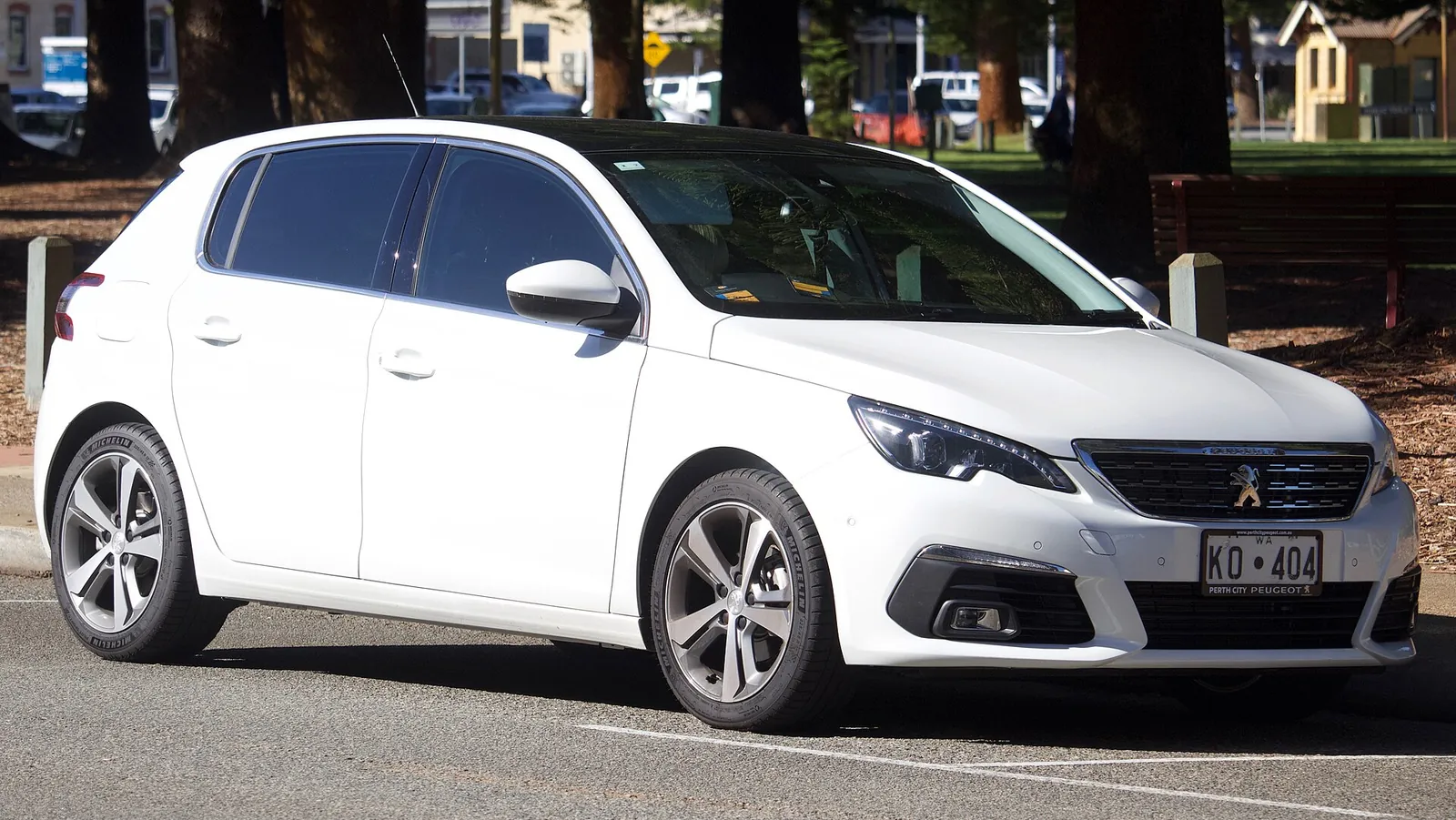
White facelifted second-generation Peugeot 308 hatchback photographed from the front three-quarter angle in a car park

Image credit

File
File:2018 Peugeot 308 (T9 MY18) Allure hatchback (2018-07-19) 01.jpg
Author (attribution required)
EurovisionNim

The second 308 moved onto PSA’s new EMP2 platform, shared with the Citroën C4 Picasso, and was around 140 kg lighter than the T7 it replaced.[1] European Car of the Year for 2014, it dropped the coupé cabriolet body style from the previous generation but kept a hatchback, an estate and, in China, a saloon.

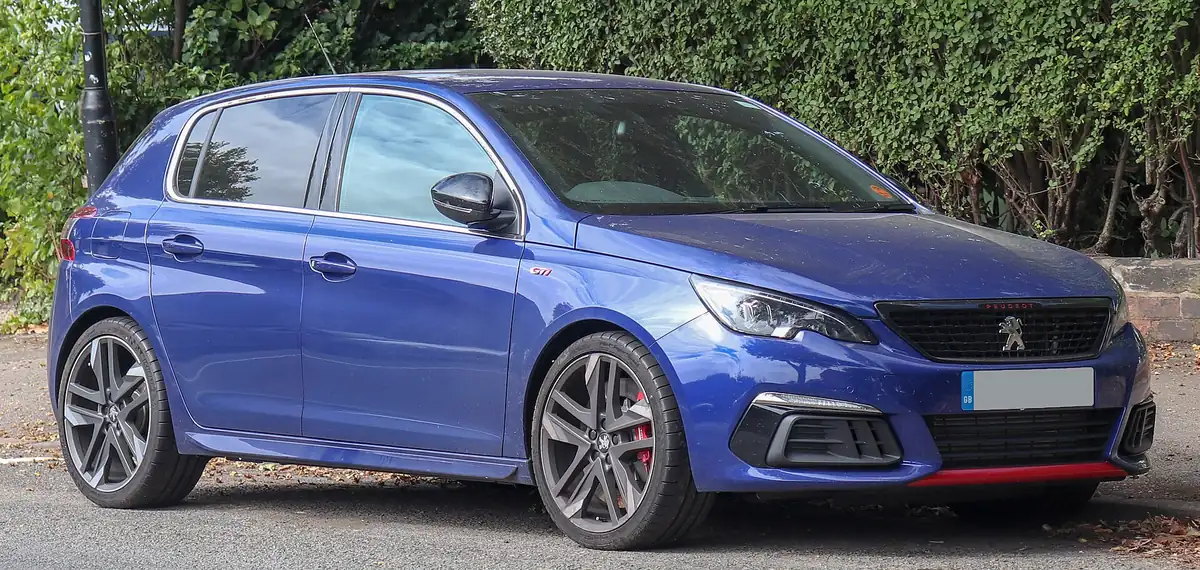
Three trims are recorded here: the 1.5 BlueHDi diesel added at the 2017 facelift, and the two distinct outputs of the GTi by Peugeot Sport (250 hp and 270 hp versions of the same 1.6-litre turbocharged four, the more powerful adding a Torsen limited-slip differential and larger Alcon front brakes). As with the T7, the source gives power output for every engine but no torque, 0-100 km/h time or top speed for any of them; those fields are left empty rather than filled from an unsourced estimate.
Overview

Manufacturer
Peugeot
Produced
2013–2021
Model code
T9
Designer
Thomas Röhm
Segment
C-segment (Europe) / Compact (US)
Positioning
Mainstream
Assembly
  • Mulhouse, France
  • Sochaux, France
  • Wuhan, China (DPCA)
  • Gurun, Malaysia (NAM)

Dimensions

Length
4,253 mm

Hatchback; the estate was 4,585 mm.

[1]

Width
1,815 mm

[1]

Height
1,460 mm

Hatchback; the estate was 1,471 mm.

[1]

Wheelbase
2,620 mm

Hatchback; the estate was 2,730 mm.

[1]

Kerb weight
1,060 kg

Lowest of a published 1,060-1,320 kg range; not attributed to one specific trim, so recorded at generation level only. Peugeot stated the new EMP2 platform saved about 140 kg over the outgoing T7.

[1]

1.5 BlueHDi 130

Trim · 2017–2021 · DV5 RC

Power
97 kW

Published as 130 bhp, converted at 1 hp = 0.745699872 kW. No torque figure, 0-100 km/h time or top speed is published in the source for this engine.

[1]

Torque
Not yet available
Kerb weight
Not yet available
0–100 km/h
Not yet available
Top speed
Not yet available
Fuel economy
Not yet available
CO₂
Not yet available
Drag coefficient
Not yet available
Frontal area
Not yet available
Displacement
1,499 cc

Joined the range at the 2017 facelift.

[1]

Boot volume
Not yet available
Seats
5
Engine
inline-4, turbocharged, 16V · DV5 RC
Drivetrain
Front-wheel drive

GTi by Peugeot Sport (250)

Trim · 2015–2021 · EP6DT

Power
186 kW

Published as 250 hp, converted at 1 hp = 0.745699872 kW. No torque figure, 0-100 km/h time or top speed is published in the source for this car.

[1]

Torque
Not yet available
Kerb weight
Not yet available
0–100 km/h
Not yet available
Top speed
Not yet available
Fuel economy
Not yet available
CO₂
Not yet available
Drag coefficient
Not yet available
Frontal area
Not yet available
Displacement
1,598 cc

The lower-output GTi, with full LED headlights, an electronic limited-slip differential, 18-inch alloys and an 11 mm lowered ride height.

[1]

Boot volume
Not yet available
Seats
5
Engine
inline-4, turbocharged, direct injection · EP6DT
Drivetrain
Front-wheel drive

GTi by Peugeot Sport (270)

Trim · 2015–2021 · EP6DT

Power
201 kW

Published as 270 hp, converted at 1 hp = 0.745699872 kW. No torque figure, 0-100 km/h time or top speed is published in the source for this car.

[1]

Torque
Not yet available
Kerb weight
Not yet available
0–100 km/h
Not yet available
Top speed
Not yet available
Fuel economy
Not yet available
CO₂
Not yet available
Drag coefficient
Not yet available
Frontal area
Not yet available
Displacement
1,598 cc

The higher-output GTi, adding 380 mm Alcon front brakes, a Torsen limited-slip differential and 19-inch lightweight alloy wheels over the 250 hp car.

[1]

Boot volume
Not yet available
Seats
5
Engine
inline-4, turbocharged, direct injection · EP6DT
Drivetrain
Front-wheel drive

Sources & confidence

Every figure above carries a status. Nothing on this page is estimated without saying so, and nothing missing has been filled in with a guess.

Last verified
2026-09-08
Review status
Compiled from cited sources

Photography on this page is credited on each image. Tap theion a photograph for its author, licence and source.

References

Every sourced figure and every cited claim on this page, numbered. Wikipedia articles record the revision they were read at, because the article will have changed by the time you check it.

  1. [1]

    Peugeot 308. Wikipedia · revision 1373155454 · read 2026-09-08

    WikipediaCC BY-SA 4.0

    Single article covering all three generations (T7, T9, P5) by section.