
Skip to content
Markey
Theme: System (currently light)
Peugeot wordmark with the chrome lion emblem

Generation

Peugeot 205

Peugeot 205, 1983-1999

Produced
1983–1999
Designer
Gerard Welter, Pininfarina (cabriolet)
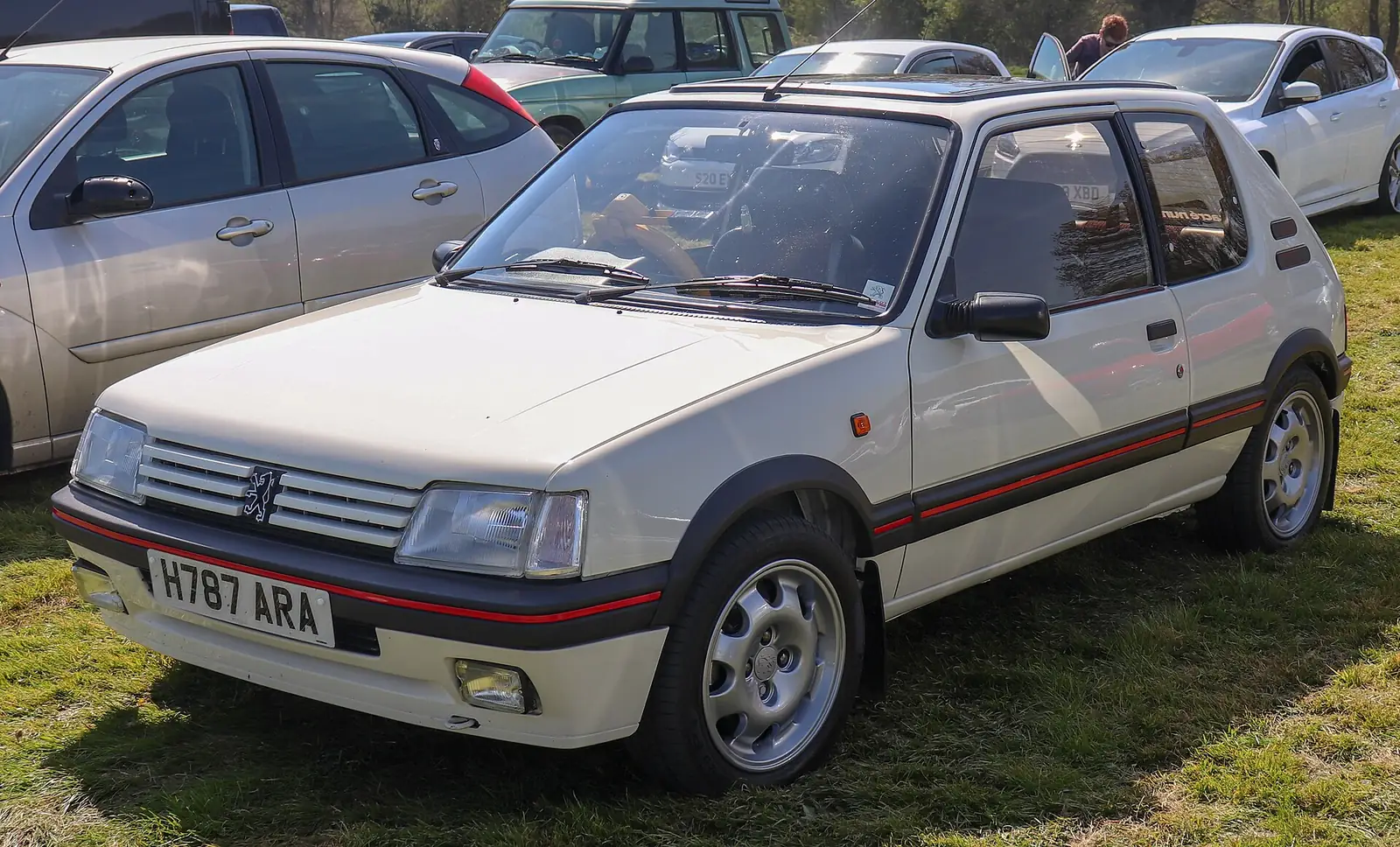
Cream Peugeot 205 GTI 1.9 hatchback photographed from the front three-quarter angle, parked on grass among other cars

Image credit

File
File:1991 Peugeot 205 GTi 1.9 Front.jpg
Author (attribution required)
Vauxford

Developed under the project name M24 and launched in February 1983, the 205 used a MacPherson-strut front and torsion-bar trailing-arm rear suspension layout that Peugeot had debuted on the 305 estate. The layout was compact enough to leave the boot largely uncompromised, and good enough that the whole platform became the template for the rest of the PSA range.[1] It narrowly lost the 1984 European Car of the Year award to the Fiat Uno, but reportedly outlasted it in the market by a wide margin.

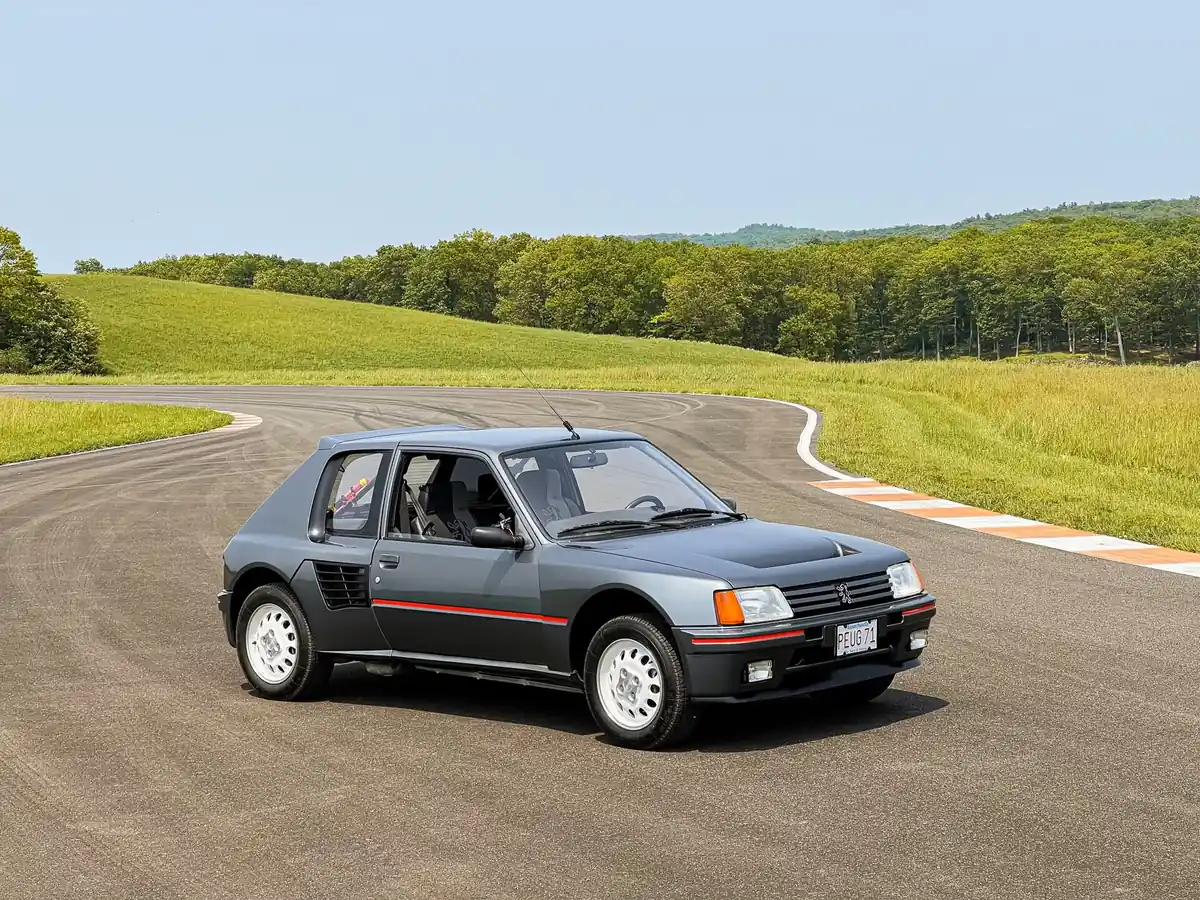
Three trims are recorded here. The 1.6 and 1.9-litre GTI, launched in 1984 and 1986 respectively, are the cars the hot-hatch reputation rests on; no torque figure or 0-100 km/h time is published in the source for either engine, so those fields are left empty rather than estimated from later road tests. The 205 Turbo 16, built in a run of exactly 200 to homologate Peugeot’s Group B rally car, is mechanically almost unrelated to the rest of the range: a mid-mounted, turbocharged, four-wheel-drive engine bolted into a 205-shaped body, making under half the power of the works rally car it existed to legalise.

Kerb weight is recorded only at generation level: the infobox gives a 740-935 kg range across the ordinary range (excluding the T16) rather than a figure for any specific trim.
Overview

Manufacturer
Peugeot
Produced
1983–1999
Designer
Gerard Welter, Pininfarina (cabriolet)
Segment
B-segment (Europe) / Subcompact (US)
Positioning
Economy
Assembly
  • Mulhouse, France
  • Cerizay, France (Heuliez, for the 205 T16)
  • Madrid, Spain (Peugeot España)
  • Los Andes, Chile (Automotores Franco Chilena)
  • Changhua, Taiwan (GSK Corp.)
  • Tehran, Iran (Iran Khodro)
  • Casablanca, Morocco (Sopriam)
  • Montevideo, Uruguay (Nordex S.A.)

Dimensions

Length
3,705 mm

Standard body; the 205 T16 was 3,820 mm.

[1]

Width
1,562 mm

Lowest of a published 1,562-1,572 mm range for standard cars; the GTI/CTI was 1,589 mm and the 205 T16 was 1,700 mm over its flared arches.

[1]

Height
1,350 mm

Lowest of a published 1,350-1,376 mm range for standard cars; the GTI/T16 was 1,354 mm and the Cabriolet 1,381 mm.

[1]

Wheelbase
2,420 mm

Standard cars; the 205 T16's rally-derived chassis had a 2,540 mm wheelbase.

[1]

Kerb weight
740 kg

Lowest of a published 740-935 kg range, excluding the 205 T16; not attributed to one specific trim, so recorded at generation level only.

[1]

GTI 1.6

Trim · 1987–1992 · XU5JA

Power
86 kW

Published as 115 bhp for the 1987-on XU5JA engine, converted at 1 hp = 0.745699872 kW. No torque figure or 0-100 km/h time is published in the source for this engine, so those fields are omitted rather than estimated.

[1]

Torque
Not yet available
Kerb weight
Not yet available
0–100 km/h
Not yet available
Top speed
Not yet available
Fuel economy
Not yet available
CO₂
Not yet available
Drag coefficient
Not yet available
Frontal area
Not yet available
Displacement
1,580 cc

The revised cylinder head introduced for the 1987 model year, replacing the original XU5J of the 1984 launch car (105 PS, 77.23 kW).

[1]

Boot volume
Not yet available
Seats
4
Engine
inline-4 · XU5JA
Drivetrain
Front-wheel drive

GTI 1.9

Trim · 1986–1991 · XU9JA

Power
94 kW

Published as 128 PS, converted at 1 PS = 0.73549875 kW. From 1992 a catalyst-equipped version of this engine made 122 PS (89.73 kW), sold alongside the outgoing 1.6 GTI until 1994.

[1]

Torque
Not yet available
Kerb weight
Not yet available
0–100 km/h
Not yet available
Top speed
Not yet available
Fuel economy
Not yet available
CO₂
Not yet available
Drag coefficient
Not yet available
Frontal area
Not yet available
Displacement
1,905 cc

[1]

Boot volume
Not yet available
Seats
4
Engine
inline-4 · XU9JA
Drivetrain
Front-wheel drive

205 Turbo 16

Trim · 1984–1985 · XU8T

Power
147 kW

Published as 200 PS at 6,750 rpm, converted at 1 PS = 0.73549875 kW. The figure is under half the output of the Group B rally car built from the same homologation base.

[1]

Torque
255 N⋅m

At 4,000 rpm.

[1]

Kerb weight
Not yet available
0–100 km/h
Not yet available
Top speed
Not yet available
Fuel economy
Not yet available
CO₂
Not yet available
Drag coefficient
Not yet available
Frontal area
Not yet available
Displacement
1,775 cc

200 homologation road cars built to satisfy Group B rally rules; beyond the bodyshell, the road car shared almost nothing with the standard 205, using the rally car's mid-engined, four-wheel-drive layout.

[1]

Boot volume
Not yet available
Seats
2
Engine
inline-4, transverse, mid-mounted, turbocharged, DOHC 16V · XU8T
Drivetrain
All-wheel drive

Sources & confidence

Every figure above carries a status. Nothing on this page is estimated without saying so, and nothing missing has been filled in with a guess.

Last verified
2026-09-08
Review status
Compiled from cited sources

Photography on this page is credited on each image. Tap theion a photograph for its author, licence and source.

References

Every sourced figure and every cited claim on this page, numbered. Wikipedia articles record the revision they were read at, because the article will have changed by the time you check it.

  1. [1]

    Peugeot 205. Wikipedia · revision 1373786020 · read 2026-09-08

    WikipediaCC BY-SA 4.0