
Skip to content
Markey
Theme: System (currently light)
The Lada badge: a blue oval containing a white stylised sailing boat, above the LADA wordmark in blue

Generation

Lada Niva (VAZ-2121)

Lada Niva (VAZ-2121), 1977-1994

Produced
1977–1994
Code
VAZ-2121
Designer
Pyotr Prusov
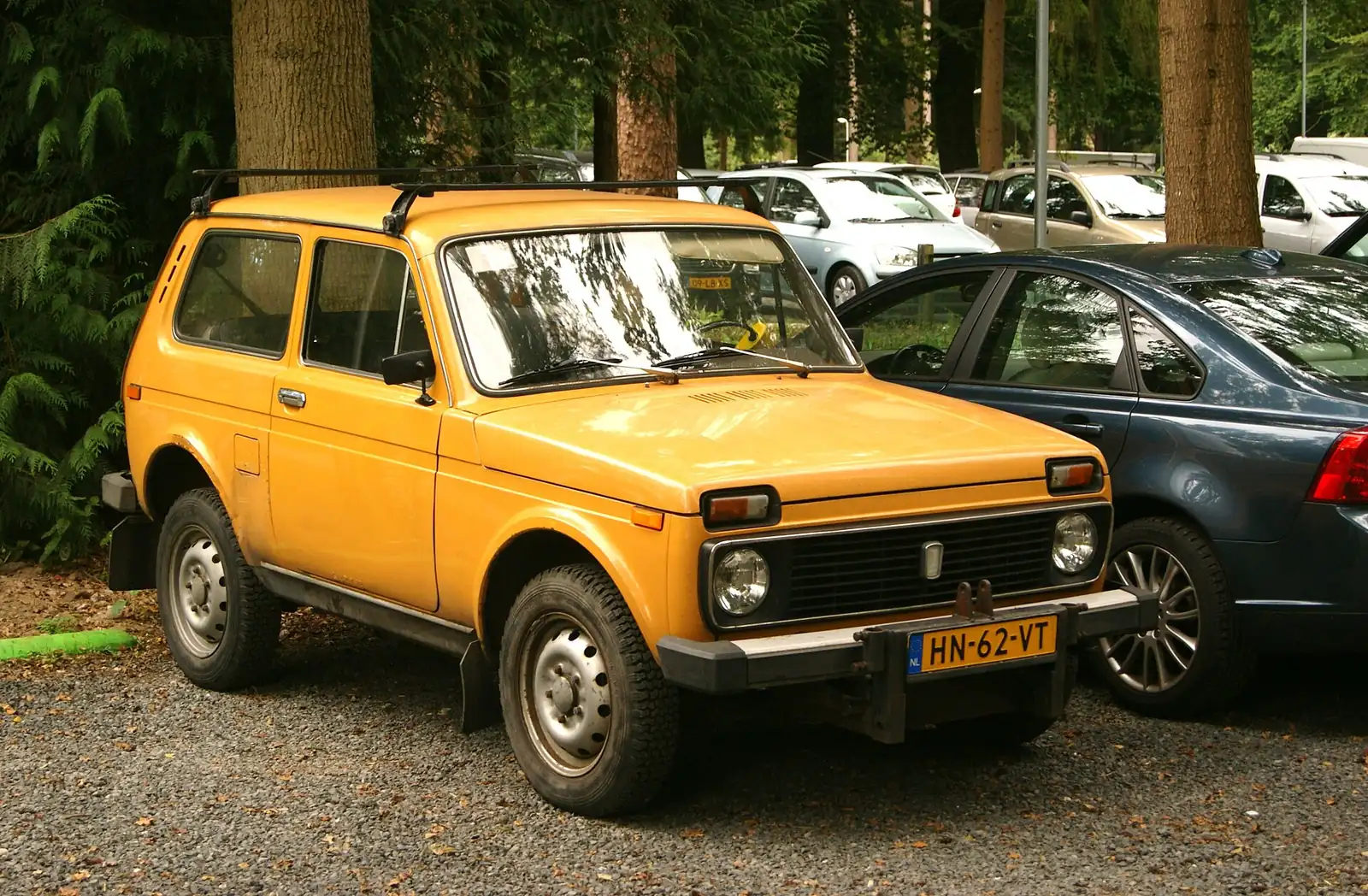
Yellow original Lada Niva photographed from the front three-quarter angle in a car park, showing its boxy body and round headlights

Image credit

File
File:1982 Lada Niva (8870754922).jpg
Author (attribution required)
Niels de Wit from Lunteren, The Netherlands
Licence
CC BY 2.0

Body style

Powertrain

Development started in 1971 after the Soviet government asked AvtoVAZ and AZLK to build something rural drivers could actually use, where the ordinary Zhiguli could not.[1] The result, tested against a UAZ-469, a Land Rover Series and a Range Rover Classic across the Urals, Siberia and the Karakum desert, borrowed its clamshell bonnet styling from the Fiat 127 and its running gear philosophy from nobody: a unitary body with three differentials, sold new in Western Europe from the late 1970s at a fraction of a Land Rover’s price.

The source’s own numbers do not agree with each other for this engine: the detailed model-code table gives 58.8 kW and 118 N·m, the article’s descriptive paragraph gives 76 PS (55.9 kW) and 126 N·m. Neither passage says which is the manufacturer’s own homologation figure. Both are recorded rather than picked between.

Overview

Manufacturer
Lada
Produced
1977–1994
Model code
VAZ-2121
Designer
Pyotr Prusov
Segment
B-SUV (Europe) / Subcompact SUV (US)
Positioning
Economy
Assembly
AvtoVAZ, Tolyatti, Russia

Dimensions

Length
3,740 mm

Three-door hatchback body; the article records this as unchanged across the model's history.

[1]

Width
1,680 mm

[1]

Height
1,640 mm

[1]

Wheelbase
2,200 mm

[1]

Kerb weight
1,150 kg

Weight given for the VAZ-2121 in the infobox.

[1]

Niva 1600

Trim · 1977–1994 · VAZ-2121

Power
59 kWSources disagree

The article's model-code table gives 58.8 kW (80 hp), which is the figure recorded here; the article's own prose separately states the same engine makes 76 PS (55.9 kW). The two are 5% apart and neither is identified as gross vs net, so both are recorded rather than one being silently discarded.

[1]

Torque
118 N⋅mSources disagree

The article's model-code table gives 118 N-m; the prose separately states 126 N-m at 5,000 rpm for the same engine. Recorded here with both figures noted rather than picking one silently.

[1]

Kerb weight
1,150 kg

[1]

0–100 km/h
Not yet available
Top speed
Not yet available
Fuel economy
Not yet available
CO₂
Not yet available
Drag coefficient
Not yet available
Frontal area
Not yet available
Displacement
1,570 cc

[1]

Boot volume
Not yet available
Seats
4
Engine
inline-4, overhead camshaft · VAZ-2121
Drivetrain
Four-wheel drive
UK market
Sold as Lada Cossack / Hussar
Germany/Austria market
Sold as Lada Taiga

Sources & confidence

Every figure above carries a status. Nothing on this page is estimated without saying so, and nothing missing has been filled in with a guess.

Last verified
2026-09-24
Review status
Compiled from cited sources

Photography on this page is credited on each image. Tap theion a photograph for its author, licence and source.

References

Every sourced figure and every cited claim on this page, numbered. Wikipedia articles record the revision they were read at, because the article will have changed by the time you check it.

  1. [1]

    Lada Niva. Wikipedia · revision 1372659556 · read 2026-09-24

    WikipediaCC BY-SA 4.0

    Covers the model now called Lada Niva Legend, formerly VAZ-2121/Lada 4x4; the unrelated Lada Niva Travel (ex-Chevrolet Niva) is a separate article.