
Skip to content
Markey
Theme: System (currently light)
Land Rover oval badge

Generation

Range Rover Classic

Range Rover Classic, 1970-1996

Produced
1970–1996
Designer
Spen King, Gordon Bashford and David Bache
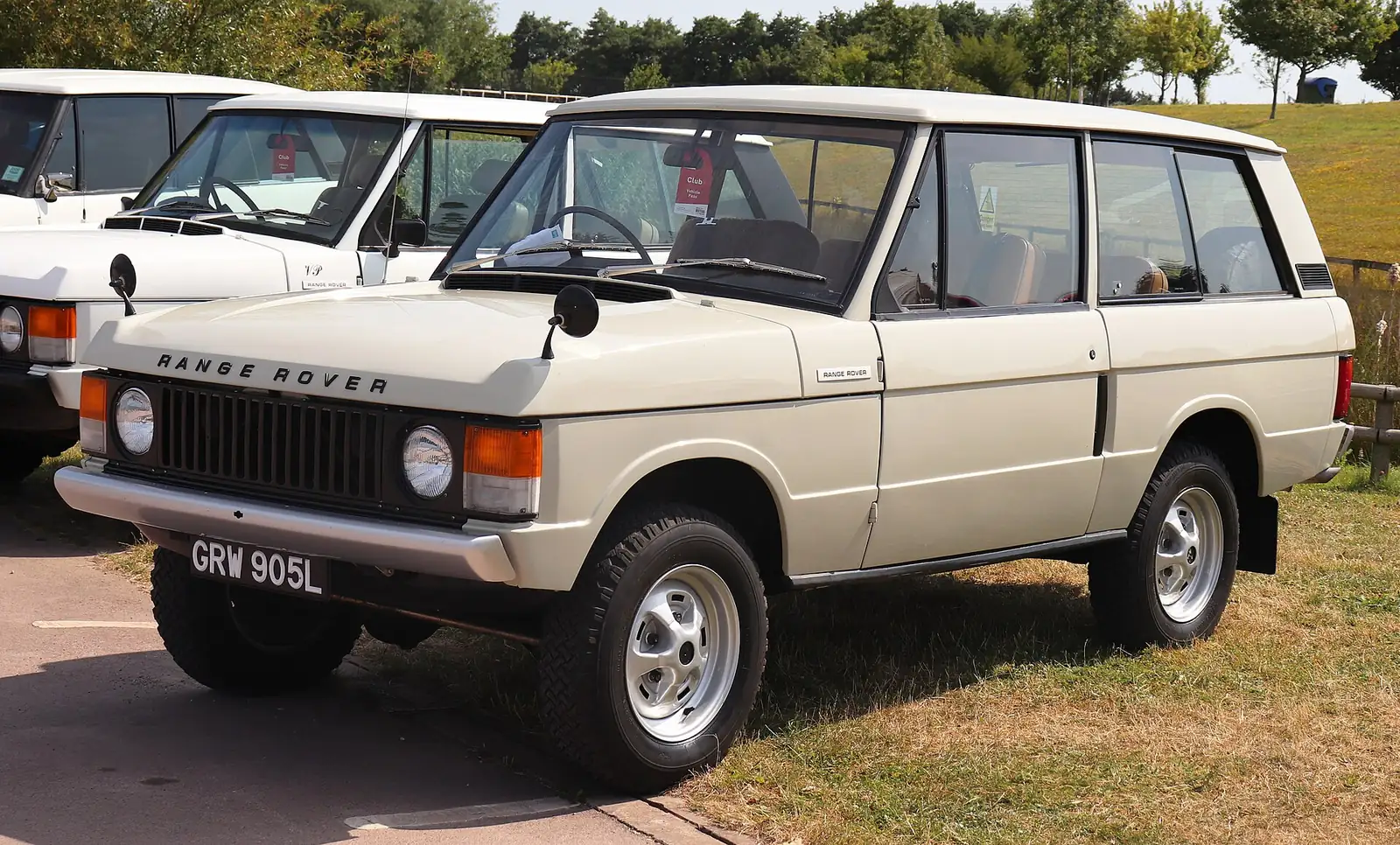
Blue 1973 Range Rover photographed from the front three-quarter angle, showing the two-door body, flat glass and castellated bonnet line

Image credit

File
File:1973 Land Rover Range Rover 3.5.jpg
Author (attribution required)
Vauxford

Body style

Powertrain

Launched in June 1970 as “A Car For All Reasons”: coil springs where every other off-roader used leaf springs, disc brakes on all four wheels, permanent four-wheel drive, and a detuned Buick-derived V8.[1] Twenty-six years and 326,070 cars later it was still recognisably the same vehicle.

This entry has no Test Drive, and the reason is a gap rather than a decision. Wikipedia publishes no kerb weight for the Classic in any language, and no output at all for the 3.9-litre V8. The weight was eventually found somewhere neither Wikipedia nor this project’s source survey had looked: NHTSA’s Canadian Vehicle Specifications, which lists 1,996 kg for the 1994 four-door County Classic.[2] The power figure is still missing, and the model cannot run without one.

Everything else is here: the dimensions, the drag coefficient measured on a 1990 car, and the EPA’s fuel figure, which works out at 18.1 L/100 km.[3]

The launch top speed is another honest disagreement. Land Rover claimed around 100 mph; Autocar measured 95 mph in November 1970. Both are recorded.

Overview

Manufacturer
Land Rover
Produced
1970–1996
Designer
Spen King, Gordon Bashford and David Bache
Segment
E-SUV (Europe) / Full-size SUV (US)
Positioning
Luxury
Assembly
  • Solihull, United Kingdom (Solihull plant)
  • Enfield, New South Wales, Australia (Leyland Australia)
  • Las Tejerías, Venezuela (Tracto Agro)

Dimensions

Length
4,445 mm

Short-wheelbase car, published as 175 in and converted at 25.4 mm/in. The 1992 long-wheelbase LSE measured 183 in.

[1]

Width
1,781 mm

Published as 70.1 in and converted at 25.4 mm/in.

[1]

Height
1,801 mm

Cars built 1970-1980, published as 70.9 in. Later cars were published as 70.1 in.

[1]

Wheelbase
2,540 mm

Published as 100.0 in and converted at 25.4 mm/in. The LSE used a 108 in wheelbase.

[1]

Kerb weight
Not yet available

No kerb weight is published for the generation as a whole. A figure for one late four-door car is recorded on the 3.9 V8 trim below, from NHTSA's Canadian Vehicle Specifications; it would be wrong to present that as the generation's weight, since the 1970 two-door was a materially lighter vehicle.

3.5 V8

Trim · 1970–1989 · Rover V8

Power
101 kW

Published as a detuned 135 hp, converted at 1 hp = 0.745699872 kW.

[1]

Torque
Not yet available
Kerb weight
Not yet available
0–100 km/h
Not yet available
Top speed
153 km/hSources disagree

The launch claim was around 100 mph; the article separately reports a tested 95 mph, citing an Autocar road test of November 1970. The tested figure is recorded, converted at 1.609344 km/mi. The article gives 0-60 mph in under 15 s, which is not a 0-100 km/h time and is not recorded as one.

[1]

Fuel economy
Not yet available
CO₂
Not yet available
Drag coefficient
Not yet available
Frontal area
Not yet available
Displacement
3,528 cc

[1]

Boot volume
Not yet available
Seats
5
Engine
V8 · Rover V8
Drivetrain
Four-wheel drive

3.9 V8

Trim · 1989–1994 · Rover V8

Power
Not yet available

The article records the displacement increase but publishes no output for the 3.9 engine in this vehicle.

Torque
Not yet available
Kerb weight
1,996 kg

Curb weight of the 1994 Canadian-market 4-door County Classic, from NHTSA's Canadian Vehicle Specifications. Wikipedia publishes no kerb weight for this generation in any language; this is a different market and body from the 1970 two-door, so it describes the late four-door car and not the range.

[2]

0–100 km/h
Not yet available
Top speed
Not yet available
Fuel economy
18.1 L/100 km

EPA combined 13 mpg (US) for the 1990 3.9 V8 automatic, converted at 235.215 L-mi/100km-gal. Post-2008 EPA methodology, recalculated for a 1990 car.

[4]

CO₂
425 g/km

EPA tailpipe CO2, 683.6 g/mi, converted at 1.609344 km/mi. US test cycle.

[4]

Drag coefficient
0.45

Listed for the Range Rover Classic, 1990.

[3]

Frontal area
Not yet available
Displacement
3,947 cc

Enlarged from 3,528 cc for the 1989 model year.

[1]

Boot volume
Not yet available
Seats
5
Engine
V8 · Rover V8
Drivetrain
Four-wheel drive

2.4 Turbo D

Trim · 1986–1989 · VM Motori

Power
Not yet available

The article describes the VM diesel and its reception in detail but publishes no output figure for it.

Torque
Not yet available
Kerb weight
Not yet available
0–100 km/h
Not yet available
Top speed
Not yet available
Fuel economy
Not yet available
CO₂
Not yet available
Drag coefficient
Not yet available
Frontal area
Not yet available
Displacement
2,393 cc

Enlarged to 2,499 cc in 1989.

[1]

Boot volume
Not yet available
Seats
5
Engine
inline-4 · VM Motori
Drivetrain
Four-wheel drive

Sources & confidence

Every figure above carries a status. Nothing on this page is estimated without saying so, and nothing missing has been filled in with a guess.

Last verified
2026-08-18
Review status
Spot-checked by hand

Photography on this page is credited on each image. Tap theion a photograph for its author, licence and source.

References

Every sourced figure and every cited claim on this page, numbered. Wikipedia articles record the revision they were read at, because the article will have changed by the time you check it.

  1. [1]

    Range Rover Classic. Wikipedia · revision 1369494215 · read 2026-08-18

    WikipediaCC BY-SA 4.0

    Publishes no kerb weight, in either the infobox or the body, and the German Wikipedia article redirects into a section with no specification table either. The kerb weight is therefore not recorded, which is why this entry has no Test Drive.

  2. [2]

    1994 Range Rover 4DR County Classic 4x4 — NHTSA Canadian Vehicle Specifications. US National Highway Traffic Safety Administration · read 2026-08-18

    DatasetPublic domain (US Government work)

    vPIC's Canadian Vehicle Specifications endpoint publishes curb weight, overall dimensions, track and front/rear weight distribution for cars from 1971. The endpoint is the one free source found that carries kerb weight for vehicles Wikipedia leaves blank. Queried by model year 1995, which returns records stamped MYR 94 and 95; the County Classic record used here is MYR 94. Cross-checked against two cars with known weights (2004 Prius 1,335 kg, 1995 Discovery 1,990 kg) to confirm CW is curb weight in kilograms.

  3. [3]

    List of automobile drag coefficients. Wikipedia · revision 1360737555 · read 2026-08-17

    WikipediaCC BY-SA 4.0

    The aerodynamic source named in several hundred production and concept vehicles, 1921 to 2024.

  4. [4]

    1990 Land Rover Range Rover 3.9 V8 automatic — EPA fuel economy record (vehicle 7414). US EPA / US Department of Energy · read 2026-08-18

    DatasetPublic domain (US Government work)Cited by the specifications

    Combined 13 mpg (US). Post-2008 EPA methodology, recalculated for a 1990 car.