
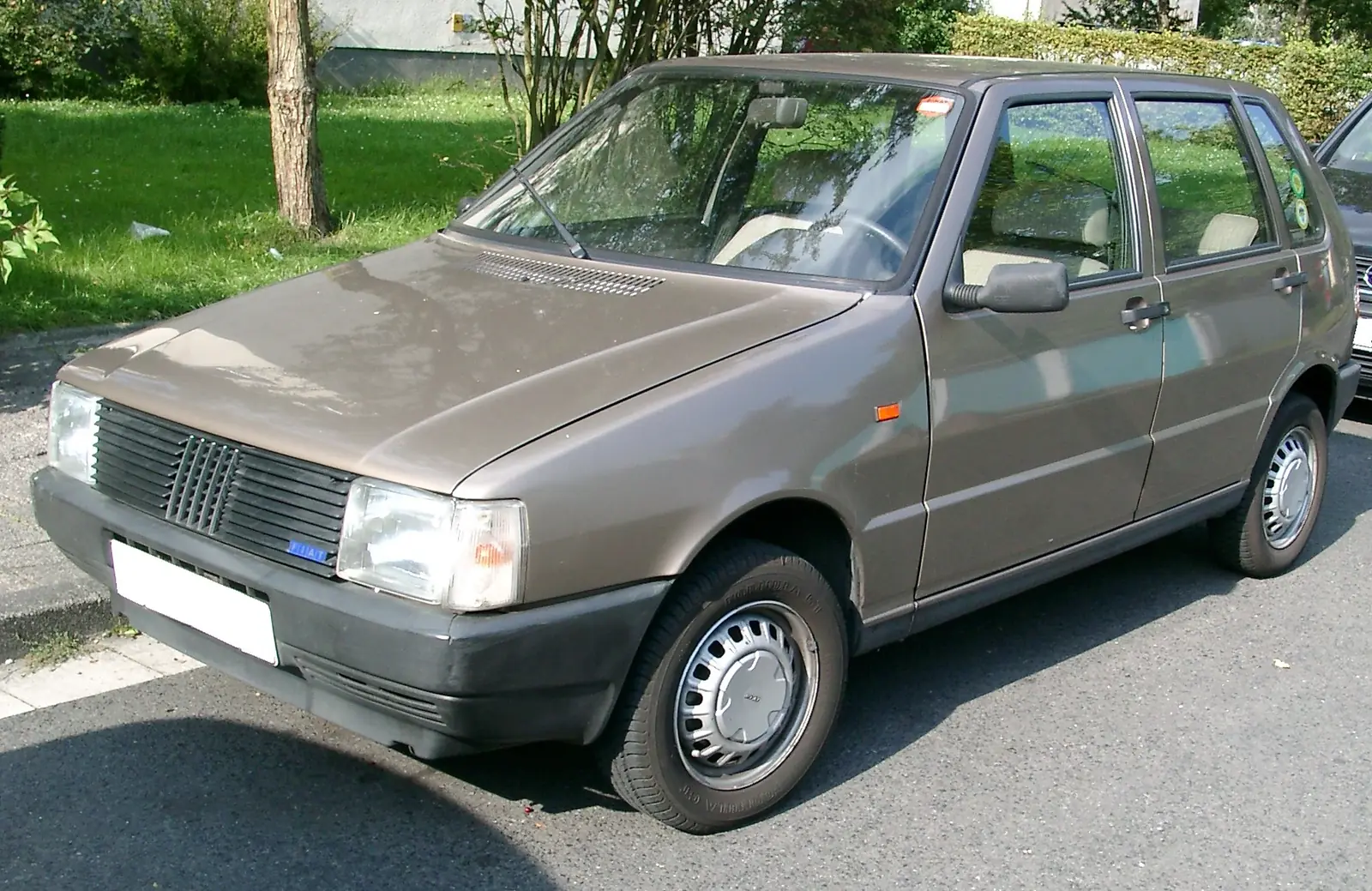
Launched in January 1983 to replace the Fiat 127, the Uno’s tall, square, Kamm-tailed body was built for interior space and aerodynamics rather than style, on Fiat’s new “Robogate” robotic assembly line.[1] It won European Car of the Year for 1984, narrowly ahead of the Peugeot 205, and by the time Italian production ended in 1995 Fiat’s own factories had built over six million. Assembly continued well beyond that in Poland (as the Innocenti Mille Clip, for the Italian market) and Yugoslavia, where Zastava fitted a locally-sourced 903 cc engine also used in the Yugo 45.
The three trims recorded here span the range from the entry 0.9 to the 1.3 Turbo i.e. hot hatch; the source’s own engine table lists ten petrol variants across the car’s run, most differing from each other only in state of tune of the same two or three basic blocks.