Skip to content
Markey
Theme: System (currently light)
The Audi emblem: four interlocking rings in a row

Generation

Audi TT (8N)

Audi TT (8N), 1998-2006

Produced
1998–2006
Code
8N
Designer
Freeman Thomas; Peter Schreyer
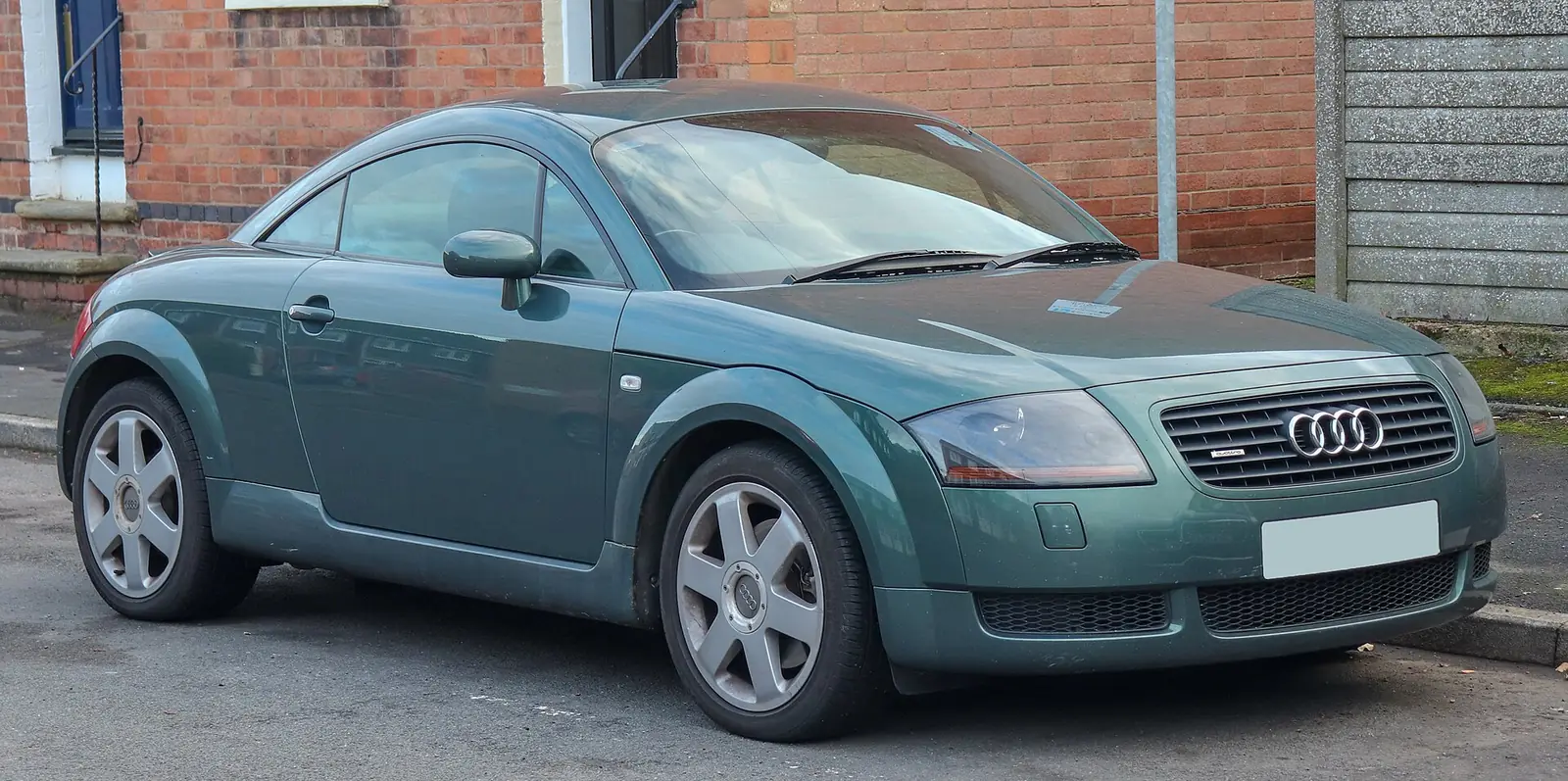
Metallic green first-generation Audi TT quattro coupé photographed from the front three-quarter angle

Image credit

File
File:2000 Audi TT Quattro 1.8 Front.jpg
Author (attribution required)
Vauxford
Test Drive this car

The original TT (Typ 8N) shared its A4 (PQ34) platform with the Volkswagen Golf Mk4 and the first-generation Audi A3, and its curved, minimal bodywork (inspired, Audi’s design team later said, by Bauhaus) was novel enough at launch to be blamed, rightly or not, for a series of high-speed accidents.[1] The fix was a rear spoiler, revised suspension and standard stability control, retrofitted across the range from 1999-2000.

Neither the generation infobox nor the detailed per-engine table in this article gives a kerb weight, an unusual gap for a Wikipedia car article this thorough. NHTSA’s Canadian Vehicle Specifications register fills it for the 1999 model year quattro coupé, and, notably, files the six-cylinder 3.2 VR6 under the very same 1,455 kg entry as the four-cylinder 1.8T, rather than a separate, heavier figure, which is recorded here rather than assumed to be wrong.

Overview

Manufacturer
Audi
Produced
1998–2006
Model code
8N
Designer
Freeman Thomas; Peter Schreyer
Segment
S-segment (Europe) / Sports car (US)
Positioning
Premium
Assembly
Győr, Hungary (engines and final assembly)

Dimensions

Length
4,041 mm

[1]

Width
1,764 mm

[1]

Height
1,346 mm

[1]

Wheelbase
2,422 mm

Front-wheel-drive car. Quattro models are 2,428 mm.

[1]

Kerb weight
1,455 kg

The article's own infobox leaves the weight field blank for this generation. NHTSA's Canadian Vehicle Specifications register fills the gap for the 1999 model year quattro coupé.

[2]

1.8 T quattro

Trim · 1998–2005 · AMU, APX, BAM, BEA

Power
165 kW

225 PS at 5,900 rpm, converted at 1 PS = 0.73549875 kW.

[1]

Torque
280 N⋅m

At 2,200-5,500 rpm.

[1]

Kerb weight
1,455 kg

[2]

0–100 km/h
Not yet available
Top speed
Not yet available
Fuel economy
Not yet available
CO₂
Not yet available
Drag coefficient
0.35

Stated once for the original TT shape, not broken out per engine.

[1]

Frontal area
Not yet available
Displacement
1,781 cc

[1]

Boot volume
Not yet available
Seats
4
Engine
inline-4, 20-valve, turbocharged · AMU, APX, BAM, BEA
Drivetrain
All-wheel drive

3.2 VR6 quattro

Trim · 2003–2006 · BHE

Power
184 kW

250 PS at 6,300 rpm, converted at 1 PS = 0.73549875 kW.

[1]

Torque
320 N⋅m

At 2,500-3,000 rpm.

[1]

Kerb weight
1,455 kg

The Canadian register lists the 3.2 quattro coupé under the same 1,455 kg entry as the 1.8T quattro coupé, rather than a separate heavier figure for the six-cylinder engine.

[2]

0–100 km/h
Not yet available
Top speed
Not yet available
Fuel economy
Not yet available
CO₂
Not yet available
Drag coefficient
Not yet available
Frontal area
Not yet available
Displacement
3,189 cc

[1]

Boot volume
Not yet available
Seats
4
Engine
VR6, 24-valve · BHE
Drivetrain
All-wheel drive

Sources & confidence

Every figure above carries a status. Nothing on this page is estimated without saying so, and nothing missing has been filled in with a guess.

Last verified
2026-09-08
Review status
Compiled from cited sources

Photography on this page is credited on each image. Tap theion a photograph for its author, licence and source.

References

Every sourced figure and every cited claim on this page, numbered. Wikipedia articles record the revision they were read at, because the article will have changed by the time you check it.

  1. [1]

    Audi TT. Wikipedia · revision 1373603591 · read 2026-09-08

    WikipediaCC BY-SA 4.0

  2. [2]

    NHTSA Canadian Vehicle Specifications — 1999-2001 Audi TT. NHTSA · read 2026-09-08

    DatasetPublic domain (US government work)Cited by the specifications