
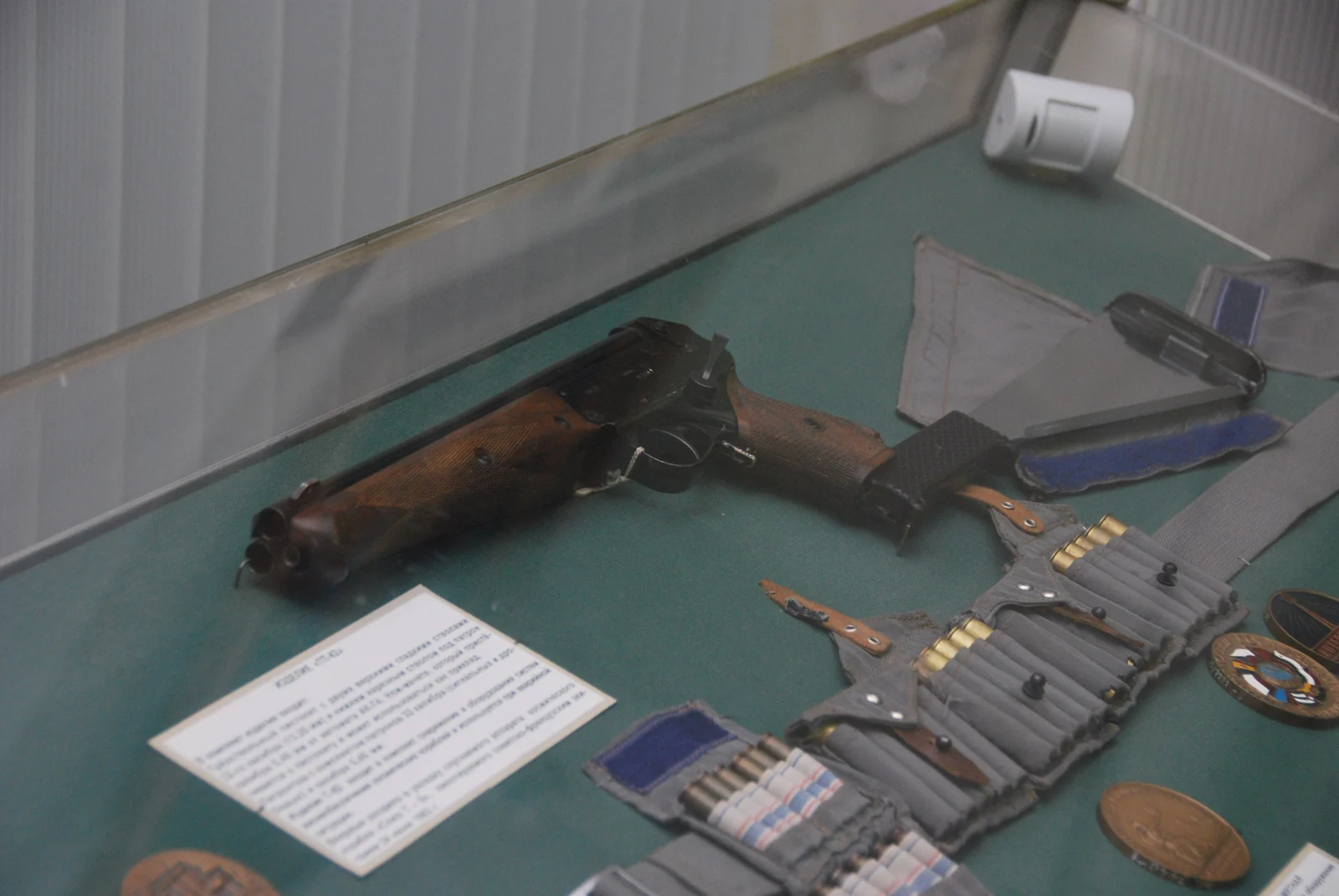
Image credit
- Title
- File:TP-82.jpg
- Author
- One half 3544
- Licence
- Public domain
- Source
- https://commons.wikimedia.org/wiki/File:TP-82.jpg

How Muzzle energy is calculated
E = ½ · m · v²
Inputs
- m3.43 g52.93 grverifiedsourceBallistics table of the cited article, which publishes bullet mass in grams.
- v880 m/s2,887 fpsverifiedMeasured with a 415 mm barrel, not this arm's 300 mm. Velocity outside the sourced range is not projected.
1 of 2 inputs link to their source.
How Muzzle velocity is calculated
nearest sourced barrel length, no extrapolation
Inputs
- v at 415 mm880 m/s2,887 fpsverifiedsourceBallistics table of the cited article.
Assumptions
- This figure belongs to a 415 mm barrel. It is shown because it is the closest measurement that exists, not because it applies here.
1 of 1 inputs link to their source.
How Loaded mass is calculated
m_loaded = m_empty + m_magazine + n · m_cartridge
Not calculated: m_magazine has no sourced figure yet. Nothing is substituted for a missing input.
Assumptions
- One magazine, filled to the stated capacity. Spare magazines, optics, slings and lights are the owner’s, not the arm’s.
No input on this calculation carries a clickable source yet.
How Free recoil is calculated
E_recoil = ½ · m_firearm · v_recoil²
Inputs
- m_firearm2.4 kg5.291 lbestimatedWikipedia's infobox figure, with the detachable machete buttstock attached, carries no inline citation of its own; matched exactly by the secondary reference site modernfirearms.net, which also states 1.6 kg with the buttstock removed.
- v_recoil1.258 m/s4.126 fpsestimated
Assumptions
- Propellant gas momentum is excluded: ARMAG does not record charge weights. This is therefore a lower bound on the real free recoil, consistent between entries but smaller than a figure that includes the gas term.
- Free recoil: the arm is unrestrained. Stock design, muzzle devices, stance and shooter mass are not modelled, because none of them is a property of the arm.
No input on this calculation carries a clickable source yet.
How Capacity is calculated
as published for the primary chambering
Inputs
- capacity1estimatedThe lower barrel is a single-shot break-open rifle chamber; no magazine is fitted.
No input on this calculation carries a clickable source yet.
Derived figures
Computed from the sourced values above. Open ƒ on any figure for the formula, its inputs, and the assumptions it makes.
How Momentum is calculated
p = m · v
Inputs
- m3.43 g52.93 grverifiedsourceBallistics table of the cited article, which publishes bullet mass in grams.
- v880 m/s2,887 fpsverifiedMeasured with a 415 mm barrel, not this arm's 300 mm. Velocity outside the sourced range is not projected.
1 of 2 inputs link to their source.
How Sectional density is calculated
SD = mass(gr) / (7000 · diameter(in)²)
Inputs
- mass3.43 g52.93 grverifiedsourceBallistics table of the cited article, which publishes bullet mass in grams.
- diameter5.6 mm0.2205 inverifiedsourceC.I.P. G1, maximum bullet diameter.
Assumptions
- Reported in the conventional lb/in² so it is directly comparable with published figures.
2 of 2 inputs link to their source.
How Power factor is calculated
PF = mass(gr) · velocity(fps) / 1000
Inputs
- mass3.43 g52.93 grverifiedsourceBallistics table of the cited article, which publishes bullet mass in grams.
- velocity880 m/s2,887 fpsverifiedMeasured with a 415 mm barrel, not this arm's 300 mm. Velocity outside the sourced range is not projected.
Assumptions
- A competition classification defined by the IPSC and USPSA rulebooks, stated in their units. It describes a scoring category, not an effect.
1 of 2 inputs link to their source.
How Magazine dump is calculated
t = (n − 1) / (rpm / 60)
Not calculated: rpm has no sourced figure yet. Nothing is substituted for a missing input.
Assumptions
- Cyclic rate held for the whole magazine, no stoppages, trigger held down. A theoretical figure for comparing mechanisms, not a measured one.
No input on this calculation carries a clickable source yet.
How Sight error at 1 mm is calculated
θ = atan(misalignment / sight radius)
Not calculated: sight radius has no sourced figure yet. Nothing is substituted for a missing input.
Assumptions
- Shows what a stated aiming error costs. The misalignment is the reader’s figure; the site does not claim how well anyone aims.
No input on this calculation carries a clickable source yet.
Specifications
Every row here is generated from the schema, so a figure recorded on this entry cannot be missing from the table, and the same rows, read the same way, are what the comparison shows.
Identity
- Type
- Shotgun
- Action
- Break action
- Fire modes
- Single shot
- Operating system
- not recorded
- Feed
- not recorded
- Roles
- Designed in
- Soviet Union
- Produced in
- Introduced
- 1986
- Production
- not recorded
Dimensions and mass
- Mass, empty
- 2.4 kg5.291 lbestimated
Wikipedia's infobox figure, with the detachable machete buttstock attached, carries no inline citation of its own; matched exactly by the secondary reference site modernfirearms.net, which also states 1.6 kg with the buttstock removed.
- Magazine, empty
- not recorded
- Length
- 670 mm26.38 inestimated
With the buttstock attached, per modernfirearms.net; the same source gives 360 mm with the buttstock removed. Wikipedia's own infobox states no length.
- Length, folded
- not recorded
- Width
- not recorded
- Height
- not recorded
- Barrel length
- 300 mm11.81 inestimated
Per modernfirearms.net, which does not distinguish the shotgun and rifle barrel lengths. Wikipedia's own infobox states no barrel length.
Sights and rifling
- Sight radius
- not recorded
- Sight height over bore
- not recorded
- Rifling twist
- not recorded
- Twist direction
- not recorded
- Grooves
- not recorded
- Sight graduation
- not recorded
Operation
- Cyclic rate
- not recorded
- Trigger pull
- not recorded
- Effective range
- not recorded
- Units produced
- not recorded
- Launch price
- not recorded
Chamberings
- 5.45×39mmprimary1 rounds
Scale
A to-scale outline against family siblings. The dimensions are sourced; the shape is a representative outline for the type, and says so.
- TP-82670 mm26.38 inheight not recorded
Representative outline: the dimensions are sourced, the shape is not. Overall length, and barrel length where recorded, are drawn from this entry's own figures; the profile is a generic one for the firearm type and says nothing about this arm's actual contours. TP-82 records no height, so its outline is drawn at the type's proportion. That height is part of the shape, not a measurement.
Detail
The TP-82 is a break-action combination gun the Soviet space programme carried aboard Soyuz missions from 1986 as a post-landing survival aid, built after cosmonaut Alexei Leonov argued that the 9×18mm Makarov pistol issued in earlier survival kits would do little against a brown bear or a wolf pack if a descent module came down off-course in the Siberian wilderness. Tula Arms Plant built it around three barrels stacked in a single break-open action: two smoothbore barrels over a single rifled barrel chambered for the 5.45×39mm round developed for the AK-74. A lever on the receiver’s left side opens the action for loading, and a small secondary grip beneath the trigger guard acts as a safety.
Its detachable buttstock is a flat steel machete with a sharpened edge, carried in a canvas sheath when not fitted to the gun, so the same object served as a tool, a signalling flare launcher and, loaded with the rifle barrel, a weapon capable of taking game or discouraging a predator at short range. NASA astronauts who later carried the weapon described it as accurate to roughly 20-30 metres. Ammunition for the design deteriorated over two decades of storage, and by 2006 a conventional semi-automatic pistol had replaced it in the Soyuz kit.
Wikipedia’s infobox gives the smoothbore barrels a chambering of 12.5×70mm, described as 40 gauge, while the secondary reference site modernfirearms.net calls the same barrels 32 gauge; neither figure carries a citation, and no dedicated free source describes this obsolete flare/shot round well enough to record it as a cartridge in its own right, so this entry models only the rifle barrel’s 5.45×39mm chambering and leaves the shotgun barrels undescribed in the structured data. Mass and dimensions likewise rest on Wikipedia’s uncited infobox figure and a matching modernfirearms.net figure rather than a primary manufacturer source, so all are recorded as estimated. This entry’s one photograph shows the pistol without its buttstock/machete attached; no photograph of the complete TP-82 with its stock fitted turned up on Wikimedia Commons, Smithsonian Open Access or DVIDS.
References
This entry's own bibliography. Every citation key on this page resolves into this list.
- TP-82 · Wikipedia · 1370042028 · read 2026-09-02 · CC BY-SA 4.0
- TP-82 space survival gun (USSR) · Modern Firearms · read 2026-09-02
Last verified 2026-09-02 · review status: agent-populated