
Stechkin automatic pistol
Автоматический пистолет Стечкина
Vyatskiye Polyany Machine-Building Plant1951–1958Early Cold War
Also known as APS, Stechkin, APB
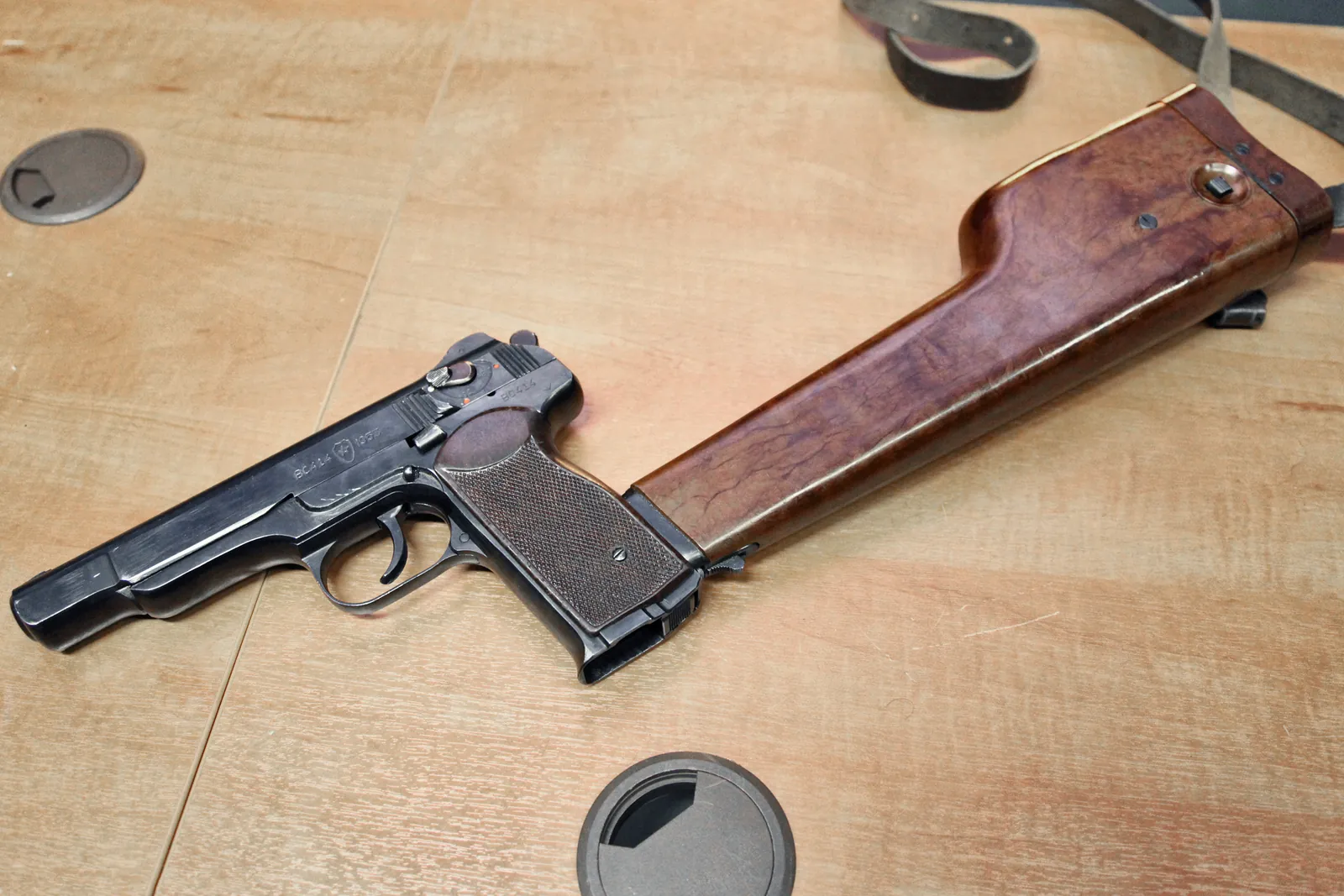
Image credit
- Title
- File:Stechkin APS.jpg
- Author
- Vitaly V. Kuzmin(attribution required)
- Licence
- CC BY-SA 4.0
- Source
- https://commons.wikimedia.org/wiki/File:Stechkin_APS.jpg

How Muzzle energy is calculated
E = ½ · m · v²
Inputs
- m6.156 g95.00 grverifiedsourcePublished as 95 gr; 1 gr = 0.06479891 g exactly.
- v319 m/s1,047 fpsverifiedMeasured with a 97 mm barrel, not this arm's 140 mm. Velocity outside the sourced range is not projected.
1 of 2 inputs link to their source.
How Muzzle velocity is calculated
nearest sourced barrel length, no extrapolation
Inputs
- v at 97 mm319 m/s1,047 fpsverifiedsourceBallistics table of the cited article.
Assumptions
- This figure belongs to a 97 mm barrel. It is shown because it is the closest measurement that exists, not because it applies here.
1 of 1 inputs link to their source.
How Loaded mass is calculated
m_loaded = m_empty + m_magazine + n · m_cartridge
Not calculated: m_magazine has no sourced figure yet. Nothing is substituted for a missing input.
Assumptions
- One magazine, filled to the stated capacity. Spare magazines, optics, slings and lights are the owner’s, not the arm’s.
2 of 4 inputs link to their source.
How Free recoil is calculated
E_recoil = ½ · m_firearm · v_recoil²
Inputs
- m_firearm1.22 kg2.690 lbverifiedsource1.22 kg. The article does not say whether the wooden holster-stock is included; the figure is roughly twice a Makarov pistol's.
- v_recoil1.610 m/s5.281 fpsestimated
Assumptions
- Propellant gas momentum is excluded: ARMAG does not record charge weights. This is therefore a lower bound on the real free recoil, consistent between entries but smaller than a figure that includes the gas term.
- Free recoil: the arm is unrestrained. Stock design, muzzle devices, stance and shooter mass are not modelled, because none of them is a property of the arm.
1 of 2 inputs link to their source.
How Capacity is calculated
as published for the primary chambering
Inputs
- capacity20verifiedsource20-round double-column steel box magazine with a two-position feed.
1 of 1 inputs link to their source.
Derived figures
Computed from the sourced values above. Open ƒ on any figure for the formula, its inputs, and the assumptions it makes.
How Momentum is calculated
p = m · v
Inputs
- m6.156 g95.00 grverifiedsourcePublished as 95 gr; 1 gr = 0.06479891 g exactly.
- v319 m/s1,047 fpsverifiedMeasured with a 97 mm barrel, not this arm's 140 mm. Velocity outside the sourced range is not projected.
1 of 2 inputs link to their source.
How Sectional density is calculated
SD = mass(gr) / (7000 · diameter(in)²)
Inputs
- mass6.156 g95.00 grverifiedsourcePublished as 95 gr; 1 gr = 0.06479891 g exactly.
- diameter9.27 mm0.3650 inverifiedsourceC.I.P. G1, maximum bullet diameter.
Assumptions
- Reported in the conventional lb/in² so it is directly comparable with published figures.
2 of 2 inputs link to their source.
How Power factor is calculated
PF = mass(gr) · velocity(fps) / 1000
Inputs
- mass6.156 g95.00 grverifiedsourcePublished as 95 gr; 1 gr = 0.06479891 g exactly.
- velocity319 m/s1,047 fpsverifiedMeasured with a 97 mm barrel, not this arm's 140 mm. Velocity outside the sourced range is not projected.
Assumptions
- A competition classification defined by the IPSC and USPSA rulebooks, stated in their units. It describes a scoring category, not an effect.
1 of 2 inputs link to their source.
How Magazine dump is calculated
t = (n − 1) / (rpm / 60)
Inputs
- n20verifiedsource20-round double-column steel box magazine with a two-position feed.
- rpm750 rpmverifiedsource750 rounds a minute, published as a single figure rather than a range. It is the rate the pistol's rate-reducer mechanism exists to produce.
Assumptions
- Cyclic rate held for the whole magazine, no stoppages, trigger held down. A theoretical figure for comparing mechanisms, not a measured one.
2 of 2 inputs link to their source.
How Sight error at 1 mm is calculated
θ = atan(misalignment / sight radius)
Not calculated: sight radius has no sourced figure yet. Nothing is substituted for a missing input.
Assumptions
- Shows what a stated aiming error costs. The misalignment is the reader’s figure; the site does not claim how well anyone aims.
No input on this calculation carries a clickable source yet.
Specifications
Every row here is generated from the schema, so a figure recorded on this entry cannot be missing from the table, and the same rows, read the same way, are what the comparison shows.
Identity
- Type
- Pistol
- Action
- Self-loading
- Fire modes
- Semi-automatic
- Fully automatic
- Operating system
- Blowback, simple
- Designed in
- Soviet Union
- Produced in
- Introduced
- 1951
- Production
- 1951–1958
Dimensions and mass
- Mass, empty
- 1.22 kg2.690 lbsource
1.22 kg. The article does not say whether the wooden holster-stock is included; the figure is roughly twice a Makarov pistol's.
- Magazine, empty
- not recorded
- Length
- 225 mm8.858 insource
Pistol alone, without the holster-stock attached.
- Length, folded
- not recorded
- Width
- not recorded
- Height
- not recorded
- Barrel length
- 140 mm5.512 insource
Sights and rifling
- Sight radius
- not recorded
- Sight height over bore
- not recorded
- Rifling twist
- not recorded
- Twist direction
- not recorded
- Grooves
- not recorded
- Sight graduation
- 200 m218.7 ydsource
The rear sight is a rotating drum with settings at 25, 50, 100 and 200 m.
Operation
- Cyclic rate
- 750 rpmsource
750 rounds a minute, published as a single figure rather than a range. It is the rate the pistol's rate-reducer mechanism exists to produce.
- Trigger pull
- not recorded
- Effective range
- 50 m54.68 ydsource
Effective range as published. The same source gives a maximum range of 200 m, which is also the furthest setting on the rear sight.
- Units produced
- not recorded
- Launch price
- not recorded
Chamberings
- 9×18mm Makarovprimary20 rounds
Scale
A to-scale outline against family siblings. The dimensions are sourced; the shape is a representative outline for the type, and says so.
- Stechkin automatic pistol225 mm8.858 inheight not recorded
Representative outline: the dimensions are sourced, the shape is not. Overall length, and barrel length where recorded, are drawn from this entry's own figures; the profile is a generic one for the firearm type and says nothing about this arm's actual contours. Stechkin automatic pistol records no height, so its outline is drawn at the type's proportion. That height is part of the shape, not a measurement.
Gallery
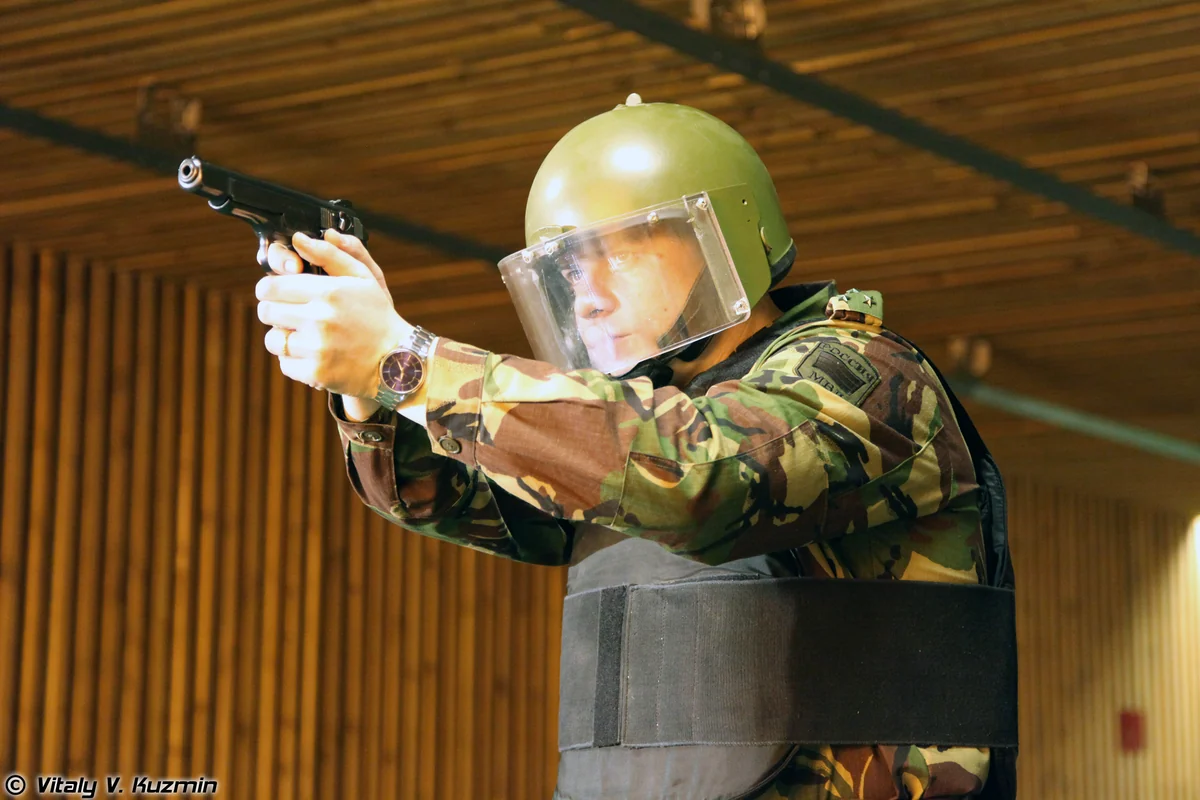
Image credit
- Title
- File:Fighter of Moscow special police unit (OMON) with APS.jpg
- Author
- Vitaly V. Kuzmin(attribution required)
- Licence
- CC BY-SA 4.0
- Source
- https://commons.wikimedia.org/wiki/File:Fighter_of_Moscow_special_police_unit_(OMON)_with_APS.jpg
_with_APS.jpg)
Detail
Igor Stechkin was a recent graduate of the Tula Mechanical Institute when he set out to build a pistol that could be fired in bursts and still hit something. The result went into Soviet service in 1951 as the APS, issued to vehicle crews, artillery crews, front-line officers and police, people who needed more than a Makarov and could not carry a rifle.
The engineering problem is that a blowback pistol in a service cartridge cycles far too fast to control on automatic, and the APS attacks it three separate ways. The slide runs a very long stroke, about three times the length of the cartridge, so there is time for it to slow before it strikes the frame. A rate-reducer lever adds resistance to the opening stroke. And an inertial plunger delays the hammer from falling after the slide has closed. Together they bring the cyclic rate down to about 750 rounds a minute, which for a 1.22 kg pistol in 9x18mm is slow enough to be usable. The selector on the slide is also the safety and the decocker: forward it locks the hammer, the slide and the free-floating firing pin; down it cuts out the auto-sear and the rate reducer for single shots; back is automatic.
Everything else is Makarov practice (heel magazine catch, slide-mounted lever, the same field-strip), scaled up around a 20-round magazine and a 140 mm barrel. The rear sight is a rotating drum reading 25, 50, 100 and 200 m, and the hollow wooden holster clips to the butt as a shoulder stock, which is what those graduations assume.
It was expensive and slow to machine, and in the field the complaints were about size, weight, the fragility of that stock and the ergonomics. Production ran only from 1951 to 1958, a suppressed APB followed in 1972-73, and the role went to short carbines like the AKS-74U. The pistol has nonetheless kept turning up in Russian police and special-forces hands ever since.
Gaps on this page: no free source publishes the APS’s width, height, sight radius, trigger pull or rifling twist, and no production total appears anywhere reachable. The 1.22 kg weight is given without saying whether it includes the magazine or the holster-stock, so it is recorded as published with that ambiguity noted rather than adjusted. The APB is listed as an alias rather than modelled as a variant, because no separate dimensions are published for it.
References
This entry's own bibliography. Every citation key on this page resolves into this list.
- Stechkin automatic pistol · Wikipedia · 1367714458 · read 2026-09-01 · CC BY-SA 4.0
Last verified 2026-09-01 · review status: agent-populated