
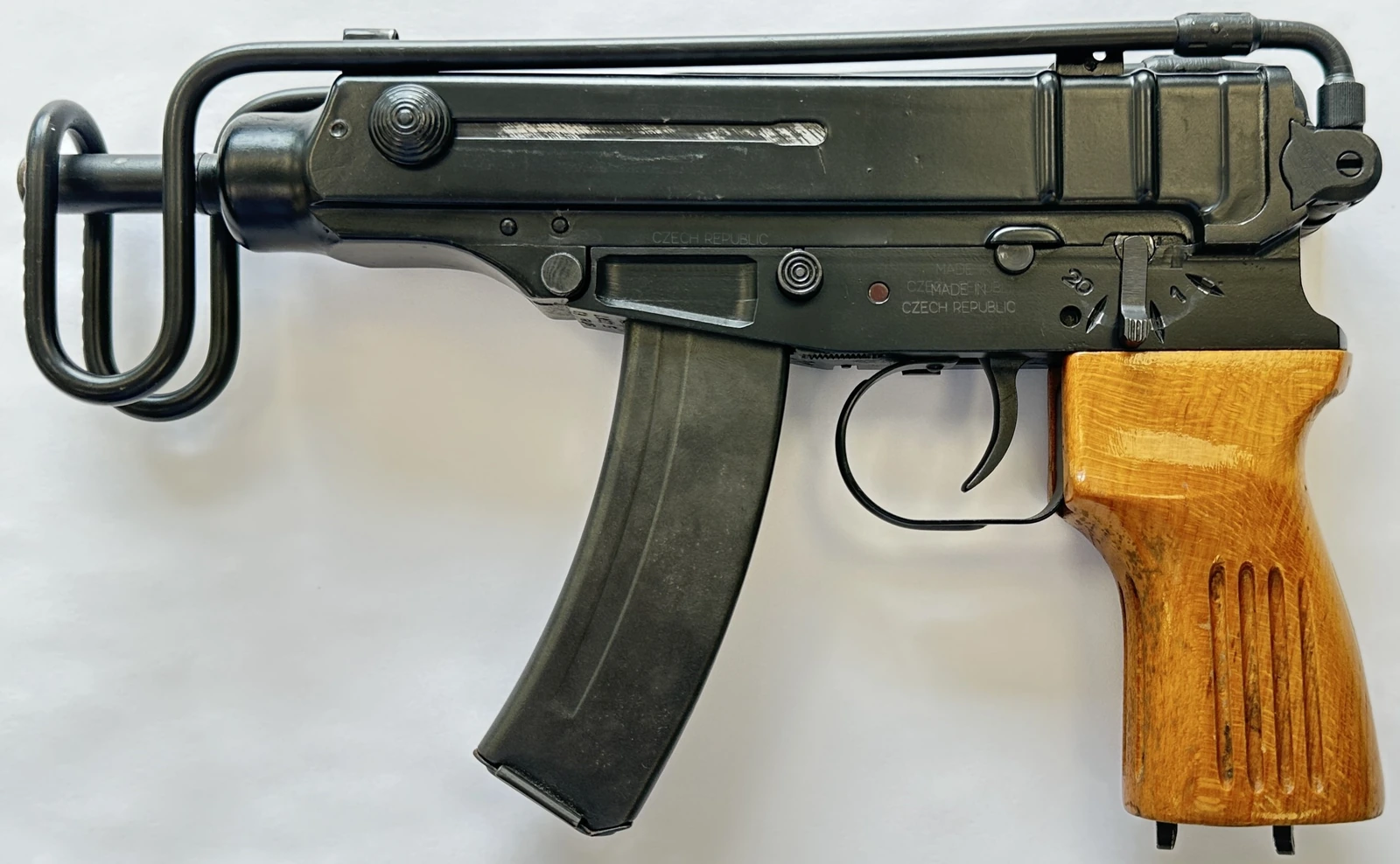
Image credit
- Title
- File:Sa vz. 61 Škorpion.jpg
- Author
- Land68
- Licence
- CC0, public domain dedication
- Source
- https://commons.wikimedia.org/wiki/File:Sa_vz._61_Škorpion.jpg

How Muzzle energy is calculated
E = ½ · m · v²
Inputs
- m4.6 g70.99 grverifiedsourcePublished as 71 grains.
- v274.3 m/s899.9 fpsverifiedMeasured with a 101.6 mm barrel, not this arm's 115 mm. Velocity outside the sourced range is not projected.
1 of 2 inputs link to their source.
How Muzzle velocity is calculated
nearest sourced barrel length, no extrapolation
Inputs
- v at 101.6 mm274.3 m/s899.9 fpsverifiedsourcePublished as 900 ft/s.
Assumptions
- This figure belongs to a 101.6 mm barrel. It is shown because it is the closest measurement that exists, not because it applies here.
1 of 1 inputs link to their source.
How Loaded mass is calculated
m_loaded = m_empty + m_magazine + n · m_cartridge
Not calculated: m_magazine has no sourced figure yet. Nothing is substituted for a missing input.
Assumptions
- One magazine, filled to the stated capacity. Spare magazines, optics, slings and lights are the owner’s, not the arm’s.
2 of 4 inputs link to their source.
How Free recoil is calculated
E_recoil = ½ · m_firearm · v_recoil²
Inputs
- m_firearm1.3 kg2.866 lbestimatedsourcefrom the infobox; no inline citation is given there.
- v_recoil0.9706 m/s3.184 fpsestimated
Assumptions
- Propellant gas momentum is excluded: ARMAG does not record charge weights. This is therefore a lower bound on the real free recoil, consistent between entries but smaller than a figure that includes the gas term.
- Free recoil: the arm is unrestrained. Stock design, muzzle devices, stance and shooter mass are not modelled, because none of them is a property of the arm.
1 of 2 inputs link to their source.
How Capacity is calculated
as published for the primary chambering
Inputs
- capacity10estimatedsourcepublished as a 10- or 20-round curved magazine, with an aftermarket 30-round straight magazine also produced, from the infobox, uncited there.
1 of 1 inputs link to their source.
Derived figures
Computed from the sourced values above. Open ƒ on any figure for the formula, its inputs, and the assumptions it makes.
How Momentum is calculated
p = m · v
Inputs
- m4.6 g70.99 grverifiedsourcePublished as 71 grains.
- v274.3 m/s899.9 fpsverifiedMeasured with a 101.6 mm barrel, not this arm's 115 mm. Velocity outside the sourced range is not projected.
1 of 2 inputs link to their source.
How Sectional density is calculated
SD = mass(gr) / (7000 · diameter(in)²)
Inputs
- mass4.6 g70.99 grverifiedsourcePublished as 71 grains.
- diameter7.85 mm0.3091 inverifiedsourceC.I.P. G1, maximum bullet diameter.
Assumptions
- Reported in the conventional lb/in² so it is directly comparable with published figures.
2 of 2 inputs link to their source.
How Power factor is calculated
PF = mass(gr) · velocity(fps) / 1000
Inputs
- mass4.6 g70.99 grverifiedsourcePublished as 71 grains.
- velocity274.3 m/s899.9 fpsverifiedMeasured with a 101.6 mm barrel, not this arm's 115 mm. Velocity outside the sourced range is not projected.
Assumptions
- A competition classification defined by the IPSC and USPSA rulebooks, stated in their units. It describes a scoring category, not an effect.
1 of 2 inputs link to their source.
How Magazine dump is calculated
t = (n − 1) / (rpm / 60)
Inputs
- n10estimatedsourcepublished as a 10- or 20-round curved magazine, with an aftermarket 30-round straight magazine also produced, from the infobox, uncited there.
- rpm850 rpmestimatedsourcefrom the infobox, uncited there.
Assumptions
- Cyclic rate held for the whole magazine, no stoppages, trigger held down. A theoretical figure for comparing mechanisms, not a measured one.
2 of 2 inputs link to their source.
How Sight error at 1 mm is calculated
θ = atan(misalignment / sight radius)
Inputs
- sight radius148 mm5.827 inestimatedsourcefrom the infobox, uncited there.
- misalignment1 mm0.03937 inverified
Assumptions
- Shows what a stated aiming error costs. The misalignment is the reader’s figure; the site does not claim how well anyone aims.
1 of 2 inputs link to their source.
Specifications
Every row here is generated from the schema, so a figure recorded on this entry cannot be missing from the table, and the same rows, read the same way, are what the comparison shows.
Identity
- Type
- Submachine gun
- Action
- Self-loading
- Fire modes
- Semi-automatic
- Fully automatic
- Operating system
- Blowback, simple
- Designed in
- Czechoslovakia
- Produced in
- Introduced
- 1961
- Production
- not recorded
Dimensions and mass
- Mass, empty
from the infobox; no inline citation is given there.
- Magazine, empty
- not recorded
- Length
stock extended, from the infobox, uncited there.
- Length, folded
stock folded, from the infobox, uncited there.
- Width
- not recorded
- Height
- not recorded
- Barrel length
from the infobox, uncited there.
Sights and rifling
- Sight radius
from the infobox, uncited there.
- Sight height over bore
- not recorded
- Rifling twist
- not recorded
- Twist direction
- not recorded
- Grooves
- not recorded
- Sight graduation
- not recorded
Operation
- Cyclic rate
from the infobox, uncited there.
- Trigger pull
- not recorded
- Effective range
- not recorded
- Units produced
- not recorded
- Launch price
- not recorded
Scale
A to-scale outline against family siblings. The dimensions are sourced; the shape is a representative outline for the type, and says so.
- Škorpion vz. 61517 mm20.35 inheight not recorded
Representative outline: the dimensions are sourced, the shape is not. Overall length, and barrel length where recorded, are drawn from this entry's own figures; the profile is a generic one for the firearm type and says nothing about this arm's actual contours. Škorpion vz. 61 records no height, so its outline is drawn at the type's proportion. That height is part of the shape, not a measurement.
Detail
Miroslav Rybář designed the vz. 61 for personnel Czechoslovakia judged did not need a full-length rifle or submachine gun but wanted more than a pistol: lower-ranking staff, vehicle and armoured-vehicle crews, and special forces working in plain clothes. Its small size follows directly from that role rather than from any attempt to match a standard submachine gun’s power; it chambers .32 ACP, the Czechoslovak security forces’ standard sidearm cartridge, a round mild enough in recoil that the design needs no more than a simple unlocked blowback action to handle it safely.
That same mildness created a different problem: a gun this light, cycling an unlocked blowback bolt, would ordinarily fire at a rate too fast to control in short bursts. The Škorpion’s answer sits inside its grip, a rate-reducing mechanism rather than anything in the barrel or bolt. Each time the bolt travels rearward it catches a spring-loaded hook that drives a plunger down through a free-moving weight in the grip; the weight’s own inertia leaves it behind for a moment, and that lag holds the bolt back briefly before it can return, dropping the cyclic rate from what would otherwise be close to 1,000 rounds per minute down to a more manageable rate.
Production ran in two separate periods (an original Czechoslovak run from 1961 to 1979, and a revival at Česká zbrojovka Uherský Brod from 2009), and the design was also built under licence by Yugoslavia’s Zastava Arms. It has turned up in conflicts far removed from its original vehicle-crew role, favoured for its concealability by irregular and paramilitary users from the 1970s onward.
Every figure in this entry traces to the Wikipedia infobox without an inline citation and is recorded as
estimated. No twist rate is published.
References
This entry's own bibliography. Every citation key on this page resolves into this list.
- Škorpion · Wikipedia · 1368441162 · read 2026-09-09 · CC BY-SA 4.0
Last verified 2026-09-09 · review status: agent-populated