
Mosin–Nagant
Винтовка Мосина
Tula Arms Plant1891–1973Smokeless revolution
Also known as Three-line rifle, M91/30
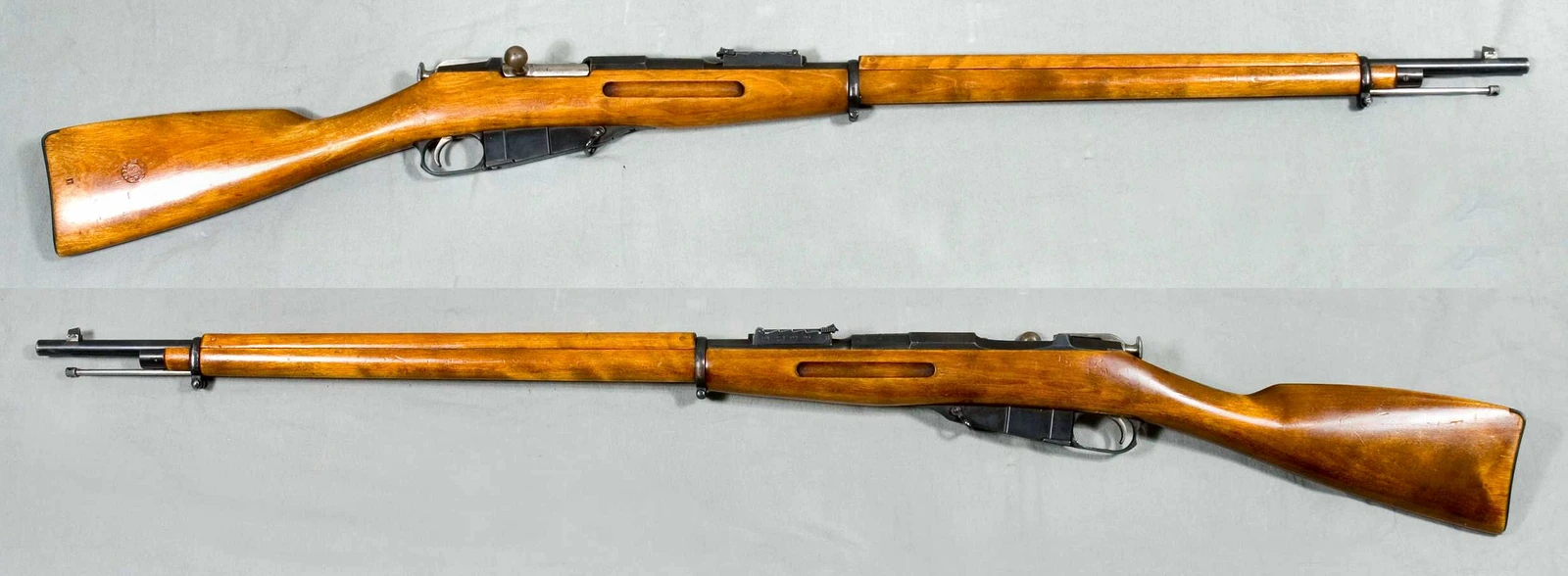
Image credit
- Title
- File:Mosin-Nagant M1891 - Ryssland - AM.032971.jpg
- Author
- Armémuseum (The Swedish Army Museum)
- Licence
- Public domain
- Source
- https://commons.wikimedia.org/wiki/File:Mosin-Nagant_M1891_-_Ryssland_-_AM.032971.jpg

How Muzzle energy is calculated
E = ½ · m · v²
Inputs
- m9.7 g149.7 grverifiedsourceBallistics table of the cited article.
- v865 m/s2,838 fpsverified
1 of 2 inputs link to their source.
How Muzzle velocity is calculated
measured at this barrel length
Inputs
- v865 m/s2,838 fpsverifiedsourceBallistics table of the cited article.
1 of 1 inputs link to their source.
How Loaded mass is calculated
m_loaded = m_empty + m_magazine + n · m_cartridge
Not calculated: m_magazine has no sourced figure yet. Nothing is substituted for a missing input.
Assumptions
- One magazine, filled to the stated capacity. Spare magazines, optics, slings and lights are the owner’s, not the arm’s.
2 of 4 inputs link to their source.
How Free recoil is calculated
E_recoil = ½ · m_firearm · v_recoil²
Inputs
- m_firearm4 kg8.818 lbverifiedsourceM91/30. The M38 carbine is published at 3.4 kg and the M44 at 4.1 kg.
- v_recoil2.098 m/s6.882 fpsestimated
Assumptions
- Propellant gas momentum is excluded: ARMAG does not record charge weights. This is therefore a lower bound on the real free recoil, consistent between entries but smaller than a figure that includes the gas term.
- Free recoil: the arm is unrestrained. Stock design, muzzle devices, stance and shooter mass are not modelled, because none of them is a property of the arm.
1 of 2 inputs link to their source.
How Capacity is calculated
as published for the primary chambering
Inputs
- capacity5verifiedsourceIntegral box magazine, loaded from stripper clips.
1 of 1 inputs link to their source.
Derived figures
Computed from the sourced values above. Open ƒ on any figure for the formula, its inputs, and the assumptions it makes.
How Momentum is calculated
p = m · v
Inputs
- m9.7 g149.7 grverifiedsourceBallistics table of the cited article.
- v865 m/s2,838 fpsverified
1 of 2 inputs link to their source.
How Sectional density is calculated
SD = mass(gr) / (7000 · diameter(in)²)
Inputs
- mass9.7 g149.7 grverifiedsourceBallistics table of the cited article.
- diameter7.92 mm0.3118 inverifiedsourceCartridge maximum, dimension G1.
Assumptions
- Reported in the conventional lb/in² so it is directly comparable with published figures.
2 of 2 inputs link to their source.
How Power factor is calculated
PF = mass(gr) · velocity(fps) / 1000
Inputs
- mass9.7 g149.7 grverifiedsourceBallistics table of the cited article.
- velocity865 m/s2,838 fpsverified
Assumptions
- A competition classification defined by the IPSC and USPSA rulebooks, stated in their units. It describes a scoring category, not an effect.
1 of 2 inputs link to their source.
How Magazine dump is calculated
t = (n − 1) / (rpm / 60)
Not calculated: rpm has no sourced figure yet. Nothing is substituted for a missing input.
Assumptions
- Cyclic rate held for the whole magazine, no stoppages, trigger held down. A theoretical figure for comparing mechanisms, not a measured one.
1 of 2 inputs link to their source.
How Sight error at 1 mm is calculated
θ = atan(misalignment / sight radius)
Not calculated: sight radius has no sourced figure yet. Nothing is substituted for a missing input.
Assumptions
- Shows what a stated aiming error costs. The misalignment is the reader’s figure; the site does not claim how well anyone aims.
No input on this calculation carries a clickable source yet.
Specifications
Every row here is generated from the schema, so a figure recorded on this entry cannot be missing from the table, and the same rows, read the same way, are what the comparison shows.
Identity
- Type
- Rifle
- Action
- Bolt action
- Fire modes
- Single shot
- Operating system
- Manually operated
- Designed in
- Russian Empire
- Introduced
- 1891
- Production
- 1891–1973
Dimensions and mass
- Mass, empty
- 4 kg8.818 lbsource
M91/30. The M38 carbine is published at 3.4 kg and the M44 at 4.1 kg.
- Magazine, empty
- not recorded
- Length
- 1,232 mm48.50 insource
M91/30; the carbines are 1,013 mm.
- Length, folded
- not recorded
- Width
- not recorded
- Height
- not recorded
- Barrel length
- 730 mm28.74 insource
M91/30; the carbines are 514 mm.
Sights and rifling
- Sight radius
- not recorded
- Sight height over bore
- not recorded
- Rifling twist
- not recorded
- Twist direction
- not recorded
- Grooves
- not recorded
- Sight graduation
- 2,000 m2,187 ydsource
Rear ladder graduated to 2,000 m on the M91/30; the M38 and M44 stop at 1,000 m.
Operation
- Cyclic rate
- not recorded
- Trigger pull
- not recorded
- Effective range
- not recorded
- Units produced
- 37,000,000source
The cited article gives "c. 37,000,000" for Russian and Soviet production.
- Launch price
- not recorded
Chamberings
- 7.62x54mmRprimary5 rounds
Scale
A to-scale outline against family siblings. The dimensions are sourced; the shape is a representative outline for the type, and says so.
- Mosin–Nagant1,232 mm48.50 inheight not recorded
Representative outline: the dimensions are sourced, the shape is not. Overall length, and barrel length where recorded, are drawn from this entry's own figures; the profile is a generic one for the firearm type and says nothing about this arm's actual contours. Mosin–Nagant records no height, so its outline is drawn at the type's proportion. That height is part of the shape, not a measurement.
Detail
A committee rifle in the most literal sense: Sergei Mosin’s action and Leon Nagant’s magazine and feed interrupter, combined by a Russian commission in 1891 after neither design won outright. The interrupter is the part worth knowing about. A rimmed cartridge stacked in a box magazine will jam if the rim of the round below sits ahead of the one above, and Nagant’s device holds the second round back until the first has been stripped away. This is a mechanical answer to a problem the 7.62×54mmR case creates and still has not stopped creating.
Everything else about the rifle is built to be made in enormous numbers by factories with poor tooling and unskilled workers. The bolt has few parts and comes apart without tools; the tolerances are generous; the receiver is a heavy forging that will survive being made badly.
It was still in front-line Soviet service in 1945, more than fifty years after adoption, and its sniper variant with a side-mounted scope is where its reputation now mostly lives.
Its five velocity figures in the cited article are given per variant with the word “approx.” attached to each, so none is recorded here; the cartridge page carries sourced velocity instead.
References
This entry's own bibliography. Every citation key on this page resolves into this list.
- Mosin–Nagant · Wikipedia · 1371939456 · read 2026-08-31 · CC BY-SA 4.0
Last verified 2026-08-31 · review status: agent-populated