
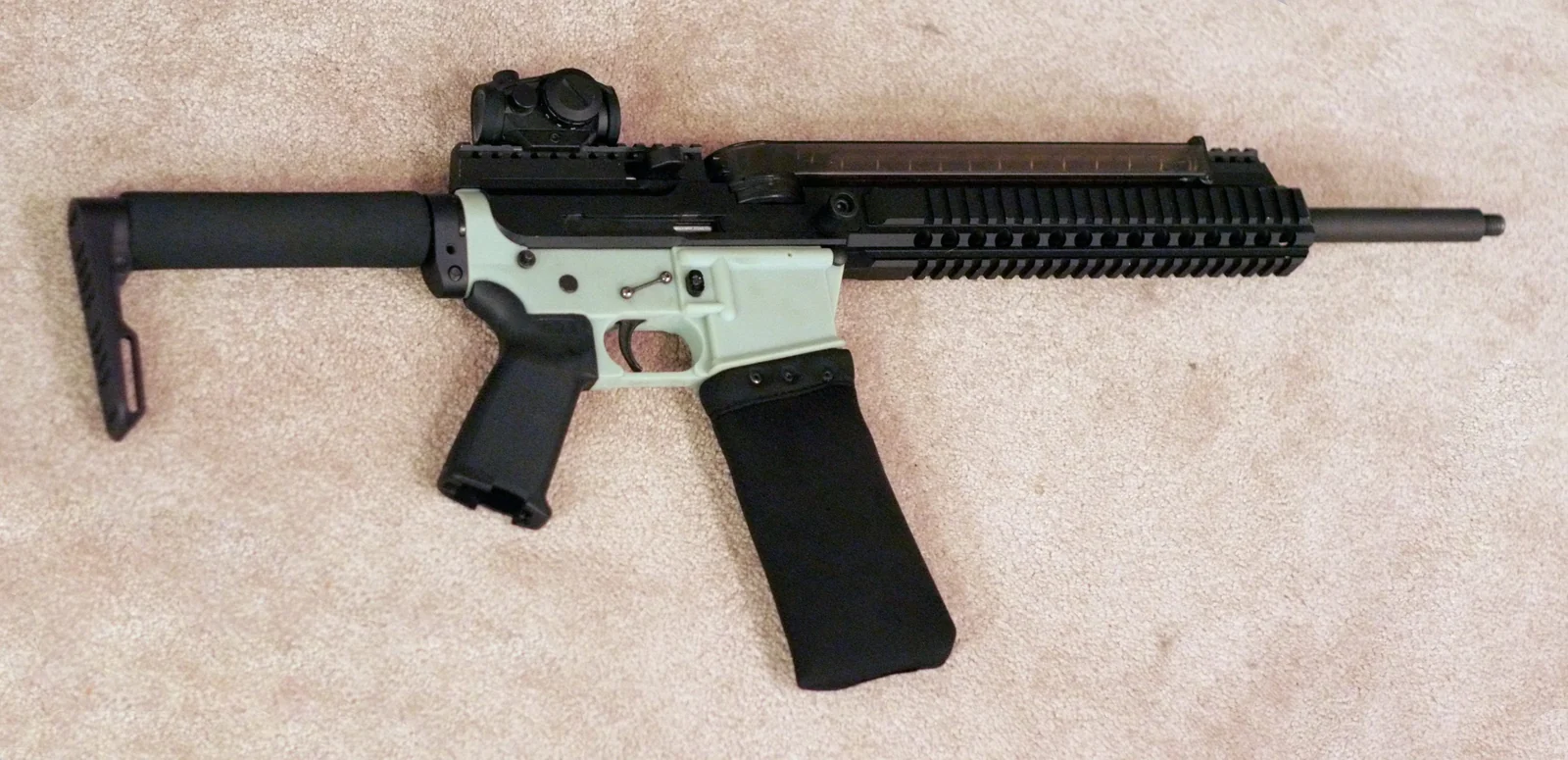
Image credit
- Title
- File:DD AR 57 3.JPG
- Author
- Kamenev
- Licence
- Public domain
- Source
- https://commons.wikimedia.org/wiki/File:DD_AR_57_3.JPG

How Muzzle energy is calculated
E = ½ · m · v²
Not calculated: v has no sourced figure yet. Nothing is substituted for a missing input.
1 of 2 inputs link to their source.
How Muzzle velocity is calculated
no sourced velocity for this load
Not calculated: muzzle velocity has no sourced figure yet. Nothing is substituted for a missing input.
No input on this calculation carries a clickable source yet.
How Loaded mass is calculated
m_loaded = m_empty + m_magazine + n · m_cartridge
Not calculated: m_magazine has no sourced figure yet. Nothing is substituted for a missing input.
Assumptions
- One magazine, filled to the stated capacity. Spare magazines, optics, slings and lights are the owner’s, not the arm’s.
No input on this calculation carries a clickable source yet.
How Free recoil is calculated
E_recoil = ½ · m_firearm · v_recoil²
Not calculated: v_recoil has no sourced figure yet. Nothing is substituted for a missing input.
Assumptions
- Propellant gas momentum is excluded: ARMAG does not record charge weights. This is therefore a lower bound on the real free recoil, consistent between entries but smaller than a figure that includes the gas term.
- Free recoil: the arm is unrestrained. Stock design, muzzle devices, stance and shooter mass are not modelled, because none of them is a property of the arm.
No input on this calculation carries a clickable source yet.
How Capacity is calculated
as published for the primary chambering
Inputs
- capacity50estimatedFeeds from FN P90 magazines; Wikipedia's cited AR57 LLC image gallery page states the rifle is supplied with two 50-round P90 magazines. 10-, 30- and 40-round P90 magazines also fit.
No input on this calculation carries a clickable source yet.
Derived figures
Computed from the sourced values above. Open ƒ on any figure for the formula, its inputs, and the assumptions it makes.
How Momentum is calculated
p = m · v
Not calculated: v has no sourced figure yet. Nothing is substituted for a missing input.
1 of 2 inputs link to their source.
How Sectional density is calculated
SD = mass(gr) / (7000 · diameter(in)²)
Inputs
- mass2.009 g31.00 grverifiedsourcePublished as 31 gr; 1 gr = 0.06479891 g exactly.
- diameter5.7 mm0.2244 inverifiedsourceC.I.P. G1, maximum bullet diameter.
Assumptions
- Reported in the conventional lb/in² so it is directly comparable with published figures.
2 of 2 inputs link to their source.
How Power factor is calculated
PF = mass(gr) · velocity(fps) / 1000
Not calculated: velocity has no sourced figure yet. Nothing is substituted for a missing input.
Assumptions
- A competition classification defined by the IPSC and USPSA rulebooks, stated in their units. It describes a scoring category, not an effect.
1 of 2 inputs link to their source.
How Magazine dump is calculated
t = (n − 1) / (rpm / 60)
Not calculated: rpm has no sourced figure yet. Nothing is substituted for a missing input.
Assumptions
- Cyclic rate held for the whole magazine, no stoppages, trigger held down. A theoretical figure for comparing mechanisms, not a measured one.
No input on this calculation carries a clickable source yet.
How Sight error at 1 mm is calculated
θ = atan(misalignment / sight radius)
Not calculated: sight radius has no sourced figure yet. Nothing is substituted for a missing input.
Assumptions
- Shows what a stated aiming error costs. The misalignment is the reader’s figure; the site does not claim how well anyone aims.
No input on this calculation carries a clickable source yet.
Specifications
Every row here is generated from the schema, so a figure recorded on this entry cannot be missing from the table, and the same rows, read the same way, are what the comparison shows.
Identity
- Type
- Carbine
- Action
- Self-loading
- Fire modes
- Semi-automatic
- Operating system
- Blowback, simple
- Roles
- Designed in
- United States
- Produced in
- Introduced
- 2008
- Production
- not recorded
Dimensions and mass
- Mass, empty
- 3.379 kg7.449 lbestimated
Wikipedia cites AR57 LLC's own product page for the AR-57 PDW carbine (7.45 lb), but that page is only reachable through a 2010 archived snapshot whose catalogue is JavaScript-driven and does not render the figure in static HTML, so it is recorded as estimated rather than independently confirmed.
- Magazine, empty
- not recorded
- Length
- 762 mm30.00 inestimated
Wikipedia cites AR57 LLC's own product page for the AR-57 PDW carbine (30 in); see the note on massEmpty for why this is recorded as estimated rather than verified.
- Length, folded
- not recorded
- Width
- not recorded
- Height
- not recorded
- Barrel length
- 406.4 mm16.00 inestimated
Wikipedia cites AR57 LLC's own product page for the AR-57 PDW carbine (16 in); see the note on massEmpty for why this is recorded as estimated rather than verified.
Sights and rifling
- Sight radius
- not recorded
- Sight height over bore
- not recorded
- Rifling twist
- not recorded
- Twist direction
- not recorded
- Grooves
- not recorded
- Sight graduation
- not recorded
Operation
- Cyclic rate
- not recorded
- Trigger pull
- not recorded
- Effective range
- not recorded
- Units produced
- not recorded
- Launch price
- not recorded
Chamberings
- FN 5.7×28mmprimary50 rounds
Scale
A to-scale outline against family siblings. The dimensions are sourced; the shape is a representative outline for the type, and says so.
- AR-57762 mm30.00 inheight not recorded
Representative outline: the dimensions are sourced, the shape is not. Overall length, and barrel length where recorded, are drawn from this entry's own figures; the profile is a generic one for the firearm type and says nothing about this arm's actual contours. AR-57 records no height, so its outline is drawn at the type's proportion. That height is part of the shape, not a measurement.
Lineage
This design
- Derived from AR-15 platform
Detail
The AR-57 turns an AR-15 lower receiver into a 5.7×28mm carbine by replacing the upper with a monolithic unit that feeds from an FN P90 magazine mounted flat above the barrel, ejecting spent cases down through the magazine well rather than to the side. It was designed by the small US shop Rhineland Arms and is sold today by AR57 LLC, either as a complete rifle or as a drop-in upper for an existing AR-15/M16 lower, keeping the AR platform’s trigger group and controls while changing everything forward of the receiver. Because ejection runs down the magazine well, an unmodified STANAG magazine can double as a brass catcher when the feed lips, spring and follower are removed.
Where a standard AR-15 upper cycles by tapping propellant gas back into the receiver, the AR-57 cycles by straight blowback, a simpler system suited to the lower pressures of the 5.7×28mm cartridge. It ships as a semi-automatic civilian carbine; a suppressed, fully automatic prototype was shown publicly in 2008 as a proposed personal defence weapon, but the arm sold to civilians has always been semi-automatic only. It uses the same 10-, 30-, 40- and 50-round P90 magazines as FN’s own weapon, giving it a substantially higher standard capacity than most AR-15 pattern rifles.
Every dimension in this entry is drawn from Wikipedia’s citation to AR57 LLC’s own product page for the “AR-57 PDW” carbine. That page survives only as a 2010 archived snapshot of a JavaScript-driven catalogue that does not render its product figures in static HTML, so mass, length and barrel length are recorded as estimated rather than independently confirmed, and no cyclic rate, muzzle velocity or sight radius is published anywhere free. This entry’s one photograph shows a Rhineland-style upper being test-fitted to a third-party lower receiver rather than a production AR57 LLC rifle; no other freely licensed photograph turned up on Wikimedia Commons, Smithsonian Open Access or DVIDS.
References
This entry's own bibliography. Every citation key on this page resolves into this list.
- AR-57 · Wikipedia · 1353993664 · read 2026-09-02 · CC BY-SA 4.0
Last verified 2026-09-02 · review status: agent-populated