
6mm Remington
Introduced 1955Fred Huntington and Mike WalkerSAAMI standard
Also known as .244 Remington: the same cartridge under different names, all of which find this page.
Dimensions and pressure
Generated from the schema, like every specification table on this site, so a figure recorded on this entry cannot be missing from the table.
Identity
- Designed by
- Fred Huntington and Mike Walker
- Introduced
- 1955
- Production
- not recorded
- Standards body
- SAAMI
- Case type
- Rimless
- Case shape
- Bottleneck
Dimensions
- Bullet diameter
- 6.19 mm0.2437 inestimated
From the Wikipedia infobox, uncited there (.2435 in).
- Bore diameter
- not recorded
- Case length
- 56.72 mm2.233 inestimated
From the Wikipedia infobox, uncited there (2.233 in).
- Overall length
- 71.76 mm2.825 inestimated
From the Wikipedia infobox, uncited there (2.825 in).
- Rim diameter
- 12.01 mm0.4728 inestimated
From the Wikipedia infobox, uncited there (.473 in).
- Neck diameter
- 7.01 mm0.2760 inestimated
From the Wikipedia infobox, uncited there (.276 in).
- Base diameter
- 11.96 mm0.4709 inestimated
From the Wikipedia infobox, uncited there (.471 in).
Pressure
- Maximum pressure
- 448.2 MPa65,006 psiestimated
From the Wikipedia infobox, uncited there (65,000 psi, SAAMI method).
- Pressure standard
- SAAMI
SAAMI and C.I.P. measure pressure differently and their figures are not interchangeable, which is why the body is always named beside the figure.
Loads
Velocity is recorded per barrel length as published. A gun page interpolates between these points and never projects beyond them.
55 gr BT
- Bullet mass
- 3.564 g55.00 grestimated
55 gr as published by Accurate Powder's reloading-data sheet for the 6mm Remington, converted to grams. A handloading bullet weight, not a factory-ammunition figure; no velocity is recorded from this source.
- Cartridge mass
- not recorded
- Bullet type
- BT
- G1 BC
- not recorded
- G7 BC
- not recorded
65 gr VMax
- Bullet mass
- 4.212 g65.00 grestimated
65 gr as published by Accurate Powder's reloading-data sheet for the 6mm Remington, converted to grams. A handloading bullet weight, not a factory-ammunition figure; no velocity is recorded from this source.
- Cartridge mass
- not recorded
- Bullet type
- VMax
- G1 BC
- not recorded
- G7 BC
- not recorded
80 gr SP
- Bullet mass
- 5.184 g80.00 grestimated
80 gr as published by Accurate Powder's reloading-data sheet for the 6mm Remington, converted to grams. A handloading bullet weight, not a factory-ammunition figure; no velocity is recorded from this source.
- Cartridge mass
- not recorded
- Bullet type
- SP
- G1 BC
- not recorded
- G7 BC
- not recorded
95 gr BT
- Bullet mass
- 6.156 g95.00 grestimated
95 gr as published by Accurate Powder's reloading-data sheet for the 6mm Remington, converted to grams. A handloading bullet weight, not a factory-ammunition figure; no velocity is recorded from this source.
- Cartridge mass
- not recorded
- Bullet type
- BT
- G1 BC
- not recorded
- G7 BC
- not recorded
105 gr RNSP
- Bullet mass
- 6.804 g105.0 grestimated
105 gr as published by Accurate Powder's reloading-data sheet for the 6mm Remington, converted to grams. A handloading bullet weight, not a factory-ammunition figure; no velocity is recorded from this source.
- Cartridge mass
- not recorded
- Bullet type
- RNSP
- G1 BC
- not recorded
- G7 BC
- not recorded
Chambered in
Computed from every entry that lists this cartridge. Nothing here is hand-maintained.
No entry on the site is chambered in it yet.
Gallery
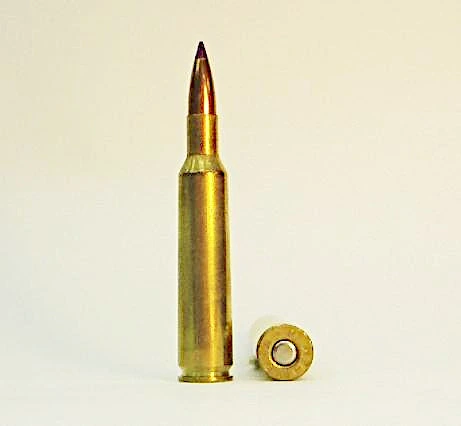
Image credit
- Title
- File:6mm Remington.JPG
- Author
- Ryan D. Larson
- Licence
- Public domain
- Source
- https://commons.wikimedia.org/wiki/File:6mm_Remington.JPG

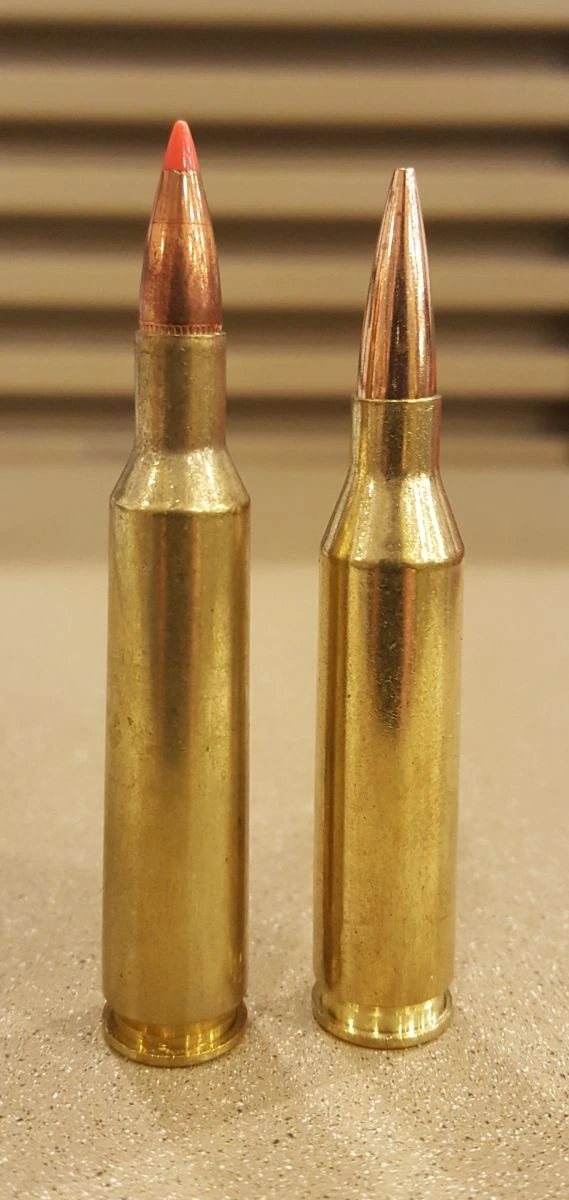
Image credit
- Title
- File:6mm + 243.jpg
- Author
- Hellbus(attribution required)
- Licence
- CC BY-SA 4.0
- Source
- https://commons.wikimedia.org/wiki/File:6mm_+_243.jpg

Detail
The 6mm Remington began life in 1955 as the .244 Remington, a rimless bottleneck round Fred Huntington and Mike Walker built by necking the .257 Roberts case (itself a necked-down 7×57mm Mauser) down to take a .24 calibre bullet. Remington chambered its Model 722 for the round with a 1-in-12-inch twist chosen to suit a 90-grain soft-point big-game bullet without over-spinning lighter varmint loads, a dual-purpose brief aimed at the same niche as the .243 Winchester, introduced the same year.
The two cartridges started from the same idea and diverged in reception rather than case design. Winchester’s .243 offered a faster 1-in-10-inch twist that could stabilise heavier 100-grain bullets and sold better from the outset; Remington’s original slow twist gave the .244 a real edge with light, high-velocity varmint bullets but limited how heavy a bullet it could shoot accurately, and it further struggled in the marketplace on a widespread but disputed belief that it was a light varmint round rather than a deer cartridge in its own right. Remington renamed it the 6mm Remington in 1963 and rechambered later rifles with a faster twist to stabilise the same heavier bullets its rival handled from the start, but it has never matched the .243 Winchester’s commercial popularity, remaining instead a round favoured by handloaders and custom rifle builders for the small ballistic edge it retains at long range.
No free dimensional standard for the 6mm Remington was found (it does not appear in the C.I.P. publication despite being a SAAMI-standardised American round), so every dimension on this page is recorded as estimated from Wikipedia’s uncited infobox rather than verified against a primary source. The only bullet-mass and load data found came from a handloading reference (Accurate Powder), whose velocity figures reflect a specific propellant charge rather than a fact about the cartridge itself and are not recorded here; no factory-ammunition source with a stated test-barrel velocity was found either, so this entry carries bullet masses without velocities and no muzzle energy.
References
- 6mm Remington · 1320524962 · read 2026-09-24
- 6mm Remington reloading data · read 2026-09-24
Last verified 2026-09-24 · review status: agent-populated